
For years, waste management in India sat far away from core business decisions. Once a product left the factory or warehouse, most companies believed their responsibility ended. Municipal systems, scrap dealers, or informal recyclers handled the rest — often without visibility or accountability.
That comfort zone no longer exists. Today, regulators expect businesses to answer a much tougher question: What happens to your product after the customer is done using it?
Extended Producer Responsibility, or EPR, is the reason this question has moved from environmental discussions into compliance meetings, audits, and boardrooms.
EPR is not just changing waste management in India. It is changing how businesses plan, operate, and assess long-term risk.
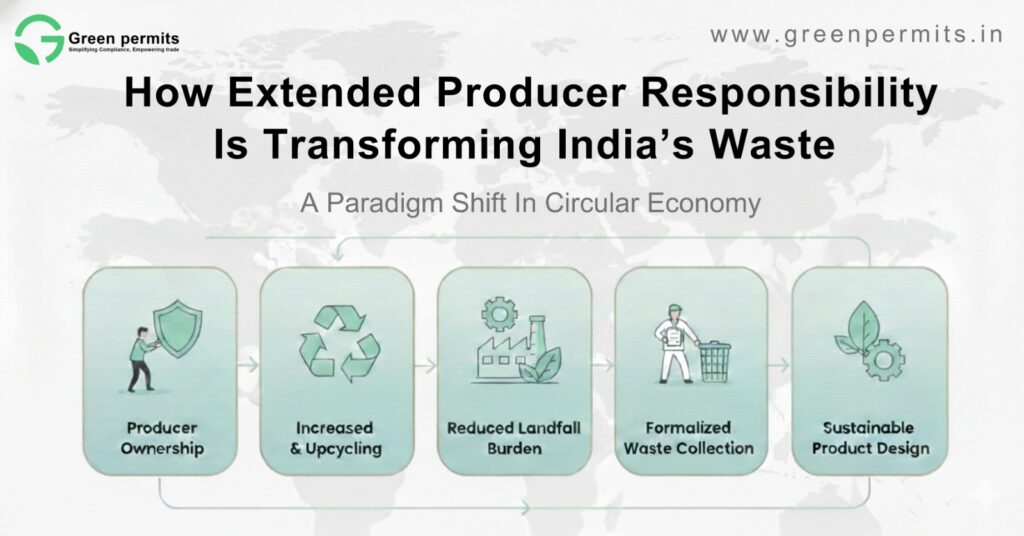
Extended Producer Responsibility is a regulatory framework that makes producers legally responsible for managing the waste generated from their products once they reach the end of their useful life. In the Indian context, this responsibility applies to manufacturers, importers, and brand owners across multiple sectors.
Unlike earlier environmental rules that focused on manufacturing permissions, EPR follows the product beyond sale. Businesses are required to ensure that waste is collected, recycled, refurbished, or scrapped through authorized channels and that this activity is recorded digitally.
For companies, EPR introduces a shift from passive compliance to active lifecycle management. It requires data, planning, partnerships with recyclers, and continuous reporting rather than one-time approvals.
India’s waste challenge is not just about volume; it is about control and traceability. For decades, recycling relied heavily on informal systems that worked economically but lacked environmental safeguards and documentation.
The EPR model was introduced to address this gap by clearly defining who is responsible for waste and how that responsibility is fulfilled. By assigning accountability to producers, regulators created a system where waste management becomes measurable, auditable, and enforceable.
At a national level, EPR also supports India’s broader goals around resource efficiency, reduced landfill dependency, and circular economy development. At a business level, it ensures that environmental responsibility is embedded into commercial activity rather than treated as an external cost.How EPR Is Reshaping India’s Waste Management Ecosystem
Earlier waste systems focused on disposal after collection. EPR forces a different mindset by connecting product design, material choice, sales volume, and end-of-life outcomes.
Businesses now need to understand how much waste their products generate, what materials can be recovered, and how recycling targets are calculated. This has pushed many companies to rethink packaging, sourcing, and even product durability.
Lifecycle thinking is no longer optional. It is built into compliance.
One of the most visible impacts of EPR is the rapid formalization of India’s recycling ecosystem. Recyclers, refurbishers, and vehicle scrapping facilities must now register, declare capacity, follow environmental standards, and operate under regulatory oversight.
This shift has reduced dependence on informal processing and increased confidence in environmental outcomes. For businesses, it also means that compliance depends on working with authorized partners who can generate valid EPR certificates.
The result is a structured ecosystem where recycling is no longer invisible but documented and regulated.
EPR introduced centralized online portals that track every stage of compliance — from producer registration to recycling output. Obligations, certificates, returns, and declarations now sit on digital dashboards accessible to regulators.
This has transformed enforcement. Non-compliance is no longer discovered years later through inspections. It is visible in real time when obligations are not declared, certificates are missing, or returns are delayed.
For businesses, this transparency reduces ambiguity but increases the importance of accuracy and timeliness.
Extended Producer Responsibility in India now covers multiple waste streams, including plastic, electronic waste, batteries, tyres, and end-of-life vehicles. Each category has its own rules, targets, and reporting requirements, but the underlying compliance structure remains consistent.
What this means for businesses is simple: if your product introduces regulated material into the Indian market, you carry an ongoing compliance obligation. Ignoring this because “it does not apply to our core operations” is one of the most common and costly mistakes companies make.
Under EPR, compliance does not end with registration. Producers must declare annual obligations, track recycling performance, purchase certificates, and file periodic returns.
This has turned EPR into a recurring operational function similar to taxation or statutory reporting. Companies that treat it as a one-time task often face last-minute issues, missed deadlines, and regulatory action.
Many businesses initially see EPR as an unpredictable cost. In reality, companies that plan early are able to budget obligations more accurately and avoid sudden penalties.
Over time, structured EPR planning leads to better cost control, fewer disruptions, and smoother audits. Late compliance, on the other hand, almost always costs more.
EPR has moved sustainability from marketing language to measurable action. Claims around recycling and responsible waste management must now be supported by certificates and portal records.
This has made EPR an important component of ESG reporting, investor disclosures, and corporate governance frameworks.
Consider two companies operating in the same sector. One delays EPR registration, assuming enforcement will remain flexible. When reporting requirements tighten, their portal access is restricted, compliance costs increase, and operations are disrupted.
The other registers early, aligns with authorized recyclers, and plans obligations annually. For them, EPR becomes a routine compliance process rather than a crisis.
The difference is not regulation. It is preparedness.
Businesses that underestimate EPR often face financial penalties, suspension of registrations, inability to trade certificates, and operational uncertainty. More importantly, non-compliance can affect market reputation and future regulatory approvals.
EPR has effectively become a business continuity issue. Treating it lightly is no longer an option.
By linking production with recycling outcomes, EPR encourages reuse, material recovery, and reduced reliance on virgin resources. It supports investment in recycling infrastructure and creates economic value from waste.
For India, this strengthens environmental resilience. For businesses, it aligns regulatory compliance with long-term sustainability goals.
Extended Producer Responsibility is not a temporary regulatory phase. It is a structural shift in how India manages waste and how businesses are expected to operate responsibly.
Companies that approach EPR early gain clarity, stability, and control. Those that delay face uncertainty, penalties, and operational stress.
The difference lies in structured compliance and informed guidance.
📞 +91 78350 06182
📧 wecare@greenpermits.in
Book a Consultation with Green Permits