
A few weeks ago, I was sitting with a mid-sized electronics distributor in Jaipur.
He looked at the piles of old systems in his warehouse and said:
“Every month we add more scrap. I know e-waste is a growing business, but I don’t know where to start. Is Rajasthan even the right place for a recycling plant?”
This is exactly where many business owners are today.
They understand the opportunity, but the pathway feels confusing—licenses, rules, EPR, permissions, machinery, land, and costs.
This guide is written to simplify the journey for you.
By the end, you’ll know exactly what it takes to set up an e-waste recycling plant in Rajasthan—step-by-step, without guesswork.
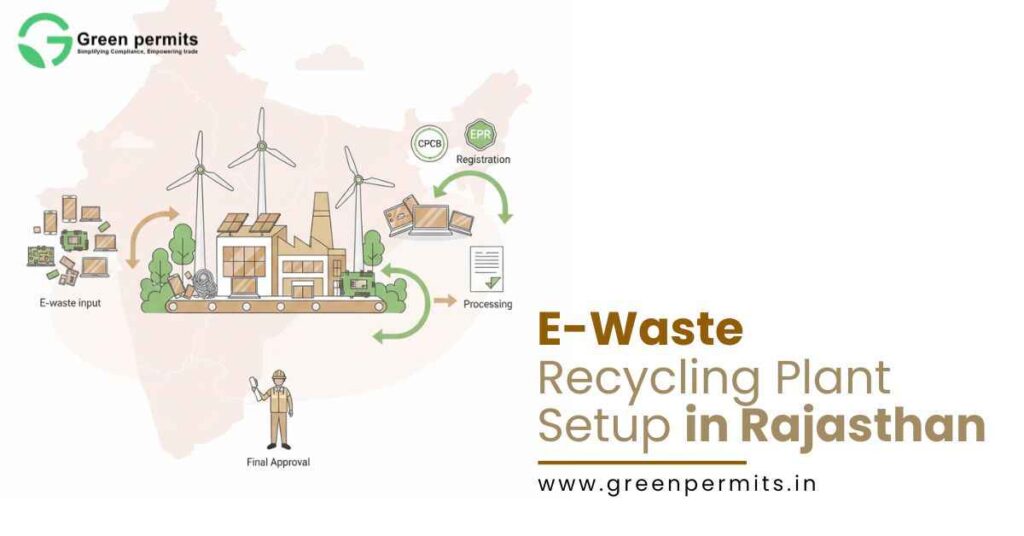
Rajasthan is no longer just a mining and manufacturing state.
Industries relocating from NCR, expanding IT and electronics parks, government digitalization, solar adoption, and EV components manufacturing have made the state a steady generator of e-waste.
Here are a few reasons why recycling here is gaining momentum:
All of this makes Rajasthan a strong location for both dismantling and full-fledged metal recovery units.
Choosing the right location is where most of your business success begins.
Perfect for medium to large recycling units.
Strong supply from NCR, better road connectivity, and established industrial infrastructure make sourcing scrap and dispatching processed material considerably easier.
Known for its Japanese and Korean industries, this region is ideal for high-quality, compliance-focused operations.
Industrial parks here have stable power, good layout planning, and reliable logistics.
Suitable for dismantling units, refurbishing, and smaller recycling lines.
Corporate waste, IT companies, retail chains, and large service centres supply huge quantities of used electronics.
Emerging area for scrap aggregation and dismantling.
A strong informal sector base makes raw material sourcing easier, provided compliance processes are followed wisely.
A recycling plant succeeds only when raw material supply is stable. Rajasthan offers a balanced mix.
Large volumes of PCB-rich material from automobile, electronic manufacturing, assembly lines, and warehouses.
Computers, servers, printers, telecom equipment—usually in bulk and with higher life value.
Collected from service centres, small retailers, aggregators, and local distributors.
Let’s break down the compliance process into plain language.
Register your entity (Udyam/MSME) and acquire industrial land—RIICO plots are preferred because zoning and clearances are smoother.
Issued by the State Pollution Control Board before you install machinery.
It validates your process, plant layout, and pollution control plan.
Once CTE is approved, you can install the dismantling and recycling equipment.
Required before the facility starts running.
The Pollution Control Board checks if your unit matches the approved design and safety guidelines.
This allows you to handle, process, collect, store, and dispose of e-waste legally.
Recyclers must be registered on the national EPR portal to issue recycling credits to producers.
Without it, you cannot legally trade EPR certificates.
Since components like PCBs and CRTs fall under hazardous waste categories, this license is essential.
A realistic cost estimate helps prevent overspending and confusion.
| Component | 1 TPD | 3 TPD | 5 TPD |
|---|---|---|---|
| Land & Civil Work | ₹25–40 lakh | ₹45–70 lakh | ₹70–1.2 crore |
| Machinery (Dismantling + Shredding) | ₹35–60 lakh | ₹75–1.2 crore | ₹1.3–1.8 crore |
| Metal Recovery/Refining Unit | ₹40–60 lakh | ₹80 lakh | ₹1.2 crore |
| Pollution Control System | ₹8–15 lakh | ₹15–25 lakh | ₹25–40 lakh |
| Licensing & Compliance | ₹5–8 lakh | ₹7–10 lakh | ₹10–12 lakh |
| Working Capital | ₹10–15 lakh | ₹20–35 lakh | ₹30–40 lakh |
What this means for you:
Costs reduce as scale increases because machinery, labour, and compliance become more efficient at higher capacities.
| Material | Typical Recovery | Price Range | Revenue Value |
|---|---|---|---|
| Copper | 10–15% | ₹650–780/kg | High |
| Aluminium | 3–5% | ₹180–220/kg | Medium |
| Precious Metals | 0.05–0.15% | Very high | Very High |
| Plastics | 20–25% | ₹25–40/kg | Medium |
| Iron/Steel | 25–30% | ₹35–45/kg | Medium |
Takeaway:
PCB-rich waste gives the highest return. Consumer waste depends more on volume than value.
Rajasthan supports recycling units through:
RIICO provides planned industrial zones suitable for recycling and waste management units.
Today, e-waste recyclers do more than just retrieve metals.
Producers buy certificates to fulfil their regulatory targets.
This has become a strong revenue line for recyclers.
Recovered metals like copper, aluminium, and soldering alloys feed into EV manufacturing, electrical components, and metal smelting industries.
Government departments and PSUs frequently auction electronics.
A compliant recycler stands a stronger chance of winning such contracts.
Understanding the rules upfront helps you avoid expensive mistakes.
A real scenario:
One Jaipur-based unit faced a three-month delay because their storage area did not match the layout submitted during authorization, causing financial losses and operational setbacks.
Here is a clear sequence most successful plants follow:
Evaluate raw material availability, location, and economic viability.
Includes process flow, machinery, safety plan, revenue model, and compliance roadmap.
Submit layout, process details, pollution control plan, and land documents.
Install dismantling lines, shredders, segregation systems, and safety equipment.
Inspection teams check alignment with approved designs.
Enables you to generate and sell EPR credits.
Safety and skill development for technicians are essential.
Quarterly and annual reporting maintain your compliance status.
Rajasthan has become a strong player in India’s e-waste recycling landscape.
With increasing electronics consumption, industrial growth, and government awareness, the demand for compliant recycling is only going to rise.
Setting up a plant can feel overwhelming, but when the process is broken into clear steps and supported with the right documentation, it becomes a structured and profitable business.
If you’re planning to set up your own e-waste recycling plant, expert guidance can save months of time, prevent mistakes, and ensure smooth approvals.
Phone: +91 78350 06182
Email: wecare@greenpermits.in