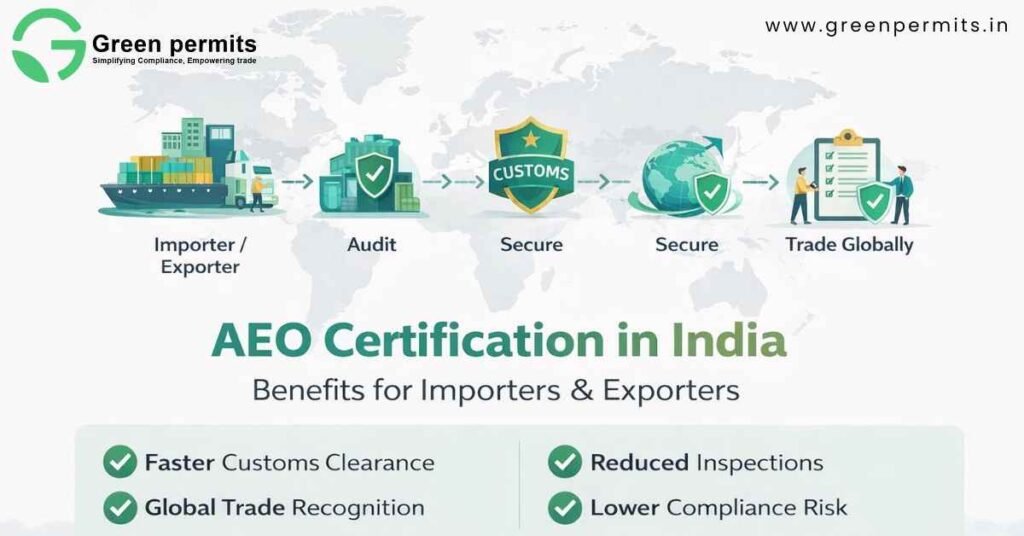
AEO Certification in India: Benefits for Importers & Exporters
In 2025–2026, Customs Risk is No Longer The Same
In FY 2024–25, importers operating without AEO status reported average container dwell times between 72 to 120 hours at major ports. Export consignments were increasingly flagged under the Risk Management System (RMS), especially for high-value sectors such as electronics, automotive components, chemicals, and machinery.
On the other hand, businesses holding AEO Certification in India reported:
Clearance within 24–48 hours
Up to 80–90% reduction in physical examination
Lower demurrage exposure
Reduced documentation queries
With trade volumes increasing and customs automation tightening, AEO Certification in India has become a structured compliance strategy rather than a facilitation add-on.
Legal Framework Governing AEO Certification in India
AEO Certification in India is governed under:
Customs Act, 1962
Section 146 (Customs compliance framework)
Section 28 (Demand and recovery of duties)
Section 117 (General penalty provision)
CBIC Circular No. 33/2016-Customs dated 22 July 2016
Subsequent amendments and procedural updates
Alignment with WCO SAFE Framework of Standards
The programme is administered by the Central Board of Indirect Taxes and Customs (CBIC).
There is no statutory government fee for applying under the AEO programme.
From a regulatory perspective, AEO is not mandatory. However, in practice, RMS profiling increasingly favors AEO-certified entities, especially those categorized as AEO-T2 and AEO-T3.
Categories of AEO Certification in India
The AEO framework is structured into multiple tiers based on compliance maturity and security standards.
Category
Applicable To
Validity
Verification Level
Compliance Depth
AEO-T1
Importers / Exporters
3 Years
Document review
Moderate
AEO-T2
Importers / Exporters
3 Years
On-site audit
High
AEO-T3
Highly compliant operators
5 Years
Extensive audit
Very High
AEO-LO
Logistics Operators
3 Years
Audit
Moderate
AEO-LP
Custodians / Terminal Operators
3 Years
Audit
High
Practical Difference Between Tiers
AEO-T1: Based largely on self-certification and document validation.
AEO-T2: Includes on-site physical verification of warehouse, IT systems, internal control procedures.
AEO-T3: Reserved for entities with exceptional compliance history and strong internal audit mechanisms.
Entities moving from T1 to T2 often report an additional 15–25% reduction in customs intervention frequency.
Eligibility Criteria for AEO Certification in India
To qualify, an applicant must demonstrate operational, financial, and compliance stability.
Minimum requirements include:
Operational history of 3 Financial Years
No serious customs offense in the last 3 years
Digital record retention for minimum 5 years
Positive net worth and financial solvency
Valid IEC and GST registration
Proper internal control systems
No major pending Show Cause Notices involving fraud or suppression
For MSMEs:
Simplified documentation under AEO-T1
Faster processing window (approx. 30 working days)
Relaxed turnover expectations
The average approval rate for properly documented applications exceeds 85%, while incomplete applications often face delays of 30–60 additional days.
Regulatory Overview and Compliance Exposure
Regulation
Core Obligation
Timeline
Exposure if Ignored
Customs Act, 1962
Correct duty declaration
Per shipment
Demand under Sec 28
CBIC AEO Circular
Security & compliance controls
During approval & post-approval
Suspension
ICEGATE RMS
Risk profiling
Real-time
Increased examination
FEMA 1999
Export proceeds realization
9 months (standard RBI norm)
Banking restrictions
What This Means for Businesses
Non-AEO importers face up to 2–3 times higher probability of physical examination.
Delayed clearance can increase logistics cost by ₹40,000 to ₹3,00,000 per container, depending on cargo type.
RMS profiling considers past compliance behavior heavily.
Step-by-Step Process for AEO Certification in India
Obtaining AEO status is procedural but manageable with structured documentation.
Stage 1: Portal Registration
Registration through ICEGATE
Submission of IEC, PAN, GST details
Immediate system acknowledgment
Stage 2: Application Submission
Documents typically required:
3 years audited financial statements
Internal control manual
Security procedures for premises
IT system access control protocols
List of key suppliers and logistics partners
Timeframe: Within 7 days of initial registration
Stage 3: Preliminary Scrutiny
Conducted by AEO Programme Manager
Evaluation of compliance history
Timeline: 30 working days
If deficiencies are found, applicant is given 7–15 working days to respond.
Stage 4: On-Site Verification (T2/T3)
Verification includes:
Warehouse access control
CCTV coverage
Cargo handling process
Employee background verification
IT data security protocols
Audit duration: 1–3 days Approval timeline: 90–120 days overall
Measurable Benefits of AEO Certification in India
Reduction in Physical Examination
70–90% reduction for T2/T3
Priority examination if selected
Lower document query rate
Faster Clearance
Average clearance time reduced from 72 hours to 24–48 hours
Lower container detention charges
Faster export documentation approval
Financial Efficiency
Reduced bank guarantee requirements
Lower warehousing charges
Estimated annual savings for mid-size exporter: ₹50 lakh to ₹1.5 crore
Global Trade Facilitation
India has Mutual Recognition Arrangements with:
USA
South Korea
UAE
Japan
This enables smoother customs processing overseas.
Business Credibility
Recognized as “Trusted Trader”
Preferred by multinational buyers
Improves ESG and compliance perception
Ongoing Compliance Obligations After Approval
AEO certification is not a one-time clearance.
Post-approval responsibilities include:
Informing customs within 30 days of structural changes
Maintaining annual internal compliance reviews
Avoiding duty misclassification
Ensuring supply chain security remains intact
Cooperating with periodic reassessment
Failure to maintain standards may result in:
Suspension within 7–15 days
Revocation after review
Higher RMS risk categorization
Compliance Risks and Penalty Exposure
If serious non-compliance occurs:
Demand proceedings under Section 28
Penalty under Section 117
Confiscation under Section 111
Increased inspection frequency
Loss of AEO privileges
Export delays and reputational damage
In regulated sectors (electronics, automotive, chemicals), customs scrutiny may combine with other regulatory reviews, increasing exposure.
Real Business Example
A Gujarat-based engineering exporter with annual turnover of ₹300 crore obtained AEO-T2 in FY 2024–25.
Outcomes within 12 months:
RMS intervention reduced by approximately 80%
Clearance time reduced from 96 hours to 28 hours
Annual demurrage savings: ₹1.2 crore
Improved buyer confidence in EU markets
Return on compliance investment achieved in less than 6 months.
Cost Structure and Investment
Government fee: Nil
Professional advisory cost:
MSME: ₹2–4 lakh
Mid-size enterprise: ₹5–8 lakh
Large enterprise: ₹8–12 lakh
Indirect investments:
CCTV installation
ERP documentation improvement
Security access control systems
Total compliance strengthening cost typically ranges between ₹5 lakh to ₹25 lakh, depending on scale.
Who Should Prioritize AEO Certification in India
AEO Certification in India is especially recommended for:
Exporters above ₹10 crore annual turnover
Import-intensive sectors
Automotive and engineering manufacturers
Multi-port operators
Companies targeting global supply chain contracts
Entities operating across more than 3 ports benefit significantly from RMS facilitation.
Conclusion
In 2026, AEO Certification in India is not just a customs benefit — it is a structured compliance advantage.
Without AEO:
Clearance delays of 72–120 hours
Higher demurrage exposure
Increased RMS intervention
With AEO:
Faster release within 24–48 hours
Lower logistics cost
Stronger trade credibility
Reduced regulatory friction
For serious importers and exporters, early compliance reduces operational risk and improves long-term cost efficiency.