
In FY 2025–26, many Indian importers discovered that compliance gaps under DGFT are identified not at the time of licence approval, but during export obligation review or customs reconciliation. A missed IEC update before 30 June can block shipments. An incorrectly calculated EPCG obligation can result in duty recovery running into crores.
Understanding DGFT Licence Types in India is no longer optional for manufacturers, MSMEs, exporters, and foreign brands entering India. It is a structured compliance responsibility backed by statutory penalties under the Foreign Trade (Development & Regulation) Act, 1992.
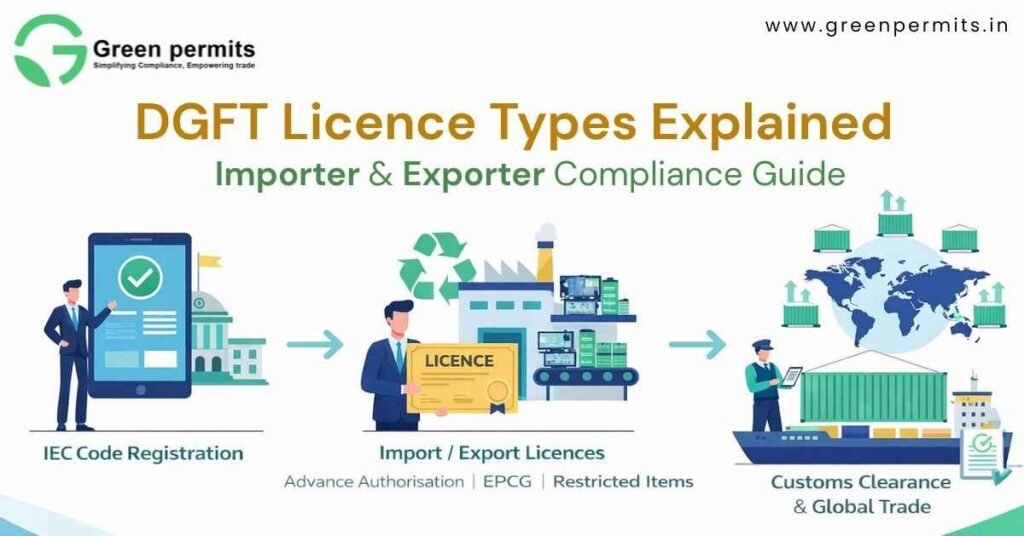
DGFT licensing operates under a clear statutory structure. The power to regulate imports and exports flows from Section 3 of the FTDR Act, 1992. Section 7 mandates Import Export Code (IEC) for any entity undertaking cross-border trade. Section 11 provides penalty provisions for contraventions.
Foreign Trade Policy (FTP) 2023 became effective from 01 April 2023 and continues with updates through 2025. The Handbook of Procedures (HBP) 2023 lays down operational timelines, documentation formats, and export obligation mechanisms.
Non-compliance exposure includes:
For businesses importing capital goods worth ₹5–10 crore, even a 10% duty dispute can mean ₹50 lakh to ₹1 crore exposure excluding interest.
Every importer and exporter must obtain IEC before initiating trade. IEC is a 10-digit code linked to PAN and issued digitally.
Key compliance parameters:
More than 14 lakh IEC holders exist in India, but every year thousands face deactivation due to non-updation.
If IEC is not updated:
Even a 7-day delay during peak export season can disrupt supply chains.
Advance Authorisation under Chapter 4 of FTP 2023 allows duty-free import of raw materials used in export production.
This scheme is widely used in:
Core compliance obligations include:
Example calculation:
Inputs imported duty-free: ₹2 crore
Required value addition at 15%: ₹30 lakh
Minimum export value required: ₹2.30 crore
If exports achieved only ₹1.80 crore within 18 months:
The most common audit issue is mismatch between SION norms and actual consumption.
Export Promotion Capital Goods (EPCG) Scheme allows import of machinery at 0% customs duty subject to export obligation.
Industries commonly using EPCG:
Compliance structure:
Example:
Capital goods imported: ₹8 crore
Duty saved: ₹1 crore
Export obligation: ₹6 crore within 6 years
If exports achieved after 6 years = ₹4.5 crore:
Shortfall = ₹1.5 crore
Consequences may include:
Many MSMEs underestimate cumulative export tracking across multiple shipping bills.
Duty Free Import Authorisation (DFIA) is issued after exports are completed.
It is useful for:
Key parameters:
A common compliance issue is incorrect mention of scheme code in shipping bills, leading to rejection during scrutiny.
Items classified as “Restricted” under ITC (HS) require prior DGFT approval before import.
Examples include:
Before approval, authorities may seek:
Import without valid licence may result in:
A 15-day customs hold at a major port can cost ₹5–10 lakh in demurrage for container shipments.
SCOMET items include goods having potential military or dual-use application.
Key compliance features:
Violation exposure is severe, including:
Exporters in chemicals, electronics, aerospace, and advanced engineering sectors must review SCOMET classification carefully.
| Regulation | Key Requirement | Deadline | Applicable To | Risk if Ignored |
|---|---|---|---|---|
| FTDR Act Sec 7 | IEC mandatory | Before trade | All traders | Customs block |
| FTP 2023 Para 2.05 | IEC annual update | 30 June | IEC holders | Deactivation |
| FTP Chapter 4 | Advance Authorisation EO | 18 months | Export manufacturers | Duty recovery |
| FTP Chapter 5 | EPCG EO (6x duty saved) | 6 years | Capital goods importers | Interest + penalty |
| ITC HS | Restricted approval | Before import | Specific HS traders | Confiscation |
Interpretation:
The majority of enforcement actions occur during post-licence review, not during application stage. Businesses often secure approval but fail in long-term compliance tracking.
| Step | Authority | Timeline | Documents Required | Risk Area |
|---|---|---|---|---|
| IEC Application | DGFT | 1–3 days | PAN, GST, bank proof | Data mismatch |
| Advance Authorisation | DGFT RA | 15–30 working days | SION, export plan | Norm deviation |
| EPCG Approval | DGFT | 30 days | Capital goods invoice | EO miscalculation |
| IEC Annual Update | DGFT Portal | By 30 June | Profile confirmation | Suspension |
| EO Closure | DGFT RA | As per licence | Shipping bills, BRC | Demand notice |
Under Section 11(2) of FTDR Act:
In recent compliance drives, authorities have focused on:
For a company importing ₹20 crore worth machinery, even a 5% compliance deviation can expose ₹1 crore plus interest and penalty.
A mid-sized engineering exporter imported CNC machines under EPCG with ₹1.5 crore duty saved.
Export obligation: ₹9 crore over 6 years.
After 6 years, exports achieved: ₹7.2 crore.
Shortfall: ₹1.8 crore.
Outcome:
Better export tracking and annual reconciliation could have prevented financial exposure exceeding ₹2 crore.
Understanding DGFT Licence Types in India requires more than procedural knowledge. It demands structured tracking, numerical planning, and regulatory awareness.
Importers and exporters must monitor:
A missed compliance step can disrupt operations worth crores.
Proactive documentation, quarterly internal audits, and professional advisory reduce regulatory exposure and protect long-term trade continuity.