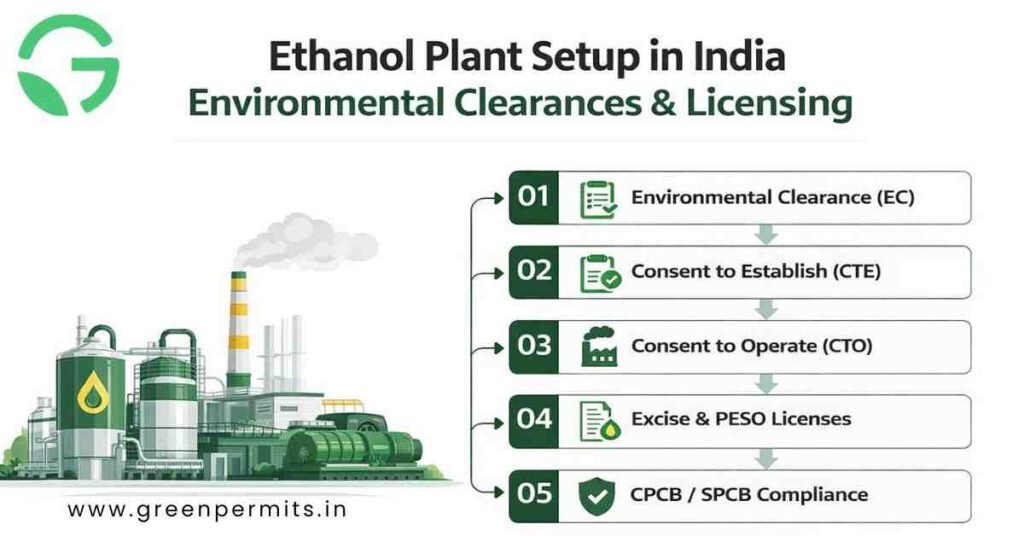
Ethanol Plant Setup in India: Environmental Clearances & Licensing
A Haryana-based agro-industrial group invested nearly ₹210 crore in a 300 KLPD grain-based ethanol project. The plant equipment was imported. Civil structure was complete. Recruitment had started.
But the Environmental Clearance process took 9 months longer than expected.
Loan interest during delay crossed ₹14 crore. Vendor claims increased. Working capital planning collapsed.
This is the reality of Ethanol Plant Setup in India. The opportunity is massive — but compliance sequencing determines profitability.
If you are planning to enter India’s ethanol market under the E20 blending program, understanding environmental and licensing approvals is not optional — it is foundational.
Regulatory Framework Governing Ethanol Plant Setup in India
Ethanol plants are categorized under pollution-intensive industries due to:
High organic load effluent (BOD levels often > 40,000 mg/L in raw spent wash)
High water consumption (800–1200 KLD for 300 KLPD capacity)
Boiler emissions
Solid by-products and hazardous residues
A typical ethanol plant must comply with at least 8 major regulatory frameworks:
Environment (Protection) Act, 1986
EIA Notification, 2006
Water Act, 1974
Air Act, 1981
Hazardous & Other Waste Rules, 2016
Factories Act, 1948
State Excise Act
Boiler & Electrical Inspectorate Regulations
Non-compliance risks include:
Plant closure under Section 5 of EPA
Environmental compensation penalties (₹5 lakh to ₹1 crore depending on violation scale)
Refusal of Consent to Operate
Blacklisting from OMC supply contracts
For investors, regulatory failure can reduce IRR by 3–5%.
Environmental Clearance (EC) for Ethanol Plant Setup in India
Environmental Clearance is often the most time-consuming approval.
Grain-based ethanol plants typically fall under:
Category A (Central MoEFCC) — large capacity projects
Category B1 (State SEIAA) — medium capacity
EC Process — 6 Structured Steps
Project Screening & Categorization
Terms of Reference (ToR) Approval
Baseline Environmental Monitoring (Minimum 90 days data)
Public Hearing (Mandatory in most cases)
EIA & EMP Submission
Expert Appraisal Committee Decision
Average Timeline
Baseline Monitoring: 3 months
Documentation & EIA Drafting: 1–2 months
Public Hearing: 45–60 days
Appraisal & Clearance: 2–3 months
Total expected time: 6 to 10 months
Why EC Gets Delayed
Incorrect land classification
ZLD design not matching CPCB norms
Public objections
Incomplete impact modelling
Improper water source justification
In nearly 35–40% of cases, EC proposals are returned for additional clarification.
Early professional documentation can reduce delay risk by 30%.
Pollution Control Board Approvals — CTE & CTO
Environmental Clearance alone does not allow plant construction or operation.
You must obtain:
1. Consent to Establish (CTE)
CTE verifies:
Plant layout
Effluent Treatment Plant design
ZLD integration
Stack height and emission control
Boiler capacity compliance
CTE typically takes 60–90 days after submission if documentation is complete.
2. Consent to Operate (CTO)
CTO is issued after physical inspection.
SPCB checks:
Online Continuous Emission Monitoring Systems (OCEMS)
Effluent reuse and ZLD proof
Storage tank safety compliance
Hazardous waste storage area
Operating without CTO can result in:
Immediate shutdown
Environmental compensation assessment
Criminal liability under Water Act
For a 300 KLPD plant, CTO delay of even 60 days can impact annual revenue by ₹25–30 crore.
Zero Liquid Discharge (ZLD) — Financial & Technical Impact
CPCB mandates Zero Liquid Discharge in most states.
ZLD System Components
Multiple Effect Evaporator (MEE)
Incineration Boiler or DDGS Dryer
Condensate Polishing Unit
Biological Treatment System
Cost Impact
ZLD CAPEX: ₹20–30 crore
Annual OPEX: ₹6–10 crore
Steam & power load increases by 15–20%
However, non-ZLD plants face:
Immediate closure notices
Heavy environmental compensation
Public litigation risk
Investing in robust ZLD protects long-term viability.
Land, Water & Infrastructure Compliance
Site selection determines regulatory speed.
For a 300 KLPD ethanol plant:
Minimum land: 15–20 acres
Fresh water requirement: 1000–1200 KLD
Boiler capacity: 50–60 TPH
Key Approvals Required
Land use conversion (if agricultural land)
Groundwater clearance (if borewell used)
Canal water allocation letter
Fire Department NOC
Factory License
Incorrect land zoning causes up to 20% EC rejections in industrial projects.
Water source justification is one of the top 3 scrutiny areas during appraisal.
Boiler, Power & Emission Licensing
Most ethanol plants include captive power generation.
Typical configuration:
7–10 MW back-pressure turbine
50–55 TPH FBC boiler
Biomass/coal mix
Required Approvals
Boiler Inspector Approval
Electrical Inspector Clearance
Stack Emission Norm Compliance
Fly Ash Disposal Plan
Stack emissions must comply with:
PM limits (often < 50–100 mg/Nm³ depending on norms)
Continuous monitoring requirements
Failure in emission control can trigger immediate Air Act prosecution.
Investment Breakdown & Compliance Cost
A typical 300 KLPD ethanol plant investment:
Component
Approximate Cost (₹ Crore)
Process Plant
130–160
Boiler & Turbine
35–45
ZLD & Effluent Systems
25–35
Utilities & Storage
20–30
Environmental Monitoring
5–10
Total Project Cost: ₹200–250 crore
Financial Impact of Delay
1 month delay may cost ₹2–3 crore in interest
6 months delay may cost ₹12–18 crore
Lost production revenue per month: ₹20–25 crore
Compliance planning is directly linked to financial performance.
Real Compliance Case
A North Indian ethanol project experienced:
9-month EC delay
ZLD redesign order
Additional ₹18 crore capital expenditure
Interest burden increase of ₹15 crore
Root cause:
Weak baseline environmental study
Poor stakeholder consultation
Incomplete water balance documentation
Lesson: Regulatory sequencing must begin before civil construction.
Step-by-Step Compliance Roadmap
Phase 1 — Pre-Investment
Land verification
Water availability confirmation
Preliminary pollution load calculation
ZLD feasibility assessment
Phase 2 — Pre-Construction
Apply for Environmental Clearance
Apply for Consent to Establish
Secure water allocation
Finalize boiler specifications
Phase 3 — Construction
Install ZLD infrastructure
Install emission monitoring
Maintain compliance documentation
Phase 4 — Pre-Operation
Apply for Consent to Operate
Conduct environmental audit
Trial runs with SPCB inspection
Proper sequencing reduces approval time by 4–6 months.
Why Early Compliance Planning Saves Crores
Businesses that align regulatory approvals early experience:
20–30% faster commissioning
Lower redesign cost
Improved investor confidence
Smooth OMC supply agreements
Reduced legal exposure
In ethanol manufacturing, regulatory certainty equals operational stability.
Conclusion
India’s E20 blending roadmap has created a historic opportunity in biofuel manufacturing. However, Ethanol Plant Setup in India requires disciplined environmental and licensing execution.
Ignoring approvals can lead to:
Project suspension
Crores in financial loss
Legal penalties
Operational shutdown
Early environmental clearance, SPCB approvals, and ZLD integration ensure sustainable growth and stable returns.