
Rohit had just received his first bulk shipment of imported kitchen appliances at Mumbai port. The marketing campaign was live, distributors were waiting, and advance payments had already been collected.
But the consignment did not move.
Customs flagged the shipment because the importer had not obtained LMPC registration under the Legal Metrology (Packaged Commodities) Rules, 2011. The issue was not product quality, not GST, not BIS — it was packaging compliance.
The delay lasted 18 days. Demurrage crossed ₹3.2 lakh. The distributor threatened cancellation. And the lesson was clear: packaging law in India is not optional.
If you import, manufacture, or sell pre-packaged goods in India, LMPC Certificate in India is a statutory requirement that directly impacts customs clearance, retail sales, and regulatory risk.
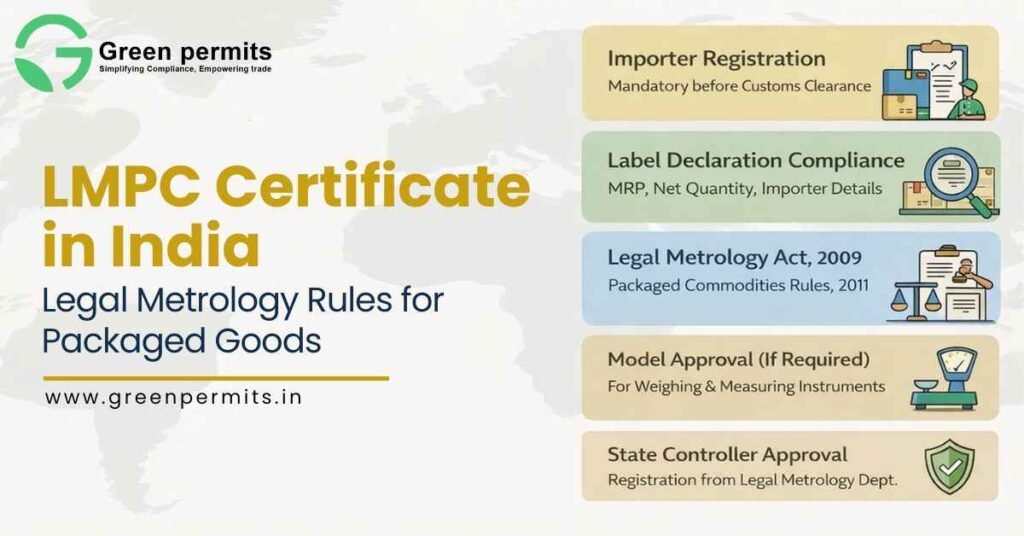
LMPC compliance is governed by a structured statutory framework:
As per Section 18 of the Legal Metrology Act, 2009, no pre-packaged commodity shall be manufactured, packed, imported, distributed, or sold unless it conforms to standard quantity and declaration requirements.
As per Rule 27, every importer of pre-packaged commodities must apply for registration before commencing import activity.
Key regulatory realities businesses must understand:
In FY 2024–25, multiple state departments increased inspections at warehouses and e-commerce fulfillment centers, particularly for electronics, cosmetics, and household appliances.
Many businesses assume LMPC applies only to large importers. That assumption is incorrect.
The following entities require registration:
If you import goods that are:
You require LMPC registration under Rule 27.
Common categories include:
Even if annual turnover is below ₹5 crore, compliance is mandatory.
Any manufacturer packing goods for retail sale must ensure:
Incorrect quantity declarations can trigger seizure of stock during inspection.
With the rise of online retail, authorities now verify:
Inconsistent declarations between packaging and online listing may trigger consumer complaints under the Consumer Protection framework.
Rule 6 of the Packaged Commodities Rules, 2011 prescribes mandatory declarations.
Each package must clearly display:
Additional compliance requirements:
For example:
During inspection drives, officers commonly verify:
Even minor formatting errors can result in seizure of stock.
| Regulation | Key Requirement | Deadline | Applicable To | Risk if Ignored |
|---|---|---|---|---|
| Section 18, LM Act 2009 | Standard quantity & declaration compliance | Before sale | All entities | Seizure |
| Rule 6 | Mandatory label details | Before distribution | Manufacturers/importers | Monetary penalty |
| Rule 27 | Importer registration | Before import | Importers | Customs detention |
| Section 36 | Penalty for contravention | Upon violation | All entities | Fine up to ₹25,000 |
Interpretation:
Authorities can detain goods for 7–30 working days if registration proof is not available. For high-value consignments, delay can cause losses exceeding ₹2–5 lakh in demurrage and warehousing.
Registration is issued by the Controller of Legal Metrology of the respective State.
| Step | Authority | Timeline | Risk Area |
|---|---|---|---|
| Application filing | State Department | Day 1 | Incorrect documentation |
| Scrutiny | Controller Office | 7–15 working days | Label mismatch |
| Inspection (if required) | LM Inspector | 7–10 days | Address inconsistency |
| Certificate issuance | Controller | 15–30 working days | Delayed clarifications |
Total processing time typically ranges between 15 and 30 working days depending on State workload.
Incomplete applications may extend timeline to 45 days.
Under Section 36 of the Legal Metrology Act:
Additional risks include:
In one recent case, a cosmetic importer had to re-label 12,000 units at port due to incorrect importer address format. The total cost of corrective compliance exceeded ₹4.8 lakh.
These are preventable compliance failures.
Regulatory enforcement has evolved due to:
Businesses with structured compliance systems experience:
Early registration reduces compliance cost significantly compared to post-detention corrective action.
LMPC Certificate in India is a statutory obligation under the Legal Metrology Act, 2009. It directly impacts:
Non-compliance may result in delays of 15–30 days, fines up to ₹25,000 per violation, and reputational damage.
Structured documentation, correct packaging declarations, and timely registration protect businesses from unnecessary regulatory disruption.
Proactive compliance always costs less than corrective compliance.
📞 +91 78350 06182
📧 wecare@greenpermits.in