
In 2025, manufacturing margins are tightening. Import-dependent industries are facing Basic Customs Duty (7.5%–15%), Social Welfare Surcharge (10% on BCD), and IGST (18%–28%) at the time of import. For a ₹100 crore machinery import, upfront duty exposure can easily cross ₹22–30 crore.
That is capital locked before the first unit is produced.
The MOOWR Scheme in India offers a legally structured mechanism under the Customs Act, 1962 to defer this duty. For capital-intensive sectors like EV, battery manufacturing, electronics, engineering, and renewable energy, this deferment can improve project IRR by 2%–4% and reduce borrowing costs by ₹2–5 crore annually depending on project size.
This guide explains the regulatory framework, compliance structure, timelines, risks, and financial impact in practical terms.
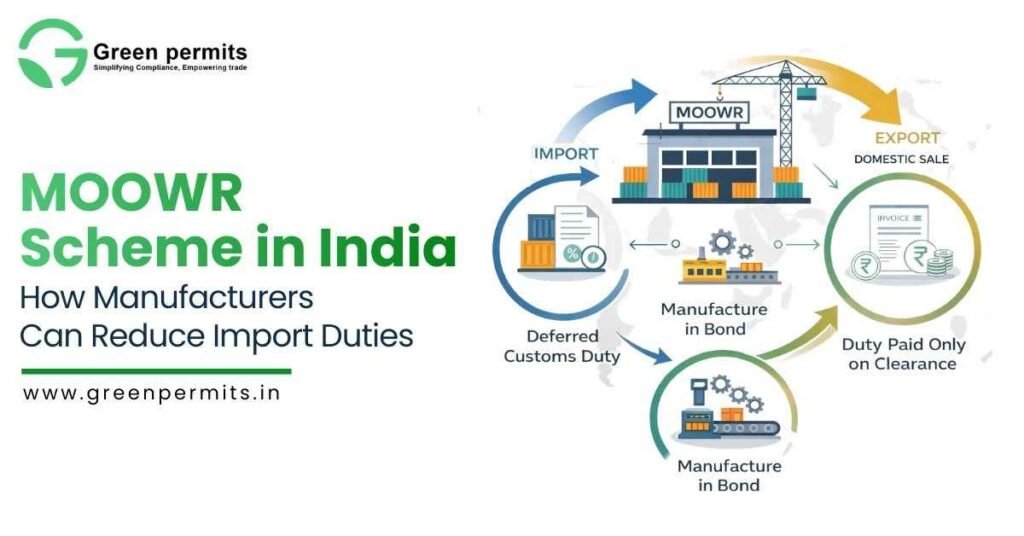
The MOOWR Scheme operates under the following statutory provisions:
Under Section 65, a manufacturer can carry out production within a bonded warehouse without paying customs duty at the time of import.
Unlike incentive schemes that depend on policy changes, MOOWR is rooted in the Customs Act, 1962. It is not a subsidy. It is not an export incentive. It is a warehousing-based duty deferment model backed by statutory authority.
This gives:
For manufacturers planning 10–20 year project horizons, this stability is critical.
At its core, MOOWR allows:
Consider a ₹200 crore greenfield plant:
Under MOOWR:
Over 5 years, that is nearly ₹18 crore in financing cost impact.
That difference directly influences project viability.
| Regulation | Key Requirement | Timeline | Applicable To | Risk if Ignored |
|---|---|---|---|---|
| Section 58 | Private bonded warehouse licence | Before import | Manufacturing unit | Import detention |
| Section 59 | Bond execution | Pre-approval | Licence holder | Financial liability |
| Section 65 | Manufacturing permission | Before production | Bonded unit | Licence cancellation |
| Section 72 | Duty recovery | Immediate | Defaulting unit | Duty + Interest |
| Section 117 | Penalty | On violation | Non-compliant entity | Monetary penalty |
Customs authorities can recover full deferred duty along with interest if inventory records are not maintained correctly. Therefore, compliance discipline is as important as financial planning.
Manufacturers must follow a structured sequence.
Most projects complete approval in 45–60 days, provided documentation is accurate.
Delays of 30–90 days occur when:
MOOWR is compliance-driven. Once operational, the unit must:
Inventory mismatch of even 1–2% may trigger customs scrutiny.
| Parameter | MOOWR | EPCG | SEZ |
|---|---|---|---|
| Upfront Duty | Deferred | Zero (conditional) | Zero |
| Export Obligation | No | Yes (6 years) | Yes |
| Location Restriction | Anywhere | Anywhere | Notified zone |
| Compliance Complexity | Moderate | High | High |
| Validity | Unlimited | Linked to EO | SEZ framework |
If domestic sales exceed 60%–70%, MOOWR often provides more flexibility than EPCG.
If exports exceed 80%, EPCG may be considered.
For most balanced manufacturing units, MOOWR improves working capital efficiency significantly.
Manufacturers in sectors such as:
are also subject to:
Importing capital equipment for these regulated industries under MOOWR reduces capital blockage while managing regulatory costs.
In capital-intensive sectors where compliance cost can account for 5%–8% of project cost, duty deferment provides liquidity cushion.
A 500 TPD engineering fabrication unit:
Using MOOWR:
This is not a marginal advantage. It changes financial modeling.
Manufacturers must understand the downside.
Risks include:
The most common risk area is improper stock accounting and failure to reconcile bonded inventory.
Customs audit frequency has increased in 2024–2025, especially in high-value import sectors.
MOOWR may not be ideal if:
Small-scale operations with limited imports may not benefit materially.
The MOOWR Scheme in India is a legally structured duty deferment mechanism under Section 65 of the Customs Act, 1962. It allows manufacturers to:
In 2025–2026, when capital efficiency determines competitiveness, structured customs planning is not optional. It is strategic.
Early planning, accurate documentation, and disciplined compliance ensure the scheme works as intended.
📞 +91 78350 06182
📧 wecare@greenpermits.in