
Rajiv, a second-generation manufacturer from Faridabad, had finalized a ₹18 crore machinery import from Germany. His consultant gave him two options — MOOWR or EPCG.
One promised duty deferment without export pressure. The other offered zero customs duty — but only if he committed to large export targets for six years.
A wrong choice could lock his business into compliance stress, cash flow strain, or penalty exposure.
If you’re facing the same decision, this detailed guide on MOOWR vs EPCG will help you choose strategically — not emotionally.
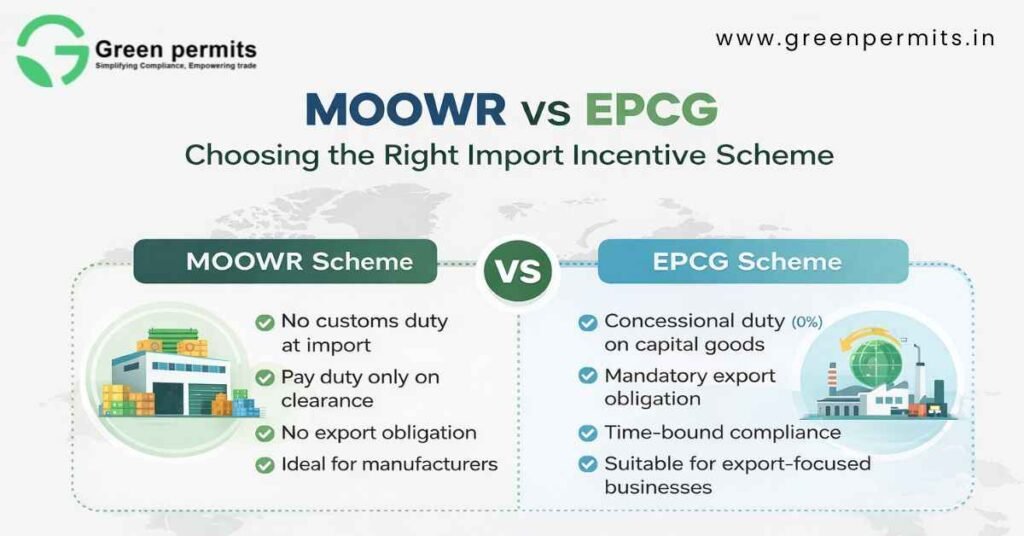
Both schemes reduce import duty burden on capital goods. However, their compliance model, financial impact, and long-term flexibility differ significantly.
Before choosing, businesses must evaluate:
The Manufacturing and Other Operations in Warehouse Regulations (MOOWR) was restructured in 2019 under Section 65 of the Customs Act. It allows manufacturers to import capital goods and raw materials without upfront customs duty payment.
It is increasingly preferred by domestic-focused manufacturers.
For companies importing machinery worth ₹10–50 crore, MOOWR significantly improves working capital efficiency.
The Export Promotion Capital Goods (EPCG) Scheme, governed under the Foreign Trade Policy (FTP 2023–28), allows zero customs duty import of capital goods.
However, it comes with strict export obligations.
Failure to meet export obligation results in:
Let’s assume machinery import value: ₹15 crore
Basic Customs Duty: 10%
IGST: 18%
| Particular | Normal Import | MOOWR | EPCG |
|---|---|---|---|
| Basic Customs Duty | ₹1.5 crore | Deferred | 0 |
| IGST | ₹2.7 crore | Payable on clearance | Payable |
| Export Obligation | No | No | 6x duty saved (₹9 crore approx.) |
| Compliance Risk | Low | Moderate | High |
| Working Capital Impact | High strain | Improved liquidity | Moderate |
Interpretation:
MOOWR improves liquidity immediately. EPCG eliminates duty but imposes export pressure worth multiple times the benefit.
Under FTP 2023–28:
| Component | Requirement |
|---|---|
| Export Multiplier | 6 times duty saved |
| Fulfilment Period | 6 years |
| Average Export Obligation | Must maintain previous export average |
| Monitoring Authority | DGFT |
For example:
If duty saved = ₹1.5 crore
Export obligation = ₹9 crore within 6 years
This equals ₹1.5 crore export annually on average.
| Scheme | Governing Authority | Legal Framework |
|---|---|---|
| MOOWR | Customs Department | Section 65, Customs Act |
| EPCG | DGFT | Foreign Trade Policy 2023–28 |
This means compliance nature differs — Customs-driven vs DGFT-driven.
For capital-intensive industries:
Companies planning capacity expansion but uncertain export orders generally prefer MOOWR.
A textile exporter in Ludhiana opted for EPCG in 2022 expecting export growth.
Due to global slowdown and geopolitical tensions, export orders dropped 30%.
They fell short of export obligation by ₹2 crore.
Result:
Strategic scheme selection could have avoided this exposure.
MOOWR is ideal if:
Industries benefiting:
EPCG is suitable if:
Industries benefiting:
Ignoring compliance requirements can lead to:
Choosing the wrong scheme increases operational risk.
| Business Scenario | Recommended Scheme |
|---|---|
| Domestic market focus | MOOWR |
| High-value machinery import | MOOWR |
| Confirmed export contracts | EPCG |
| Aggressive export growth plan | EPCG |
| Working capital constraints | MOOWR |
Choosing between MOOWR vs EPCG is not about which scheme saves more duty.
It’s about:
MOOWR provides flexibility and working capital advantage.
EPCG offers permanent duty exemption but demands export performance.
Early regulatory planning prevents costly mistakes later.
Green Permits helps manufacturers:
📞 +91 78350 06182
📧 wecare@greenpermits.in