
A solar EPC contractor in Rajasthan finalized a large utility-scale project. Modules were sourced from an overseas supplier at competitive rates. Payment was made. Shipment arrived at port.
But customs didn’t clear it.
The reason? The modules did not have valid BIS registration under the Compulsory Registration Scheme (CRS).
What followed was 38 days of detention, mounting demurrage, legal consultation, and project delay penalties from the client.
For many importers, Solar Module Imports Without BIS is not a compliance detail — it becomes a financial crisis.
Let’s understand the legal structure and business risks clearly.
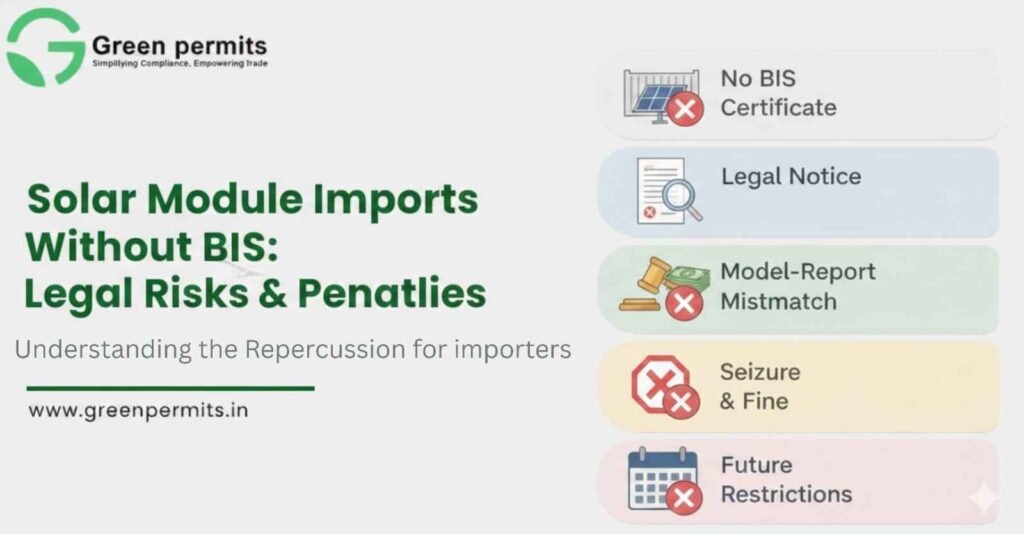
When you import solar modules into India, you are not just moving goods — you are entering a regulated quality control framework. The Government of India mandates BIS certification to ensure that solar modules meet safety, reliability, and performance standards suitable for Indian climatic and grid conditions.
This is not optional or project-specific. It applies at the product level, irrespective of whether the modules are used in rooftop, utility-scale, commercial, or government projects.
Under the Compulsory Registration Scheme (CRS):
Many businesses assume that supplier assurance is enough. It is not. Responsibility ultimately rests with the importer placing goods into the Indian market.
If BIS registration is absent, expired, mismatched, or invalid — the shipment becomes legally vulnerable.
Solar module compliance is enforced through interconnected regulatory systems. Even if one document seems valid, non-compliance at another level can halt operations.
The legal structure includes:
| Law / Regulation | Governing Authority | Compliance Impact |
|---|---|---|
| BIS Act, 2016 | Bureau of Indian Standards | Mandatory CRS registration |
| Quality Control Orders | Relevant Ministry | Product compliance requirement |
| Customs Act, 1962 | CBIC | Detention, seizure, confiscation |
| Foreign Trade Policy | DGFT | Import eligibility conditions |
| ALMM Guidelines | MNRE | Government project qualification |
This layered framework means:
If you import solar modules without BIS, the violation is not procedural — it is statutory.
From a business perspective, this multiplies risk because enforcement can come from multiple directions.
Many importers believe customs will allow minor deviations. In reality, enforcement is increasingly structured and digital.
When a shipment arrives without proper BIS registration, several stages of disruption may occur.
The first impact is operational. Customs may withhold clearance pending documentation review.
You may face:
Meanwhile, container detention and port storage charges accumulate daily.
If non-compliance is confirmed, authorities may:
Re-exporting solar modules is logistically complex and expensive, especially for large container volumes.
The BIS Act empowers authorities to penalize sale, distribution, or import of non-compliant goods.
Possible consequences include:
Beyond fines, compliance history may affect future regulatory interactions.
In the renewable energy sector, delays are costly.
Import without BIS can result in:
In competitive bidding markets, reputation matters. One compliance incident can affect multiple future bids.
India’s solar market is expanding rapidly, and policy focus has shifted toward quality control and domestic manufacturing support.
| Indicator | Estimated Data |
|---|---|
| Installed Solar Capacity | 70+ GW |
| Annual Solar Additions | 20–25 GW |
| Historical Import Dependence | 60–80% |
| Basic Customs Duty on Modules | 40% |
What this means for businesses:
Compliance checks are no longer random — they are structured.
From real-world advisory experience, most issues arise not from intent, but from assumptions.
Typical mistakes include:
Each of these can result in detention or penalty.
This confusion is common and costly.
BIS certification ensures that the product meets Indian safety and quality standards.
ALMM listing determines eligibility for certain government and DISCOM-linked projects.
You may:
They are separate frameworks. Both may be required depending on your project type.
Understanding this distinction prevents expensive compliance gaps.
A foreign manufacturer informed the importer that BIS approval was in final stage. To avoid project delay, shipment was dispatched before registration was granted.
The approval was delayed by three weeks.
Shipment arrived. Customs verified registration number. It did not exist yet.
Outcome:
The lesson is simple: application under process does not equal compliance.
If you are importing solar modules manufactured outside India, the process requires structured documentation and coordination.
The typical pathway includes:
Before dispatching shipment, you must verify:
A pre-shipment compliance audit often prevents downstream disruption.
| Scenario | Likely Outcome |
|---|---|
| Import without BIS | Detention + penalties + re-export |
| Proper BIS before shipment | Smooth customs clearance |
| Model mismatch | Shipment rejection |
| Early compliance review | Predictable regulatory cost |
In most cases, one detained shipment costs more than full compliance planning.
If you are planning Solar Module Imports Without BIS documentation clarity, pause and reassess.
A structured approach should include:
Compliance is not a one-time formality. It is an operational safeguard.
Solar Module Imports Without BIS can trigger cascading risks:
In a high-growth renewable sector, regulatory compliance is part of competitive advantage.
Early action reduces uncertainty, protects capital, and strengthens project execution confidence.
📞 +91 78350 06182
📧 wecare@greenpermits.in