
A consumer electronics company importing lithium batteries recently faced a serious compliance issue while preparing its FY 2024–25 CPCB EPR return. The company had introduced nearly 1,850 metric tons (MT) of batteries into the Indian market, but the recycling certificates available covered only 130 MT of waste batteries.
When the compliance report was generated on the CPCB portal, the system flagged a recycling deficit of 18% of the required obligation. Until the gap was resolved, the company faced potential regulatory consequences including environmental compensation, EPR registration suspension, and restrictions under the Environment Protection Act, 1986.
Situations like this are becoming increasingly common. With stricter enforcement expected in 2026, battery manufacturers, EV battery importers and electronics brands must clearly understand Battery EPR penalties, CPCB compliance targets, and legal methods to regularize shortfalls.
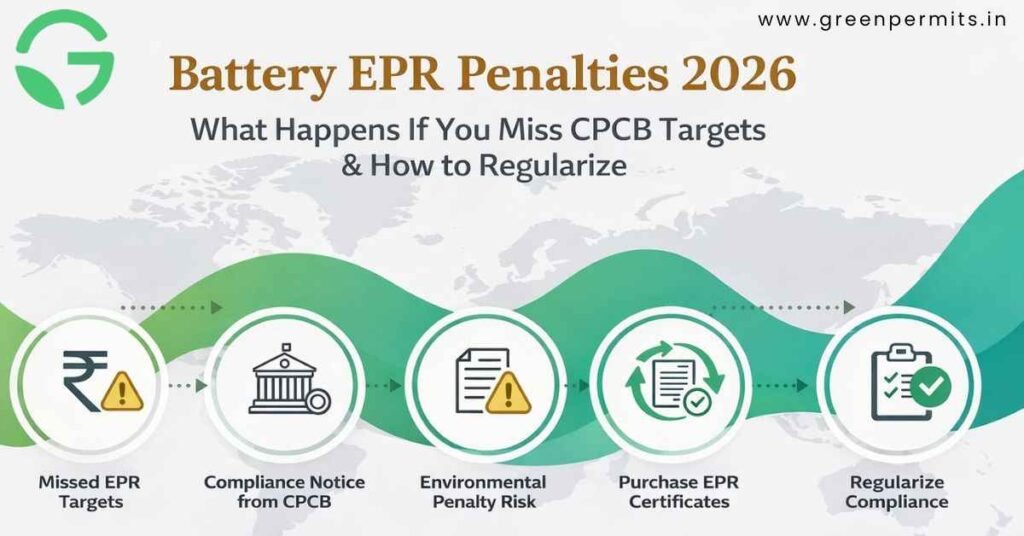
India introduced a structured Extended Producer Responsibility framework to regulate battery waste and ensure environmentally sound recycling.
The regulatory framework applies to businesses that introduce batteries into the market, including:
• battery manufacturers
• importers of batteries or battery-powered equipment
• EV battery suppliers
• automotive battery brands
• industrial battery producers
Under this framework, producers must ensure that a percentage of the batteries sold each year are collected and recycled through authorized recyclers.
Battery EPR compliance typically includes the following steps:
• registration on the CPCB EPR portal
• declaration of annual battery sales
• purchase of recycling certificates
• quarterly compliance reporting
• annual EPR return filing
Failure to follow these steps can trigger regulatory action.
| Regulation | Key Requirement | Deadline | Applicable To | Risk if Ignored |
|---|---|---|---|---|
| Battery Waste Management Rules | Mandatory EPR registration | Before market entry | Manufacturers & importers | Market restriction |
| CPCB EPR Portal Registration | Online compliance system | Prior to product sale | Producers & importers | Application rejection |
| Annual Recycling Obligation | Recycling targets based on sales | Financial year basis | Battery producers | Environmental compensation |
| Annual Compliance Return | Submit recycling data | End of financial year | Registered producers | Portal suspension |
| Environment Protection Act Section 15 | Legal penalty for violation | Continuous enforcement | All regulated entities | Fine or imprisonment |
For many companies, EPR compliance has become a market entry requirement rather than just an environmental obligation.
Businesses without active EPR registration may face difficulties importing batteries or obtaining environmental approvals.
To manage EPR obligations, the Central Pollution Control Board operates a centralized digital compliance platform.
The portal allows businesses to:
• register as producers or importers
• declare battery quantities placed in the market
• purchase recycling certificates
• file quarterly returns
• submit annual compliance reports
Registration requires submission of several documents, including:
• GST registration certificate
• company PAN
• Import Export Code (IEC)
• Corporate Identification Number (CIN)
• authorized signatory details
Once registered, the system automatically calculates the company’s recycling obligations based on sales data.
Battery recycling obligations are calculated as a percentage of batteries introduced in the market during a financial year.
The targets gradually increase to support development of recycling infrastructure.
Typical compliance stages include:
• 8% recycling obligation in the initial compliance stage
• 13% recycling obligation during intermediate stage
• 18% recycling obligation in advanced compliance stage
Example calculation:
If a company sells 2,000 MT of batteries in a financial year, the recycling obligation at the 8% stage would be:
160 MT of waste batteries
These recycling quantities must be fulfilled through authorized recycling facilities.
| Step | Authority | Timeline | Documents Required | Risk Area |
|---|---|---|---|---|
| EPR Registration | CPCB | 30–60 days | GST, PAN, IEC, CIN | Application rejection |
| Sales Declaration | CPCB Portal | Start of financial year | Battery category data | Incorrect obligation |
| Certificate Purchase | Registered recyclers | Throughout FY | EPR certificates | Target deficit |
| Quarterly Return Filing | CPCB Portal | Every 3 months | Compliance data | Portal alerts |
| Annual Return Filing | CPCB Portal | End of financial year | Compliance summary | Penalty trigger |
Most compliance issues arise during the annual return stage, when the system verifies recycling certificates against declared sales.
Missing EPR targets can trigger several enforcement actions from regulators.
These actions generally follow a structured escalation process.
The CPCB digital portal automatically detects discrepancies such as:
• insufficient recycling certificates
• incomplete quarterly filings
• incorrect sales declarations
If the system identifies a deficit, a compliance alert is generated.
Environmental compensation may be imposed if recycling targets are not achieved.
The compensation amount is typically calculated based on:
• quantity of recycling deficit in metric tons
• environmental damage cost factor
• duration of non-compliance
For example, a recycling deficit of 50 MT may trigger a compensation amount significantly higher than the cost of compliance.
If compliance gaps remain unresolved, CPCB may suspend the producer’s registration.
Consequences may include:
• suspension of EPR certificate transactions
• blocking of return filing
• inability to update compliance records
Without active registration, companies may struggle to maintain regulatory compliance.
For battery importers, non-compliance can impact supply chains.
Authorities may delay or question imports if:
• EPR registration becomes inactive
• compliance filings are incomplete
This risk is particularly significant for EV battery importers and electronics manufacturers.
Serious or repeated violations may attract penalties under the Environment Protection Act, 1986.
Possible enforcement measures include:
• financial penalties
• imprisonment for severe violations
• closure directions for continued non-compliance
Consider an electronics brand importing lithium batteries.
Annual battery imports:
2,200 MT
Recycling obligation at 8% stage:
176 MT
Recycling certificates purchased:
142 MT
Remaining deficit:
34 MT
Until the company purchases additional recycling certificates to cover the 34 MT gap, the system will show the company as non-compliant.
If EPR targets are missed, companies have several legal options to correct the deficit.
The most common solution is to purchase additional certificates from authorized recyclers.
These certificates represent verified recycling of battery waste.
Once uploaded to the CPCB portal, they can offset the deficit.
In some cases, incorrect sales declarations create inflated obligations.
Companies should review:
• battery categories reported
• annual sales volumes
• imported battery quantities
Correcting data may reduce the calculated recycling obligation.
If incorrect information was filed earlier, businesses may submit revised compliance returns.
This ensures that the CPCB portal reflects accurate compliance data.
If recycling certificates are unavailable, regulators may require payment of environmental compensation.
This payment is often required before restoring full compliance status.
Several market and policy trends suggest stronger enforcement in the coming years.
Key drivers include:
• rapid growth in EV battery demand
• increase in lithium battery imports
• expansion of recycling infrastructure
• digitization of CPCB compliance systems
India’s battery market is expected to exceed 150 GWh of annual demand by 2030, making waste management a critical regulatory priority.
Authorities are therefore strengthening monitoring of recycling obligations and EPR compliance.
Companies dealing with batteries should implement a structured compliance strategy.
Key compliance actions include:
• register on the CPCB EPR portal
• maintain accurate annual sales records
• calculate recycling obligations in metric tons
• purchase recycling certificates periodically
• submit quarterly compliance returns
• file annual EPR reports on time
Following these steps helps businesses avoid regulatory risks.
Battery EPR compliance is now a critical regulatory requirement for companies operating in India’s battery and EV ecosystem.
Failure to meet CPCB recycling targets can result in:
• environmental compensation penalties
• suspension of EPR registration
• delays in battery imports
• legal enforcement under environmental law
However, businesses can avoid these risks by maintaining accurate sales declarations, purchasing sufficient recycling certificates, and filing compliance reports on time.
With stricter enforcement expected in 2026 and beyond, structured documentation and proactive compliance management will be essential for uninterrupted business operations.
📞 +91 78350 06182
📧 wecare@greenpermits.in