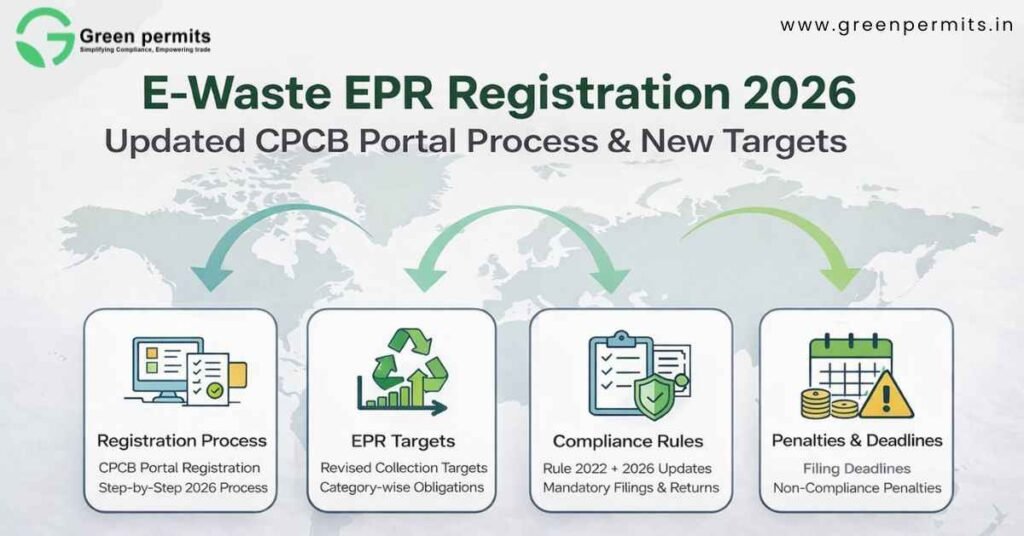
In FY 2025–26, several electronics manufacturers across Delhi NCR, Pune, Noida, and Bengaluru received portal observations from CPCB because their EPR targets were incorrectly declared before the 30 April deadline. Some had calculated targets using outdated 2016 rules. Others failed to reconcile GST sales turnover with EPR category reporting.
The result?
Registration delays of 30–45 days
Import consignments placed on hold
Environmental compensation notices
With digital tracking tightened under the E-Waste (Management) Rules, 2022 and stricter portal validation in 2025–2026, E-Waste EPR Registration 2026 has become a high-risk compliance area for manufacturers and importers.
If you manufacture, assemble, import, or sell electrical and electronic equipment (EEE) in India, your CPCB EPR registration , recycling target declaration, and certificate purchase mechanism must be numerically accurate and timeline-driven.
Regulatory Framework Governing E-Waste EPR Registration 2026
E-Waste EPR compliance operates under a structured legal system:
E-Waste (Management) Rules, 2022
Environment (Protection) Act, 1986
Section 15 – Penalty provision
CPCB centralized EPR Portal framework
CPCB Producer SOP guidelines
CPCB Return Filing Instructions
As per Rule 4(1) of the E-Waste (Management) Rules, 2022, every producer shall obtain registration from CPCB prior to placing EEE in the market.
This includes:
Manufacturing units
Brand owners
Importers holding IEC
Online sellers placing own-branded EEE
Key Legal Facts:
Registration is mandatory before first sale
Registration validity is typically 5 years
Annual return filing is mandatory by 30 June
Target declaration is mandatory by 30 April
Non-registration may attract penalty under Section 15 of EPA, 1986
The regulatory intent is clear — no producer can operate outside the digital compliance framework.
Who Must Apply for E-Waste EPR Registration in 2026?
The term “Producer” under the E-Waste Rules, 2022 includes any entity engaged in:
Manufacture and sale under own brand
Sale under own brand manufactured by others
Import of EEE
Refurbished product resale under own brand
Typical industries affected:
Consumer electronics manufacturers
LED and lighting brands
IT hardware companies
Telecom equipment suppliers
Solar electronics distributors
Small appliance manufacturers
Mandatory Documents:
GST Certificate
PAN (Company)
PAN (Authorized Signatory)
IEC Certificate (for importers)
CIN (if applicable)
Board Authorization Letter
Digital Signature Certificate
In 2026, CPCB portal validation cross-checks:
GST turnover vs declared sales
IEC imports vs EPR category
Historical returns vs new declarations
Misclassification of EEE categories is one of the top 3 reasons for portal observation.
CPCB EPR Portal Process – Updated 2026 Registration Steps
The E-Waste EPR Registration 2026 process is entirely online through CPCB centralized portal.
Step 1: Sign-Up and Account Creation
GST auto-verification
PAN authentication
Authorized person validation
Email OTP confirmation
Time required: 1–2 working days for system activation.
Step 2: Application Submission
Upload required documents in PDF (less than 2 MB each).
Step 3: Product Category Declaration
EEE must be classified under Schedule I categories such as:
IT & Telecom Equipment
Consumer Electricals
Lighting Equipment
Solar PV Panels
Medical Devices
Incorrect mapping may inflate or understate recycling targets.
Step 4: Annual Recycling Target Declaration
Mandatory declaration by 30 April every financial year.
Targets are calculated based on:
Quantity placed in market in previous financial years
Category-specific calculation basis
Historical sales data
Step 5: Payment of Registration Fee
Fees depend on annual recycling target (MT basis).
Step 6: CPCB Scrutiny
Average scrutiny time: 20–30 working days
Clarification window: 7–15 days
Final approval digitally issued
Delay in response automatically freezes application
Registration Fee Structure for Producers
CPCB fee slab based on Annual Recycling Target (in Metric Tons):
Annual Target (MT)
Registration Fees (₹)
< 50 MT
2,500
50–100 MT
7,500
100–1000 MT
1,50,000
1000–5000 MT
10,00,000
> 5000 MT
15,00,000
Additional Charges:
New Producer (initial year): ₹10,000
Amendment: ₹10,000
Annual Maintenance Charges: ₹5,000
For a producer placing 1200 MT annually, registration fee falls under ₹10,00,000 slab.
Incorrect estimation of target may result in underpayment and reprocessing delay of 30+ days.
Compliance Timeline – Critical Dates for FY 2025–26
E-Waste compliance operates on financial year basis (1 April – 31 March).
Compliance Requirement
Deadline
Risk if Missed
EPR Registration
Before first sale
Illegal market placement
Annual Target Declaration
30 April
Non-declaration flag
Quarterly Return
Sequential basis
Filing blockage
Annual Return
30 June
Environmental Compensation
Certificate Purchase
Before FY closure
Target shortfall
Important Numerical Notes:
Declaration must reflect exact MT quantity
Certificate purchase must match declared target
Returns must reconcile 100% of transaction data
In 2025–2026, portal analytics detect mismatch beyond 2–5% deviation.
Annual & Quarterly Return Filing – What CPCB Checks in 2026
Quarterly Return:
Filed in sequence (Q1 → Q2 → Q3 → Q4)
Awareness tab optional
Certificate adjustment required
Annual Return:
Awareness tab compulsory
Complete financial year summary
Must be filed by 30 June
If Annual Return is not filed:
Show Cause Notice may be issued within 30–60 days
Environmental Compensation may be calculated
Portal status may shift to “Under Review”
For medium manufacturers (500–1500 MT target), EC may run into several lakhs depending on shortfall percentage.
EPR Target Fulfilment Mechanism – Numerical Accuracy Matters
Producers must purchase EPR certificates from registered recyclers.
Key Requirements:
Certificate quantity (MT) must equal declared obligation
Certificates must be generated in same FY
No double accounting permitted
Transaction traceability maintained digitally
Example:
If declared obligation = 850 MT
Shortfall may attract:
Environmental compensation
Carry forward obligation
Portal compliance downgrade
Digital audit trail is maintained for 5+ years.
Compliance Risks and Penalty Exposure Under Section 15
Under Section 15 of Environment (Protection) Act, 1986:
Imprisonment up to 5 years
Fine up to ₹1,00,000
Additional fine for continuing offence
Possible prosecution
Operational Risks:
Import clearance delays
Marketplace suspension
SPCB refusal of Consent to Operate
Brand reputation damage
ESG reporting impact
In 2026, enforcement focus includes:
High-volume importers (>1000 MT)
Multi-brand distributors
Marketplace sellers
Refurbished electronics sellers
Real Business Example – Target Miscalculation Case
A 900 MT consumer electronics importer miscalculated category mapping, under-declared 120 MT.
Impact:
Portal flagged variance during annual filing
35-day compliance hold
Additional certificate purchase at higher market rate
Environmental compensation calculated on shortfall
Financial impact exceeded ₹18–22 lakh including penalties and compliance cost.
Why 2026 Compliance Is More Stringent Than Before
Compared to 2016–2018 regime, the 2022–2026 framework includes:
Centralized digital portal
Real-time certificate tracking
GST-linked validation
IEC-linked import tracking
Sequential filing control
Mandatory awareness disclosure
Data retention for audit
Manual compliance practices are no longer sufficient.
Numerical discipline and documentation accuracy are essential.
Conclusion – Structured Compliance Reduces Financial Risk
E-Waste EPR Registration 2026 is not a one-time registration. It is an annual compliance ecosystem requiring:
Accurate MT calculation
Timely declaration
Structured documentation
Certificate purchase planning
Quarterly reconciliation
Annual reporting
Delays increase cost.
Early registration and proactive compliance reduce:
Portal delays
Certificate cost escalation
Regulatory notices
Operational disruption
📞 +91 78350 06182
Book a Consultation with Green Permits