
A medium-scale recycling plant in northern India invested more than ₹3 crore in machinery, infrastructure, and workforce—only to discover that operations could not legally begin because the required SPCB authorization had not yet been issued.
The facility was technically ready. Machines were installed, raw material supply contracts were signed, and more than 25 workers had already been hired. But without environmental authorization from the State Pollution Control Board, the plant could not start production.
Within three weeks of trial operations, the company received a regulatory notice asking it to immediately stop operations until proper authorization was obtained. Electricity supply was temporarily disconnected and the plant remained idle for nearly 52 days, resulting in operational losses exceeding ₹45–50 lakh.
Situations like this are far more common than most businesses expect.
Across India, hundreds of manufacturers, recyclers, and processing facilities face delays in SPCB authorization approvals every year. While official processing timelines may appear to be 30 to 60 days, the actual approval period often stretches to 90–120 days due to technical scrutiny, inspection scheduling, and documentation clarifications.
For businesses planning to start operations in 2026, understanding the real SPCB authorization process, approval timelines, escalation mechanisms, and compliance requirements can make the difference between a smooth plant launch and months of costly operational delays.
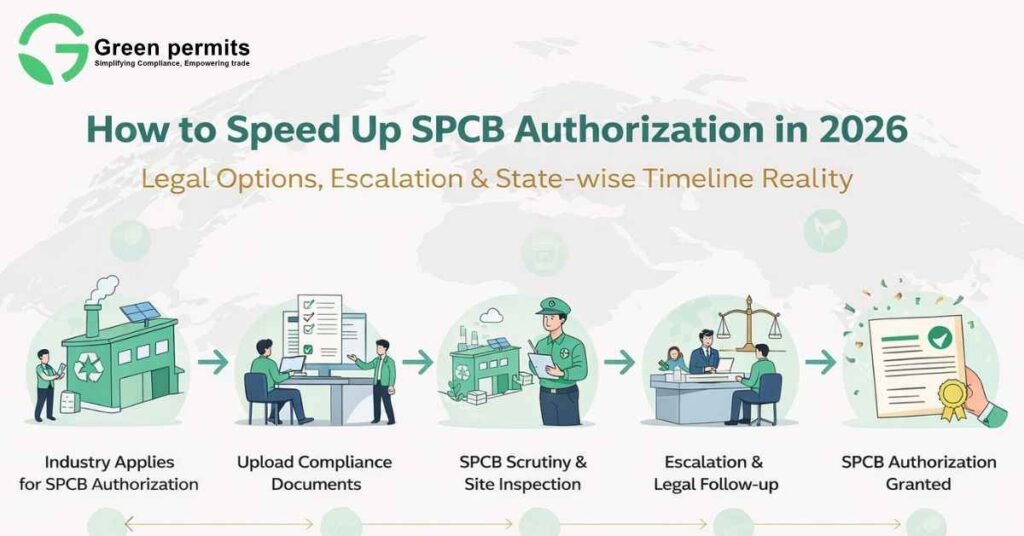
SPCB authorization is one of the most critical environmental approvals required for operating any manufacturing, recycling, or waste-handling facility in India.
The authorization ensures that industries install and operate pollution control systems capable of managing environmental impacts such as air emissions, wastewater discharge, hazardous waste generation, and noise pollution.
Industries that typically require SPCB authorization include:
Environmental approvals serve three key purposes.
First, they ensure that pollution control systems such as Effluent Treatment Plants and Air Pollution Control Devices are installed before industrial operations begin.
Second, they allow regulatory authorities to verify that industrial activities comply with environmental standards for emissions, wastewater discharge, and hazardous waste handling.
Third, they create a traceable compliance record that regulators can monitor through inspections and annual filings.
Without this authorization, an industrial unit cannot legally operate, even if all other licenses such as factory license, GST registration, and electricity connections are obtained.
| Regulation | Key Requirement | Deadline | Applicable To | Risk if Ignored |
|---|---|---|---|---|
| Environment Protection Act | Environmental compliance for industries | Before starting operations | Manufacturing and recycling units | Legal prosecution |
| Hazardous Waste Rules | Authorization for hazardous waste handling | Before waste generation | Chemical industries | Plant shutdown |
| Plastic Waste Management Rules | Authorization for plastic processing | Before recycling activity | Plastic recyclers | Authorization rejection |
| Battery Waste Management Rules | Registration and recycling compliance | Annual filing | Battery producers and recyclers | Environmental compensation |
| ELV Management Rules | Registration for scrapping facilities | Before scrapping operations | Vehicle dismantling units | Suspension of operations |
Environmental regulations are enforced through State Pollution Control Boards, which verify that industries comply with environmental standards before granting operational approval.
Failure to obtain authorization can result in enforcement actions ranging from financial penalties to closure orders.
Many businesses assume that SPCB approval is a single license. In practice, the environmental approval process involves multiple stages.
Most industries require three separate permissions before they can operate legally.
Consent to Establish is required before installing any industrial equipment or construction of a manufacturing facility.
This approval confirms that the proposed project design complies with environmental norms related to air emissions, wastewater discharge, and waste management.
Typical processing timeline:
Typical documentation requirements include:
SPCB technical officers review these documents to assess the potential environmental impact of the proposed industrial activity.
For example, a plastic recycling plant processing 5 MT of waste per day must demonstrate:
Only after CTE approval can the industry proceed with construction and installation of machinery.
Consent to Operate is issued after the industrial facility is constructed and pollution control systems are installed.
Before granting CTO approval, SPCB officers conduct a site inspection to verify the actual installation of pollution control equipment.
Typical processing timeline:
During inspection, regulators verify several operational parameters.
These include:
For example, an e-waste recycling plant processing 1 ton of electronic waste per day must demonstrate:
Failure to demonstrate these systems often results in additional inspections or delay in approval.
Industries that generate or process waste require additional authorization.
This applies to industries handling:
Typical approval timeline:
Authorization validity usually ranges between 3 and 5 years, depending on the industry category and state regulations.
Waste authorization ensures that industries maintain records of waste generation, storage, transportation, and disposal.
For example:
A chemical plant generating 2 tons of hazardous waste per month must demonstrate:
Without this authorization, hazardous waste handling becomes illegal.
| Step | Authority | Timeline | Documents Required | Risk Area |
|---|---|---|---|---|
| Application filing | State Pollution Control Board | Day 0 | Application form, project report | Incomplete documentation |
| Technical review | SPCB technical officers | 10–30 days | Pollution control system details | Clarification queries |
| Site inspection | SPCB inspection team | 20–60 days | Installed pollution equipment | Inspection scheduling |
| Approval review | SPCB committee | 15–30 days | Compliance verification | File backlog |
| Authorization issuance | SPCB | 30–120 days | Complete documentation | Rejection risk |
While official timelines appear shorter, practical processing times often depend on inspection schedules and the completeness of submitted documentation.
Environmental approval timelines vary widely across states due to differences in industrial volume, administrative workload, and inspection procedures.
Average approval timelines observed in major industrial states are as follows:
| State | Typical Processing Time |
|---|---|
| Gujarat | 30–45 days |
| Maharashtra | 45–75 days |
| Tamil Nadu | 45–90 days |
| Karnataka | 45–80 days |
| Uttar Pradesh | 60–120 days |
Industrial states with higher manufacturing activity generally experience longer approval timelines due to higher application volumes.
For example, Maharashtra Pollution Control Board processes more than 12,000 industrial consent applications annually, which often leads to longer review periods during peak filing seasons.
Most environmental authorization delays occur due to documentation errors or technical deficiencies rather than regulatory refusal.
The most common causes include the following.
Many applications fail because they lack essential technical information such as pollution control system specifications or waste management plans.
Typical missing details include:
Even small technical omissions can delay approval by 20 to 40 days.
Waste categories must be declared accurately according to environmental regulations.
Incorrect classification often leads to repeated clarification requests from regulators.
For example:
A recycler declaring plastic scrap processing instead of plastic waste recycling may face regulatory queries requiring revised documentation.
SPCB officers verify that industrial layouts clearly indicate pollution control infrastructure.
Plant layouts must show:
Facilities that submit incomplete layouts often face additional inspection visits.
Many SPCB applications are now submitted through digital portals.
Incorrect portal submissions can lead to delays such as:
These issues can delay application processing by 15 to 30 days.
Companies that prepare strong environmental documentation typically receive approvals significantly faster.
Several practical strategies can reduce approval timelines.
A comprehensive compliance file should include:
Providing clear environmental data allows technical reviewers to process applications without repeated clarification requests.
SPCB inspections focus heavily on pollution control equipment.
Facilities should install and test systems such as:
Operational pollution control systems significantly increase the chances of faster inspection approval.
SPCB officers frequently request clarifications during the review process.
Typical response timelines expected by regulators are between 7 and 10 days.
Delayed responses can extend approval timelines by 30 to 60 days.
When applications remain pending beyond reasonable timelines, businesses may pursue formal escalation channels.
Applicants may submit written representation requesting status updates when approvals remain pending for more than 60 days.
State environment departments oversee SPCB operations and may intervene in prolonged regulatory delays.
CPCB supervises environmental regulation implementation and may review unresolved authorization issues reported by industries.
In extreme cases where approvals remain pending for more than 6 months, businesses may seek legal relief through the National Green Tribunal.
This step is generally used only in cases involving unjustified rejection or prolonged administrative delays.
Operating an industrial facility without environmental authorization can result in severe enforcement actions.
Common regulatory consequences include:
Financial penalties can reach several lakhs depending on the scale of violation.
In some cases, industrial operations remain suspended for 30 to 90 days, causing significant financial losses.
SPCB authorization is a critical regulatory requirement that every manufacturing, recycling, or industrial facility must obtain before starting operations.
While official approval timelines range between 30 and 90 days, real processing times often extend up to 120 days due to technical scrutiny and inspection schedules.
Businesses that submit complete environmental documentation, install proper pollution control systems, and respond promptly to regulatory queries significantly improve their chances of receiving faster approvals.
Understanding the real approval timelines and escalation mechanisms can help industries avoid operational delays and financial losses.
Companies that approach environmental compliance strategically rather than treating it as a last-minute formality are far more likely to obtain timely approvals and operate without regulatory interruptions.
📞 +91 78350 06182
📧 wecare@greenpermits.in