
If you’re importing plastic packaging or products into India, you already know that one missed document or misinterpreted CPCB guideline can delay an entire shipment. Many business owners in Delhi face this regularly—customs flags the consignment, the consultant is unavailable, the CPCB portal shows errors, and the importer loses both time and money.
A few months ago, a small importer from Nangloi reached out after facing three months of shipment delays simply because their previous consultant uploaded the wrong turnover documents. That’s when the importance of choosing the right EPR consultant becomes clear — not just anyone, but someone who understands plastic import rules deeply.
This guide helps you make that choice with confidence.
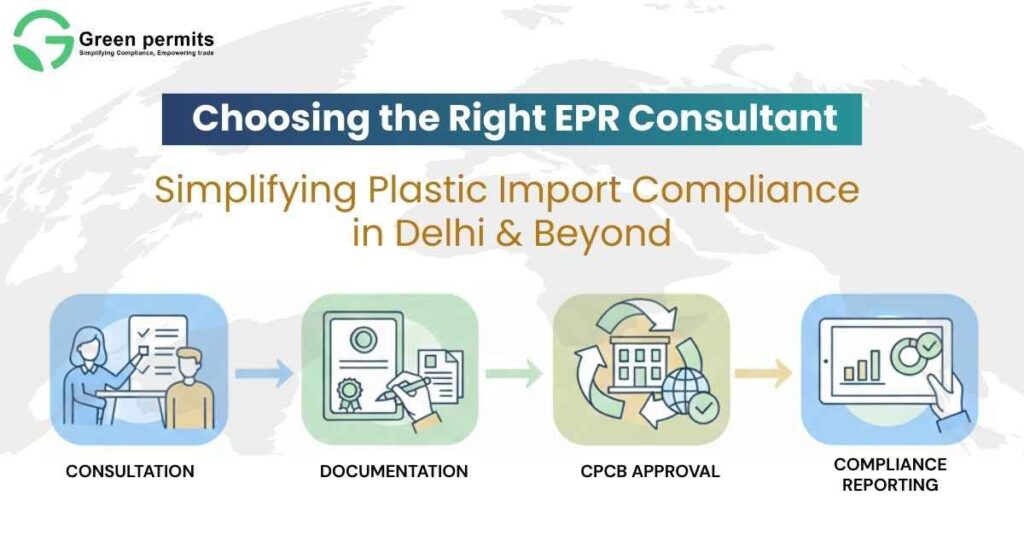
Compliance for plastic importers isn’t the same as compliance for domestic manufacturers.
Your obligations are based on:
A good EPR consultant for plastic importers helps you navigate all this without stress. Let’s break down what truly matters.
Before choosing a consultant, you must know what you’re hiring them for.
Importers have to register as PIBOs under CPCB and meet EPR targets based on the quantity of plastic packaging they import.
This includes:
Before we choose the right one, understand what choosing wrongly can cost.
An importer from Okhla lost ₹4.75 lakh in unnecessary warehousing charges because the consultant incorrectly filed the PWP certificate mapping. CPCB later issued a show-cause notice, and the importer spent another month resolving it.
When choosing your EPR consultant, evaluate them on the following:
Ask for past importer cases, especially those involving plastic packaging.
They should understand:
A consultant must be able to break down:
Especially during:
No hidden costs, no unclear PWP certificate pricing.
| Required Document | Purpose | Verification Requirement |
|---|---|---|
| GST Certificate | Confirms business details | Must match business address |
| IEC Certificate | Mandatory for importers | Verified with DGFT data |
| PAN & CIN | Legal identity | Must match GST details |
| Plastic packaging data | Used to calculate EPR target | Category-wise breakups needed |
| Sales/import invoices | Proof for annual return | Checked by CPCB during audits |
Interpretation: A consultant must cross-verify each detail; mismatches lead to registration rejection.
| Violation | Business Impact | Potential Penalty |
|---|---|---|
| Import without EPR Registration | Shipment hold or detention | EC based on qty + daily penalty |
| Wrong category filing | Incorrect EPR targets | Additional EC burden |
| Missing annual return | Default record with CPCB | No renewal until fixed |
| Insufficient PWP certificates | Target shortfall | EC per kg shortfall |
Interpretation: A consultant who understands penalties protects you from avoidable financial losses.
A plastic granule importer from Rohini reached out after two rejected CPCB applications. The issue?
His previous consultant uploaded mismatched GST and PAN data.
A senior consultant reviewed the documents, corrected the inconsistencies, revised the plastic category selection, and the importer was approved within 9 working days.
The client now files returns on time and has avoided three potential EC penalties.
If you operate in Delhi NCR, a Delhi-based consultant offers:
This geographic advantage can reduce approval timelines.
Use this practical list:
If the answer isn’t yes to all of these, keep searching.
Choosing the right EPR consultant for plastic importers is not just about documentation — it’s about securing your supply chain, preventing customs delays, and ensuring CPCB compliance without stress.
Businesses that invest early in professional compliance support:
If you want to simplify your plastic import compliance — the right consultant can make all the difference.
📞 +91 78350 06182
📧 wecare@greenpermits.in