
When Ravi, a mid-sized importer from Mumbai, brought in his first container of refurbished laptops, everything looked perfect on paper — IEC in place, GST active, packaging correct, and a reliable foreign supplier. But when the consignment reached the port, Customs raised a compliance query: “Please provide CPCB EPR Registration details.”
This was the first time Ravi had ever heard of EPR registration. The delay cost him two weeks and a significant demurrage fee. Like thousands of importers, he discovered late that India’s E-Waste Management Rules treat every importer of electrical or electronic devices as a Producer, and registration with CPCB is mandatory before any commercial sale.
This guide simplifies the entire process so you can avoid the confusion and financial loss that many importers face when they approach EPR compliance for the first time.
Most importers assume that EPR rules only apply to manufacturers or big tech brands. However, the E-Waste Management Rules make it explicit: the moment you import an electrical or electronic equipment (EEE), you become a Producer under Indian law.
That includes:
As a Producer–Importer, you automatically take on responsibilities like:
Ignoring registration is risky. It may lead to:
This is why early registration is not only a regulatory requirement but also a strategic business decision.
Before logging into the portal, importers should gather certain documents and data. Preparation significantly reduces rejection chances because CPCB performs strict verification.
These documents help CPCB verify your legal standing:
Having consistent business addresses across GST, IEC, CIN, and your EPR registration is crucial. Most delays occur because the corporate office address varies across documents.
Importers must correctly select:
These inputs directly affect EPR targets and audit evaluations.
One of the most critical steps involves uploading year-wise import data:
Importers often make the mistake of uploading “unit-based” data. CPCB only accepts weight-based data.
The portal requires:
Importers must be careful: a product booklet that does not mention ROHS becomes grounds for application rejection.
Preparing these items upfront reduces the number of “shortcoming reports” from CPCB.
Understanding the portal flow helps importers avoid unnecessary confusion.
The EPR portal is built to:
For importers, the portal:
This is why accuracy is more important than speed. A mistake in brand selection or wrong EEE code can cause weeks of delay.
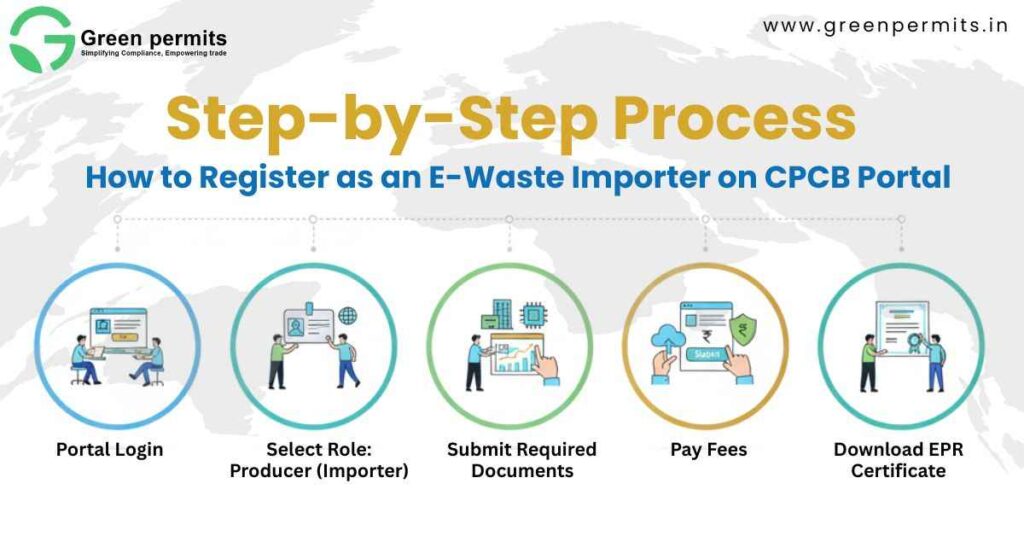
Below is the most importer-friendly breakdown available, prepared to minimize rejection.
Go to the CPCB E-Waste Portal and click on “Producer Registration.”
You must enter:
Importer Note:
If your IEC address differs from GST or corporate address, update it first. CPCB checks for consistency.
Inside the application, fill in:
These details are used again during CA certification and registration evaluation.
A consistent and verifiable profile increases chances of a quick approval.
This is where importers select the products they deal in.
For foreign-branded products, the importer must list the original brand. For generic imports, select “No Brand.”
Selecting the correct EEE codes is extremely important because EPR targets are category-specific.
This is where most importers face challenges.
Example:
Laptops → 5-year lifespan
You must upload sales/import data for the last 5 financial years.
Importers must ensure the CA certificate is:
Any mismatch leads to immediate rejection.
The portal automatically generates a ROHS declaration form.
Importers must:
This confirms that products are free from restricted substances like lead, mercury, cadmium, and others.
This section is a mandatory requirement and is often underestimated.
Documents needed include:
A clean, PDF-based document set improves approval speed.
The fee is determined by your annual E-waste recycling target.
Here is the correct fee structure:
| Annual E-Waste Target | Registration Fee |
|---|---|
| < 50 MT | ₹2,500 |
| 50–100 MT | ₹7,500 |
| 100–1000 MT | ₹1,50,000 |
| 1000–5000 MT | ₹10,00,000 |
| >5000 MT | ₹15,00,000 |
| Newly started importers | ₹10,000 |
Payment is made through the secure gateway on the portal.
CPCB reviews:
If anything is missing, CPCB sends a shortcoming report.
You get approximately 7 days to respond.
A well-prepared file often gets approved in the first review cycle.
After successful review, CPCB issues:
This certificate is valid for five years.
Once approved, you must comply with ongoing responsibilities.
Registration is only the first step. Importers must maintain compliance continuously.
Importers must buy EPR recycling certificates from registered recyclers to meet yearly targets. These certificates correspond to the quantity of e-waste recycled on your behalf.
Deadline: 30 June every year
The return includes:
Some importers deal with rapidly moving products. The CPCB portal may require daily entry for specific categories.
You must keep:
Doing so may lead to penalties or cancellation.
This is the most common mistake. It changes the entire EPR calculation.
CPCB does not calculate weight for you.
IEC, GST, and CIN must align with portal details.
Every brand sold must be declared.
Without ROHS details, your application is incomplete.
The CA must certify weight, brand, and year-wise data.
E-Waste importer registration on the CPCB portal is more than a compliance step — it’s essential to running a legally secure and operationally smooth business. Importers who complete registration early:
Timely compliance isn’t just about avoiding trouble — it makes your import business more stable, predictable, and trustworthy.
📞 +91 78350 06182
📧 wecare@greenpermits.in
Book a Consultation with Green Permits
Let our experts prepare your documents, validate data, file your application, and guide you through every step until approval.