
When the founders of Voltora Energy Systems, a small EV component supplier in Bengaluru, decided to set up their own lithium battery plant, they imagined it would be a smooth transition from trading to manufacturing.
But three months later, they found themselves juggling land clearances, fire audits, CPCB registrations, and the complexities of choosing the right battery chemistry — all while trying to estimate the true cost of machinery and utilities.
Their struggle mirrors what hundreds of Indian entrepreneurs face today.
Lithium battery demand is growing rapidly, but the setup requirements are multi-layered, and a lot of crucial steps remain unclear to first-time manufacturers.
This guide breaks everything down — from land and project cost to technology selection, manpower, compliance, and EPR responsibilities — so that your plant starts right and stays compliant.
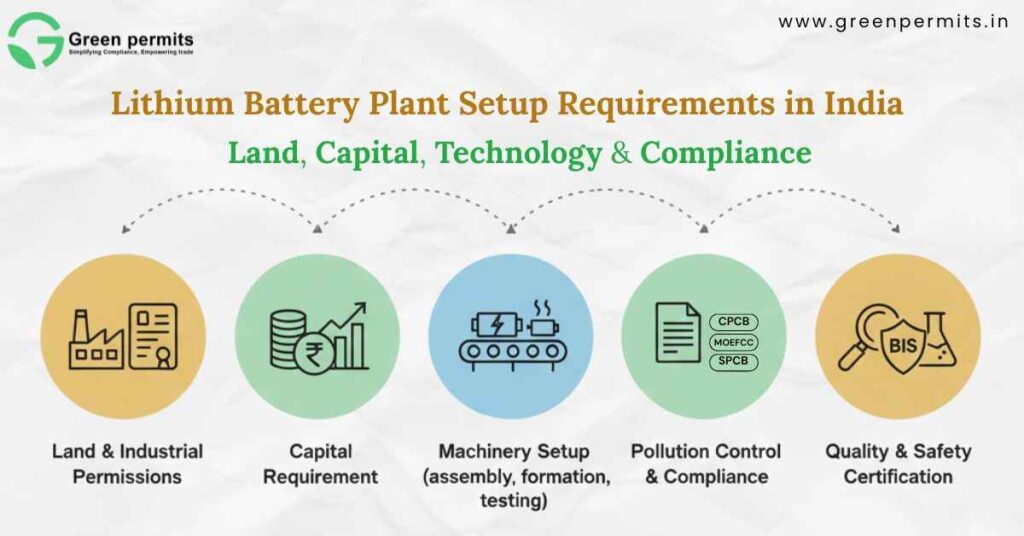
Choosing the right land is not just a real-estate decision — it is a regulatory requirement that affects your fire safety, pollution control permissions, factory license, and overall plant layout.
Lithium battery units fall under Red Category industries, which means state pollution boards require them to operate only inside approved industrial zones.
Setting up in agricultural, mixed-use, or residential spaces is usually rejected during the Consent to Establish (CTE) stage.
A lithium battery plant’s land requirement depends on:
| Type of Plant | Minimum Land Requirement | Additional Notes |
|---|---|---|
| Battery Pack Assembly | 20,000–40,000 sq ft | Suitable for MSMEs, low chemical handling |
| Lithium Cell Manufacturing | 2–5 acres | Requires dry rooms, electrode coating area |
| GWh ACC Cell Plants | 20–50 acres | High power load, chemical storage, logistics |
Interpretation:
Pack assembly units can work in smaller industrial plots, whereas cell plants demand vast, environmentally controlled spaces with precise zoning and chemical management.
Capital planning determines the long-term sustainability of your plant. Many businesses underestimate operational expenses — especially in testing, compliance, and dry-room maintenance.
Lithium battery plant investments fall under:
Machinery accounts for the largest share of CAPEX.
Pack unit machines cost only a fraction of full cell manufacturing lines.
Includes:
Covers:
| Cost Category | Pack Assembly Unit | Cell Manufacturing Unit |
|---|---|---|
| Land + Civil | ₹50 lakh – ₹2 crore | ₹10–50 crore |
| Machinery | ₹1.2–3 crore | ₹150–600 crore |
| Testing Lab | ₹20–40 lakh | ₹5–20 crore |
| HVAC/Dry Room | Minimal | ₹40–150 crore |
| Compliance + Licensing | ₹2–10 lakh | ₹25–75 lakh |
| Working Capital | ₹30–60 lakh | ₹10–30 crore |
Interpretation:
If you are entering the market for the first time, pack assembly is the logical starting point.
Cell manufacturing requires deep pockets, long-term planning, and high-level engineering capability.
Technology selection determines production efficiency, safety, and BIS conformity.
Popular chemistries in India:
Your choice influences:
Pack assembly units require:
This includes:
Why dry rooms matter:
Cell components react to moisture, so RH levels must stay below 1%, which requires advanced HVAC systems.
Compliance is the most critical — and commonly misunderstood — part of setting up a battery plant.
Obtained before construction begins.
Requires:
Approved after infrastructure completion.
Because lithium batteries fall under hazardous/other waste category and must be stored and disposed safely.
As per rules, all producers, manufacturers, and importers must register on CPCB’s Battery EPR Portal.
Key obligations:
Lithium cells and packs require:
You must obtain:
Interpretation:
A compliant plant does not just avoid penalties — it also builds trust with OEMs who demand strict quality and safety checks.
Lithium battery manufacturing is skilled work.
A capable team reduces wastage, improves productivity, and enables seamless audit management.
Note:
Many first-time founders hire only production staff. But as Voltora Energy Systems learned, a dedicated compliance supervisor often becomes the most valuable team member during SPCB inspections.
Lithium units depend heavily on stable utilities.
High power load requires:
Low for pack assembly
Moderate for cell production (mixing, cleaning, coolant systems)
Interpretation:
Utility planning must start early — poor power infrastructure delays machinery installation and CTO approval.
Missteps often delay a plant by months or trigger legal complications.
Setting up a lithium battery plant in India is a high-opportunity venture — but it demands clarity, planning, and strict compliance.
From choosing the right land to setting up advanced machinery, obtaining pollution permissions, registering on the CPCB EPR portal, and passing BIS tests, every step must be executed systematically.
The correct approach not only avoids penalties but positions your company as a trusted supplier in India’s booming EV and ESS market.
📞 +91 78350 06182
📧 wecare@greenpermits.in
Book a Consultation with Green Permits