
When Rajiv, a mid-sized metals trader from Gujarat, first heard about lithium battery recycling, he didn’t imagine chemistry, flow sheets, or CPCB filings. He imagined opportunity.
He had dealers bringing him EV packs and laptop batteries every week. Market reports were loudly predicting billion-dollar opportunities. Consultants said recycling margins could be impressive if he moved early. On paper, everything looked perfect.
Six months later, Rajiv was staring at a spreadsheet that told a very different story: higher capex than expected, fluctuating scrap prices, lower metal recovery, and EPR payments that weren’t coming in as quickly as he thought.
This blog is written for people like Rajiv — business owners, compliance heads, and investors who want a realistic, India-specific picture of how profitability actually works in lithium battery recycling.
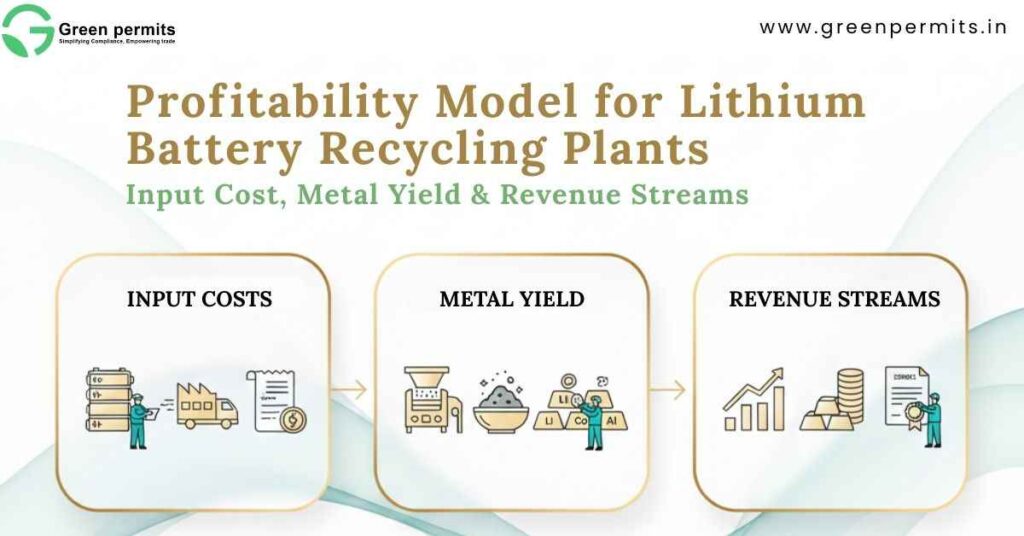
The last five years have seen a surge in India’s EV adoption, energy storage installations, and electronics consumption. All of these industries rely on lithium-based batteries, and all of them will eventually generate end-of-life waste that must be recycled in a compliant manner.
A few key trends shaping return on investment:
But large opportunity does not automatically mean good returns. Lithium battery recycling is an industrial business; it depends on technology choices, metal yield, working capital, compliance, and pricing discipline.
A reliable financial model begins with an honest look at what a plant costs to build and operate in India.
A typical 5,000–10,000 TPA integrated lithium battery recycling plant may include:
Depending on technology and scale, such a plant in India can require ₹120–300 crore.
Costs increase if:
Major recurring expenses include:
Accurate OPEX estimation matters because even small variations in scrap cost, chemical consumption, or power tariffs can shift ROI significantly.
Working capital is often underestimated in feasibility studies. In practice:
A prudent model keeps 2–3 months of operating costs available as working capital.
Your revenue isn’t driven by tonnage of batteries; it comes from kilograms of recoverable metals.
Different chemistries (LFP, NMC, NCA, LCO) contain different amounts of valuable metals:
Hydrometallurgical plants with good controls typically target 90–95% recovery efficiency for many metals. Lower efficiencies directly reduce revenue.
If your plant processes 10,000 tonnes annually, even a 5% drop in recovery efficiency can reduce topline revenue by crores of rupees each year.
This is why skilled operators, good labs, and stable process control matter as much as the machinery itself.
A well-rounded profitability model should account for multiple income streams:
Many starter plants only dismantle and shred batteries, selling black mass to refiners.
Pros: lower capex
Cons: lower margin
Higher-value outputs such as:
Pros: much higher margins
Cons: higher capex, more process complexity
OEMs and importers may pay recyclers:
This stabilises revenue even when metal prices fluctuate.
Under India’s battery waste rules, producers must meet recycling targets using certificates issued by registered recyclers.
For recyclers, this means:
A well-run recycler can integrate EPR-linked payments as a predictable revenue source.
| Parameter | Estimate | Business Insight |
|---|---|---|
| Total Indian battery recycling market (2025) | Moderate but growing | Early entrants can secure supply chains |
| Market by 2030 | Significantly larger due to EV growth | Demand will exceed current processing capacity |
| Cost of recycled metals vs virgin | Recycled metals often cheaper and domestically available | Strong buyer interest from cell manufacturers |
| Volume of end-of-life batteries | Rising sharply post-2027 | Feedstock reliability improves long-term |
Interpretation:
The ecosystem is expanding. Regulatory pressure and domestic manufacturing targets will push more batteries into compliant recycling channels, creating room for multiple scalable plants.
This is a simplified example to explain how ROI is typically evaluated.
| Cost/Revenue Item | Indicative Value | Notes |
|---|---|---|
| Input capacity | 10,000 TPA | Full utilisation by Year 3 |
| Total CAPEX | ₹220 crore | Integrated dismantling + shredding + refining |
| Scrap cost | ~₹35,000/tonne | Varies with chemistry and region |
| OPEX (exc. scrap) | ~₹35,000–40,000/tonne | Power, chemicals, labour |
| Metal recovery revenue | ₹90,000–1,10,000 per tonne of input | Sensitive to metal prices and yield |
| EBITDA | ₹15–30 crore annually | Depends on reliability of operations |
| Payback | 5–8 years | Shorter with incentives & OEM contracts |
Takeaway:
Battery recycling is profitable when recovery efficiency, feedstock security, and compliance-linked premiums are managed well. It is not a quick-turnover business; it behaves like a long-term industrial asset.
The rules create compliance responsibilities but also commercial advantages.
Producers must use registered recyclers to meet their recycling targets.
Producers value recyclers who provide:
This allows recyclers to negotiate better terms compared to informal handlers.
Every model must include:
These costs are manageable but must not be ignored, because suspension or delays can directly impact revenue.
OEM contracts and collection partnerships stabilise volume.
Some start with dismantling + black mass, then expand to hydrometallurgy.
Yield improvement by even a few percentage points has major financial impact.
Proper reporting and transparent documentation allow recyclers to negotiate better commercial terms.
Government incentives for critical mineral recycling, once active, can cut payback periods.
Some situations are financially risky:
Being realistic from the beginning prevents expensive mistakes.
Lithium battery recycling in India offers strong long-term potential, but profitability depends on disciplined execution.
A well-designed project with transparent operations, secure feedstock, solid recovery efficiency, and professional compliance management can achieve healthy returns.
If you want help building a custom ROI model, evaluating technology options, or preparing for CPCB registration, our team works with recyclers across India.
📞 +91 78350 06182
📧 wecare@greenpermits.in
Book a Consultation with Green Permits