
When entrepreneurs speak to us about entering the recycling business, their motivation often isn’t philosophical. It’s practical. One client from Nashik put it perfectly during our first conversation:
“There is plastic everywhere, but good recyclers are rare. Surely there’s an opportunity in that gap?”
He wasn’t wrong. Maharashtra produces some of India’s highest volumes of plastic waste and has one of the most structured industrial ecosystems to support recycling. Yet many capable business owners hesitate because the compliance path seems confusing.
This guide explains the business, regulatory, and financial aspects of setting up a plastic recycling plant in Maharashtra—without long jargon or fragmented information.
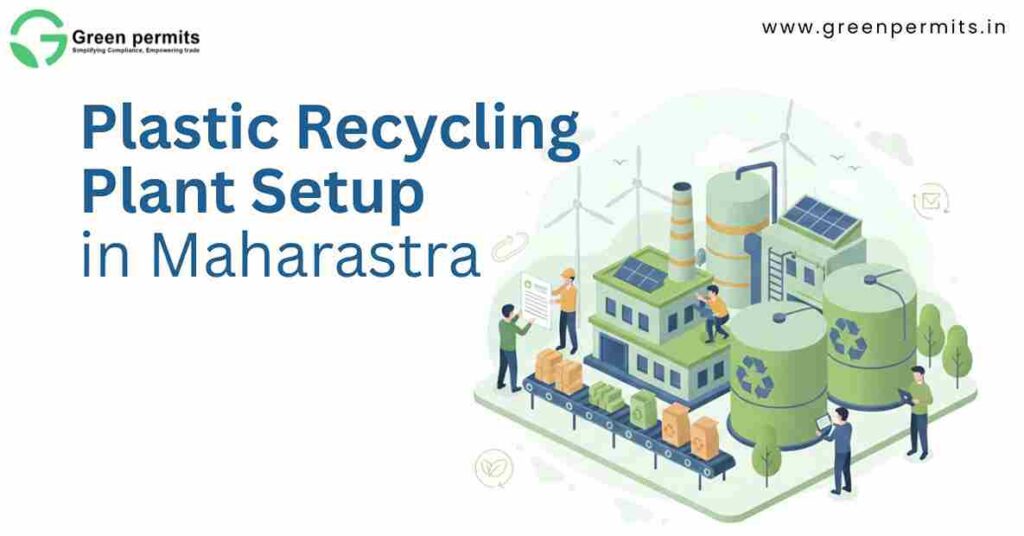
Plastic recycling is not merely a sustainability-driven sector; it is a business with strong market demand. Maharashtra, in particular, presents a unique combination of waste availability, industrial consumption, and government support.
The state’s urban density creates a constant flow of collectable post-consumer waste. Simultaneously, Maharashtra hosts thousands of FMCG, packaging, logistics, and retail-based companies that urgently need recycled content for packaging to meet their EPR targets.
For a recycling unit, the biggest risk is inconsistent scrap inflow. Maharashtra reduces this risk significantly due to its integrated waste supply chain, dense municipal collection systems, and strong private scrap networks.
One of the biggest advantages Maharashtra offers is the extensive MIDC ecosystem with specialised industrial clusters designed to host manufacturing and processing units.
A recycling unit must be housed in an area that:
These areas have proven advantageous for existing recyclers:
Taloja MIDC (Navi Mumbai)
Suited for PET and HDPE recycling due to proximity to wholesalers, large FMCG units, and exporters.
Ambernath & Dombivli MIDC
Favoured for more complex recycling processes such as MLP, LDPE film, and industrial waste.
Ranjangaon MIDC (Pune District)
Ideal for granule manufacturing and PET washing lines with rapid access to packaging units.
Butibori MIDC (Nagpur)
An excellent central location that optimizes procurement from Vidarbha and distribution across the state.
| District | Estimated Plastic Waste Availability | Suitability |
|---|---|---|
| Mumbai Metropolitan Region | Highest in state | PET, LDPE, MLP recycling |
| Pune | Consistent with high expansion potential | HDPE, LDPE |
| Nagpur | Stable scrap flow | Mixed plastics & MLP |
| Nashik | Growing industrial waste | PET & HDPE |
| Aurangabad | Balanced municipal + industrial waste | Multi-category processing |
Business insight: Setting up near major collection centres often reduces raw material costs by 20–30%.
A profitable recycling business starts with a predictable and affordable scrap supply. Maharashtra’s informal and formal networks provide both.
Cities like Mumbai, Pune, Nagpur, Nashik, and Thane have dense networks of:
They supply:
Industrial scrap offers higher purity and consistency. Key sources include:
Industrial scrap often commands higher prices but significantly reduces cleaning and processing costs.
Under EPR obligations, brands and PIBOs must channel recyclable plastic to authorized PWPs.
This allows recyclers to:
- Business relevance: Long-term scrap contracts stabilize cost structure, which is crucial for maintaining margins.
The most common cause of delay for new plants is incomplete compliance documentation. Maharashtra’s regulatory framework is structured but must be followed sequentially.
A plant typically requires:
| Approval | Authority | Purpose |
|---|---|---|
| Consent to Establish (CTE) | Maharashtra Pollution Control Board | Approval prior to construction and machinery installation |
| Consent to Operate (CTO) | MPCB | Permission to operate after installation |
| Factory License | Directorate of Industrial Safety & Health | Worker safety and operational compliance |
| Udyam Registration | MSME | Eligibility for subsidies |
| Trade License | Local Municipal Authority | Local operational permissions |
| Fire NOC | Fire Department | Mandatory for all industrial units |
| PWP Registration (Plastic Waste Processor) | CPCB/SPCB Portal | To issue EPR certificates |
A practical approach is to prepare a documentation checklist before starting the approval process to avoid back-and-forth with MPCB.
The cost of setting up a recycling unit depends on:
| Plant Capacity | Machinery Cost | Infrastructure & Utilities | Total Estimated CAPEX |
|---|---|---|---|
| 1 TPD | ₹35–45 lakh | ₹15–20 lakh | ₹50–65 lakh |
| 2–3 TPD | ₹60–90 lakh | ₹30–40 lakh | ₹1–1.25 crore |
| 5 TPD | ₹1.2–1.5 crore | ₹40–60 lakh | ₹1.7–2.1 crore |
Recurring monthly costs include:
Plastic recycling margins depend heavily on material type:
A well-run unit generally achieves payback within 18–30 months, depending on capacity and operational efficiency.
Maharashtra’s industrial policies classify waste management units as “Green Businesses,” enabling them to access incentives not available to typical MSMEs.
Entrepreneurs can access:
These benefits are higher for units located in less-developed district categories.
Incentives directly reduce upfront financial burden and improve long-term profitability.
A recycling plant can sell to multiple industries:
Under the EPR framework:
A recycler who is fully compliant gains access to these high-value buyers.
Unlike many industries, demand for recycled material does not fluctuate sharply because EPR obligations must be met annually.
Environmental compliance is non-negotiable in Maharashtra. The MPCB has been strict with inspections, and lapses can halt operations immediately.
Recycling plants must ensure:
A small PET recycler in Thane had a complete halt of operations for 22 days because their ETP plumbing was not aligned with the original MPCB-approved layout. Even after rectification, the resumption approval took time—resulting in business loss and missed contracts.
This reinforces the importance of maintaining compliance from Day 1.
Choose an MIDC-approved industrial plot that permits recycling activities.
Submit detailed project reports, machinery specs, process flows, and site photos.
Ensure:
MPCB verifies machinery installation, ETP setup, and compliance.
This allows you to generate and sell EPR certificates.
Document daily scrap inflow and processed quantities for smooth EPR return filing.
Stable inflow and steady buyers ensure financial predictability.
Few states offer such a powerful mix of waste availability, industrial demand, and compliance structure. Maharashtra is particularly suitable for entrepreneurs who want a business that is stable, scalable, and future-ready.
The pathway requires careful attention to environmental norms, but units that operate professionally and maintain complete documentation consistently benefit from long-term buyer relationships and premium EPR demand.
For anyone planning to invest in recycling, Maharashtra is one of the most reliable markets to begin with.
For expert assistance with MPCB approvals, PWP registration, or complete compliance documentation, you can reach our team:
+91 78350 06182
wecare@greenpermits.in
Book a Consultation with Green Permits