
Amit Singh, founder of EcoCycle Plastics Pvt. Ltd., didn’t plan on entering the recycling business. His small trading company in Patna relied heavily on imported plastic granules, but rising raw material prices pushed him to explore alternatives. After speaking with manufacturers across Bihar, he realized a surprising truth — the state generates far more recyclable plastic waste than the number of operational recycling units.
Yet Amit still spent six months figuring out approvals, choosing machinery, and understanding Bihar-specific norms because every article he found online showed only generic national-level guidance.
If you are in the same situation — curious, motivated, but unsure about the exact process — this guide brings you state-specific clarity on how to set up a plastic recycling plant in Bihar with fewer delays and more confidence.
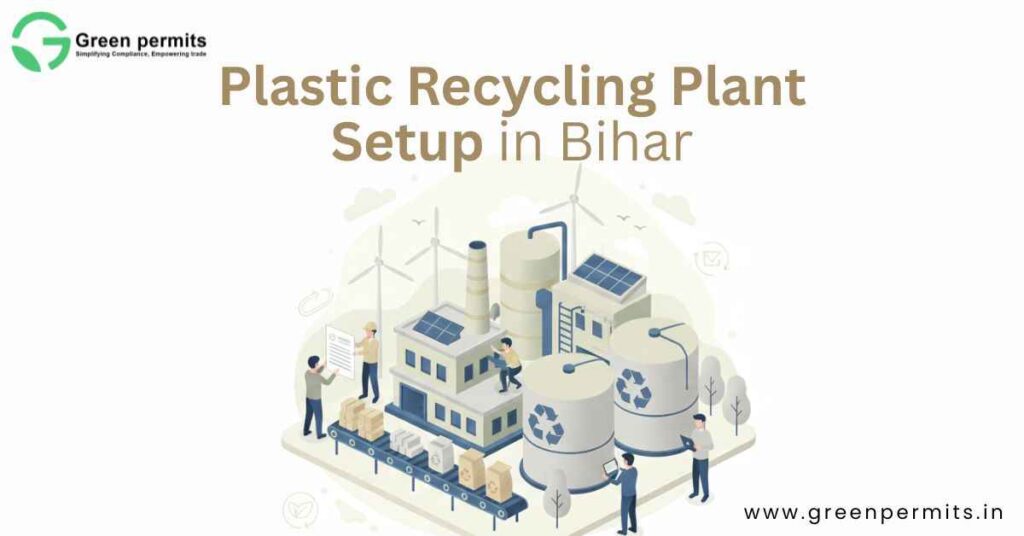
Bihar has undergone steady industrialisation in the past decade, driven by infrastructure expansion, FMCG penetration, and agricultural packaging needs. These activities naturally increase the volume of plastic waste generated in both urban and semi-urban districts.
Bihar’s recycling sector is still in a growth phase. While states like Maharashtra, Tamil Nadu, and Gujarat have a mature recycling ecosystem, Bihar stands out for a different reason — demand is rising faster than supply.
A few compelling reasons behind this shift include:
With local demand for recycled granules increasing and most buyers still dependent on neighbouring states, Bihar creates a unique advantage for new recycling units to fill the gap.
Choosing the right industrial zone is one of the most important decisions in the setup journey because it impacts raw material sourcing, electricity availability, workforce access, and transportation costs.
Here are locations that offer supportive infrastructure for setting up a recycling plant:
Bihta (Patna):
A rapidly developing industrial cluster with excellent road connectivity, skilled labour access, and proximity to scrap aggregators.
Hajipur Industrial Area (Vaishali):
Well-connected through rail and road, ideal for SME-scale recycling units looking for efficient distribution to nearby districts.
Barauni (Begusarai):
Close to petrochemical facilities, this area is emerging as a preferred location for plastic-related industries.
Fatuha Industrial Area:
Known for MSME clusters, making it suitable for recycling units needing easy worker availability and affordable land.
Gaya Industrial Estate:
Supports easy procurement of semi-urban waste streams and acts as a distribution point to South Bihar.
Bihar’s scrap generation is stronger than most new entrepreneurs assume. The supply ecosystem includes both structured and informal networks.
Most scrap originates from daily municipal operations and the kabadi network. A strong recycler builds relationships across both — ensuring steady supply, even during seasonal fluctuations.
Bihar’s plastic consumption grows annually, particularly due to agriculture and FMCG packaging. This ensures consistent availability of scrap year-round, supporting plant utilization.
A significant challenge for new entrepreneurs is navigating compliance. However, when properly sequenced, approvals move smoothly without unnecessary delays.
Plastic recycling requires clearance from Bihar State Pollution Control Board:
1. CTE – Consent to Establish
Must be obtained before installing machinery.
2. CTO – Consent to Operate
Required before starting commercial production.
3. PWP Registration
This is Plastic Waste Processor Registration under Plastic Waste Management Rules, ensuring recyclers can legally sell EPR credit-linked certificates.
Failing to register as a Plastic Waste Processor (PWP) or operating without CTO can lead to:
One recycler in North Bihar expanded his machine capacity without updating the CTO. During inspection, the unit was asked to halt operations. Close to three weeks of downtime led to a major loss in supply contracts and working capital stress.
Correct sequencing of approvals prevents such setbacks.
Understanding capital and operational expenses helps determine the plant scale and financial feasibility.
A medium-scale recycling plant (300–500 kg/hr) generally requires:
Plants in Bihar, due to lower labour and rental costs, often achieve higher margins compared to similar setups in metropolitan states. Once optimized, net profitability ranges between 8–12% on average, with break-even achievable within 18–30 months based on capacity utilization.
Bihar’s industrial policies are significantly supportive toward MSMEs, including recycling units.
These benefits reduce the effective cost of setting up the plant:
For many recycling units, capital subsidy alone reduces the payable loan amount by 20–30%. This directly improves cash flow stability and accelerates break-even timelines.
The demand ecosystem in Bihar is strengthening due to rapid growth in packaging, agriculture, and FMCG distribution.
Under EPR norms, companies must buy recycled plastic certificates from registered recyclers. This increases the demand for certified recycling output and creates stronger long-term buyers for your plant.
To operate sustainably and without disruption, adopt the following practices from day one:
A disciplined compliance approach ensures uninterrupted plant operations and builds trust with buyers.
Setting up a recycling plant becomes far smoother when you follow a structured, sequential approach.
Many successful recyclers build efficiencies over time rather than investing heavily in the first stage.
Bihar presents a compelling combination: stable raw material availability, expanding industries, lower competition, supportive subsidies, and direct access to neighbouring markets. For entrepreneurs willing to approach the process methodically — with proper approvals, strong supplier networks, and a clear business model — Bihar offers an excellent environment to build a long-term, profitable recycling enterprise.
Need expert help with Pollution Control Board approvals, PWP registration, or plant setup documentation?
We support entrepreneurs with complete compliance management and faster approvals.
📞 +91 78350 06182
📧 wecare@greenpermits.in
Book a Consultation with Green Permits