
A few months ago, a Jaipur-based fleet owner told us something striking:
“I was spending more money keeping my 15-year-old trucks alive than earning from them.”
When he explored replacing them, he discovered Rajasthan’s evolving scrapping ecosystem — new RVSF facilities, government incentives, and district-level waste-to-wealth plans.
But he quickly realized: setting up a scrapping plant is not about cranes and cutters — it’s about compliance, sourcing, and state-specific opportunities.
This guide is written for founders like him who want clarity before investing.
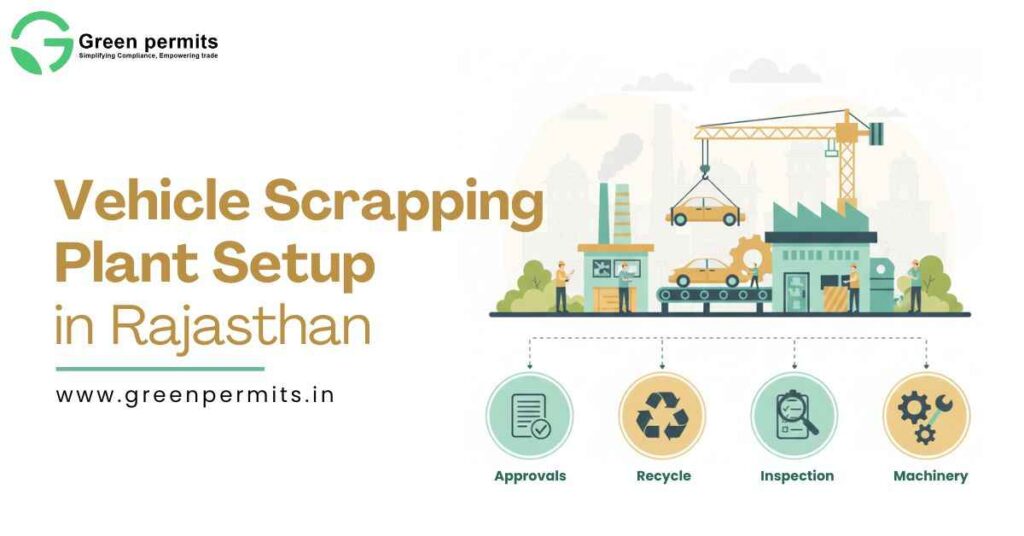
Rajasthan has long been known for its industrial belts — from the automotive clusters of Bhiwadi–Neemrana to the transport-heavy hubs of Jaipur, Jodhpur, and Alwar. In recent years, rising ELV (End-of-Life Vehicle) volumes and the Rajasthan Vehicle Scrap Policy announcement under the Green Budget 2025 have created a powerful momentum for formal scrappage businesses.
Rajasthan is shifting from informal yards to RVSF-compliant, safe, and profitable scrapping units — making this the right time for investors to enter.
Each region offers unique sourcing and operational advantages.
Located along the Delhi–Mumbai Industrial Corridor, these zones offer:
Your goal is to balance ELV sourcing, outbound scrap buyers, land cost and regulatory approvals. Proximity to OEMs, fleet hubs and scrap consumers (steel mills, foundries) dramatically improves ROI.
Most new RVSF investors underestimate sourcing. In Rajasthan, sourcing strengths come from:
Build pre-signed Memoranda with transport unions, OEM dealerships, government depots, and use digital lead-generation for individual owners.
Setting up an RVSF requires compliance under:
(3–5 line intro)
Every RVSF must align with MoRTH Vehicle Scrapping Facility Rules, state pollution norms, and district-level approvals. Missing even one mandatory clearance can stall operations or trigger penalties.
Investment varies by capacity — generally ₹50 lakh to ₹5 crore for small to mid-scale facilities across India (SERP-confirmed ranges).
Below is a Rajasthan-specific planner:
| Component | Small RVSF (1 TPD) | Mid RVSF (3 TPD) | Large RVSF (5 TPD+) |
|---|---|---|---|
| Land (1–5 acres depending on scale) | ₹20–60 lakh | ₹1–2 crore | ₹2–4 crore |
| Machinery: depollution, dismantling, cranes | ₹25–40 lakh | ₹60–90 lakh | ₹1.2–2 crore |
| Compliance + registration + audits | ₹5–10 lakh | ₹10–15 lakh | ₹20+ lakh |
| Total Estimated CAPEX | ₹50–90 lakh | ₹1.7–3 crore | ₹3.5–6 crore |
Interpretation: Even a 1–TPD unit is capital-intensive because it must meet RVSF safety & environmental norms, not just dismantling.
Rajasthan’s Green Budget 2025 and upcoming Vehicle Scrap Policy support circular economy projects.
While the state has not published a dedicated scrappage-incentive structure yet, early RVSF applicants benefit from easier approvals and market capture.
Scrapping generates four major revenue streams:
High demand from rolling mills in Mandi Govindgarh, Alwar, Bhiwadi.
Strong margins — used by auto component and utensil industries.
Tyres, catalytic converters, batteries yield significant returns.
Rajasthan’s massive government ecosystem ensures steady annual auction cycles.
Compliance is the backbone of an RVSF. The 2021–2024 MoRTH rules specify strict operational, safety, and environmental protocols.
A Rajasthan dismantling yard saw its operations halted when RSPCB found leakage of coolant and improper hazardous waste storage — leading to license suspension and loss of OEM contracts.
This is avoidable by following proper depollution SOPs.
(3–5 line intro)
Starting an RVSF requires a structured roadmap that aligns land acquisition, approvals, machinery installation and compliance workflows. The sequence matters — skipping steps can delay registration.
Rajasthan’s industrial growth, rising ELV volume, and the state’s push for greener infrastructure make RVSF units one of the most promising recycling investments today.
Investing early means securing long-term fleets, dealership tie-ups, and government recycling contracts.
With the right site, compliance strategy, and machinery planning, entrepreneurs can build a profitable, sustainable vehicle scrapping plant that aligns with India’s circular economy goals.
Need help setting up your RVSF in Rajasthan?
Green Permits assists with RSPCB approvals, RVSF registration, machinery planning, layout design, and compliance audits.
📞 +91 78350 06182
📧 wecare@greenpermits.in