
You’ve done everything right.
Your product is compliant, packaging looks good, sales are growing — and then a notice from CPCB or a question from an investor stops you cold:
“Do you have EPR registration?”
Most business owners don’t ignore EPR intentionally. They simply assume waste rules apply to someone else — recyclers, municipalities, or large manufacturers. This guide exists to remove that confusion and help you understand what EPR really means for your business in India.
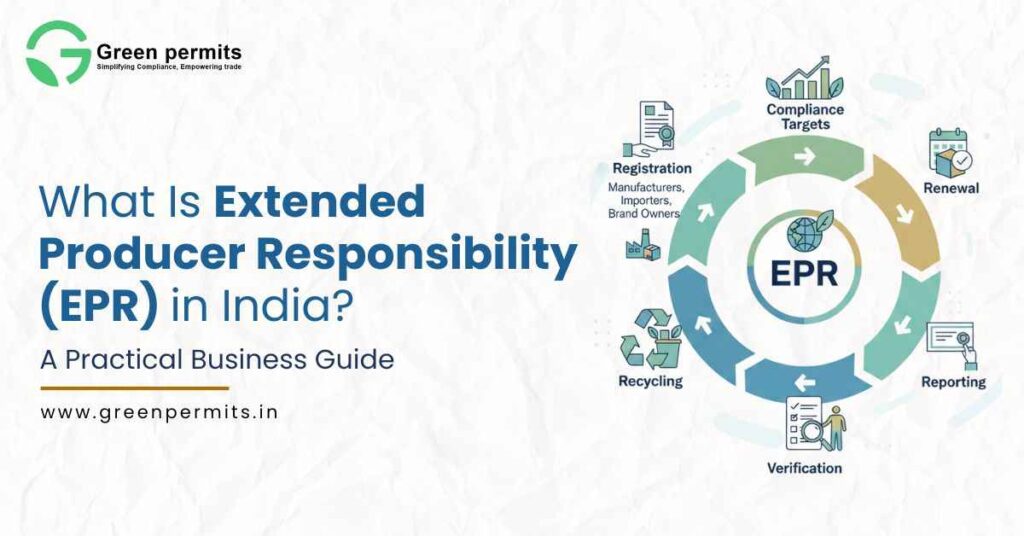
Extended Producer Responsibility (EPR) is a statutory obligation that makes producers responsible for managing the post-consumer waste generated from the products they introduce into the Indian market.
In practical business terms, EPR means:
EPR is enforced under the Environment (Protection) Act, 1986 through rules notified by MoEFCC and implemented by CPCB.
Business relevance:
EPR compliance directly affects your ability to sell, import, expand, and raise capital.
India’s waste problem is no longer manageable through municipal systems alone. Plastic waste, e-waste, and battery waste have grown faster than recycling infrastructure.
EPR was introduced to:
For businesses, this marks a clear shift: environmental compliance is now a core operational responsibility, not a CSR initiative.
One of the biggest misconceptions is that EPR applies only to large manufacturers. In reality, many SMEs and importers fall under EPR without realizing it.
If your product generates plastic, electronic, or battery waste, EPR likely applies — regardless of turnover.
Plastic EPR applies to any entity introducing plastic packaging into the market.
This includes:
Business obligation:
Meet annual recycling targets based on the quantity of plastic introduced.
E-waste EPR applies to producers of electrical and electronic equipment (EEE).
Covered categories include:
Business obligation:
Ensure end-of-life recycling through CPCB-authorized recyclers and meet assigned EPR targets.
Battery EPR applies to:
Business obligation:
Fulfil material-wise recycling targets and submit EPR certificates annually.
| Authority | Role in EPR |
|---|---|
| MoEFCC | Policy formulation & rule notifications |
| CPCB | Central registration, portals, enforcement |
| SPCB / PCC | State-level monitoring & inspections |
| Authorized Recyclers | Issue EPR certificates |
Interpretation for businesses:
EPR compliance is centrally tracked and digitally auditable. There is no room for informal shortcuts.
After registration, EPR becomes a recurring compliance cycle.
Missing any step can result in portal blocks or compliance notices.
| EPR Category | Registration Validity | Typical Cost Range |
|---|---|---|
| Plastic EPR | 1–3 years | ₹10,000 – ₹50,000 |
| E-Waste EPR | 5 years | ₹15,000+ |
| Battery EPR | 5 years | Turnover-based |
What this means:
EPR is far more affordable when planned early than when addressed after penalties or business disruptions.
Many businesses only take EPR seriously after a problem arises.
A practical example:
An electronics importer delayed EPR registration assuming distributors were responsible. During customs clearance, missing EPR details triggered verification — delaying shipments and causing avoidable financial losses.
EPR compliance failures usually stem from misunderstanding, not intent.
Businesses that plan EPR early:
EPR done proactively is manageable. EPR done reactively is expensive.
At Green Permits Consulting, we work with manufacturers, importers, startups, and global brands to:
Our role is to ensure EPR never becomes a business disruption for you.
EPR in India is not an environmental trend — it is a core regulatory requirement that directly affects your ability to operate.
Ignoring it creates risk.
Addressing it early creates stability, predictability, and compliance confidence
📞 +91 78350 06182
📧 wecare@greenpermits.in