
An electronics brand had just scaled operations across multiple Indian states. Sales were growing, distributors were aligned, and marketing was on track. Then an unexpected email from the CPCB portal landed in the founder’s inbox.
The message was simple but unsettling: EPR compliance pending. Returns incomplete. Action required.
Nothing illegal had been done intentionally. The problem was confusion. Like many businesses, they assumed EPR was a one-time registration exercise. What followed was weeks of back-and-forth, portal clarifications, and growing anxiety about penalties.
This is a familiar situation for many Indian manufacturers, importers, and brand owners dealing with EPR compliance.
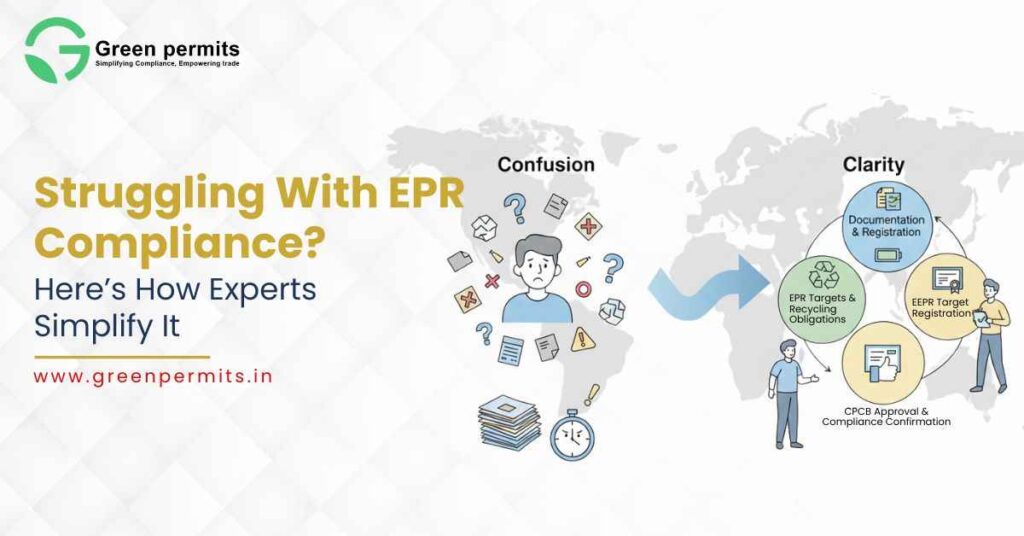
EPR compliance doesn’t feel difficult because business owners lack intent. It feels difficult because the system was never designed with business workflows in mind.
Most founders and compliance heads discover EPR obligations only after operations are already underway. By then, multiple responsibilities overlap, and the learning curve becomes steep.
What adds to the pressure is that EPR compliance sits outside daily operations but carries serious regulatory consequences.
Businesses often struggle because:
When compliance feels unclear, even well-run businesses start feeling exposed.
A common misconception is that EPR compliance ends once registration is approved. In practice, registration is just the entry point.
EPR is a continuous responsibility that follows your business year after year.
Once registered, businesses must:
Each of these steps depends on the previous one being done correctly. When even one element is missed, the entire compliance chain becomes fragile.
EPR non-compliance rarely starts with penalties. It usually starts with silence.
No follow-ups, no reminders — until enforcement catches up.
Businesses often underestimate the downstream impact of small mistakes made early in the compliance process.
| Compliance Gap | What It Means for Business |
|---|---|
| Incomplete registration | Delayed operations |
| Incorrect filings | Return rejection |
| Missed targets | Financial penalties |
| Outdated information | Legal notices |
| Poor recordkeeping | Audit complications |
The cost is rarely just financial. It includes lost time, internal stress, and distraction from growth.
EPR experts don’t replace the law. They translate it into something businesses can actually execute.
Instead of leaving companies to interpret regulations on their own, experts bring structure, predictability, and clarity to the process.
In practice, this means:
The result is not just compliance, but confidence. Businesses know where they stand and what comes next.
Many companies start EPR compliance internally, often as an extension of legal or accounts teams. While this can work in simple cases, complexity increases quickly as business scales.
| Area | Internal DIY | Expert-Led |
|---|---|---|
| Rule interpretation | Time-intensive | Clear guidance |
| Documentation | Rework common | Validated upfront |
| Portal handling | Learning curve | Managed end-to-end |
| Risk exposure | Higher | Controlled |
| Long-term effort | Unpredictable | Structured |
What businesses often realize later is that expert involvement reduces effort rather than adding cost.
A growing importer completed EPR registration but overlooked annual returns, assuming registration alone ensured compliance.
Two years later, notices arrived covering multiple financial years, along with penalty calculations.
Resolving the issue required:
What could have been routine compliance became damage control.
When experts are involved early, compliance becomes a system instead of a struggle.
Businesses benefit from:
Early clarity almost always costs less than late correction.
EPR compliance is not about filling forms or reacting to notices. It’s about creating a stable, repeatable system that protects your business.
When managed properly, EPR becomes predictable.
When ignored or misunderstood, it becomes a risk.
The difference lies in how early and how well the process is handled.
📞 +91 78350 06182
📧 wecare@greenpermits.in