
Environmental compliance has quietly become one of the most critical risk parameters in investor due diligence. In India, where environmental regulations are closely monitored by multiple authorities, even small compliance gaps can raise serious concerns during funding, mergers, or acquisitions.
For investors, environmental compliance is not just about legality—it reflects how prepared, scalable, and reliable a business truly is.
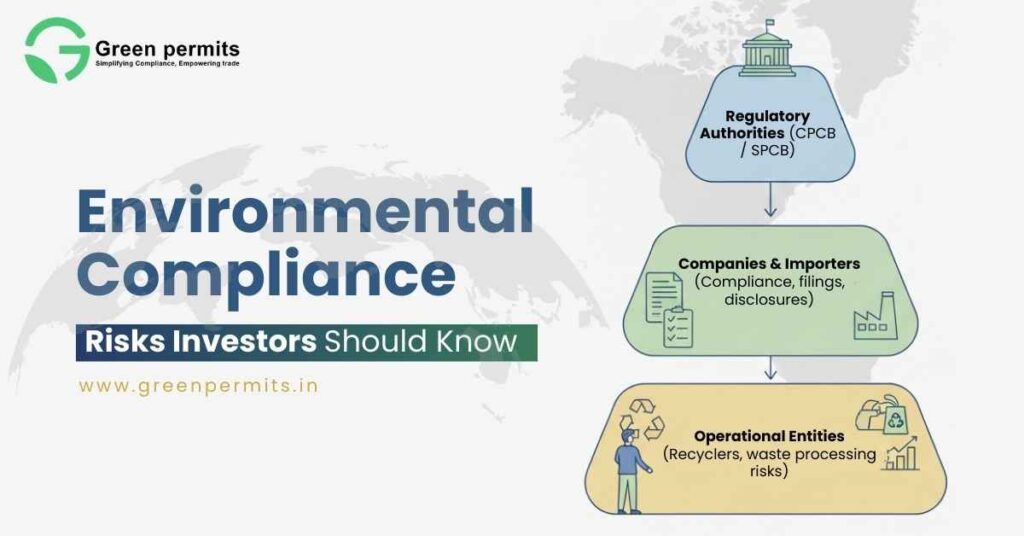
Investors evaluate risk through predictability. Environmental non-compliance introduces uncertainty that directly impacts business continuity, growth plans, and exit timelines.
When compliance is unclear or incomplete, investors begin to factor in:
A business that appears profitable today but vulnerable to regulatory disruption tomorrow is rarely considered investment-ready.
One of the first things investors review is whether a company is legally permitted to operate as it currently does.
Common approval-related issues include:
Even when physical operations are running smoothly, missing approvals signal governance gaps. For investors, this raises doubts about internal controls and compliance discipline.
Extended Producer Responsibility (EPR) has become a major checkpoint during investor due diligence, especially for businesses dealing with electronics, batteries, plastics, and packaging.
Investors often uncover issues such as:
| Waste Stream | Typical Gap | Investor Reaction |
|---|---|---|
| E-Waste | Registration missing | Immediate compliance concern |
| Battery Waste | Targets not met | ESG and cost risk |
| Plastic Waste | Returns not filed | Regulatory exposure |
| Packaging Waste | Wrong categorization | Audit delay |
These gaps suggest that compliance was treated as a formality rather than an ongoing responsibility.
Environmental penalties today are not limited to small fines. Authorities have the power to restrict, suspend, or shut down operations.
Investors closely examine whether a business has:
| Non-Compliance Area | Possible Outcome | Business Risk |
|---|---|---|
| Operating without CTO | Unit closure | Revenue loss |
| Improper waste disposal | Monetary penalties | Cash flow strain |
| False or incomplete filings | Registration cancellation | Trust erosion |
From an investor’s lens, these are not past issues—they are indicators of future disruption.
Many investment decisions are based on growth projections. Environmental compliance plays a major role in determining whether those projections are realistic.
Investors assess:
If compliance documentation does not support future growth, investors may discount the business plan or postpone funding entirely.
Environmental compliance now extends beyond regulators to public perception and ESG expectations.
Non-compliance can lead to:
Investors increasingly prefer businesses that demonstrate proactive environmental responsibility rather than reactive compliance.
When environmental compliance is weak, investors rarely walk away immediately. Instead, they protect themselves by:
What could have been a straightforward compliance cost becomes a long-term financial compromise for founders.
Businesses that address environmental compliance early stand out during due diligence.
From an investor’s perspective, compliant companies offer:
From a founder’s perspective, early compliance means smoother negotiations, stronger valuations, and fewer last-minute surprises.
Environmental compliance is no longer a backend operational task. It is a visible indicator of how seriously a business takes risk management and governance.
Companies that treat compliance as a strategic priority—not a reactive obligation—position themselves as safer, more attractive investment opportunities.
📞 +91 78350 06182 | 📧 wecare@greenpermits.in
Book a Consultation with Green Permits