
Plastic Extended Producer Responsibility (EPR) has become a critical compliance requirement for importers in India. If your business imports products or materials that involve plastic packaging, you are legally responsible for managing that plastic waste — even if the packaging is designed or manufactured outside India.
This guide explains what Plastic EPR means for importers, the risks most businesses overlook, and a practical compliance checklist to help you stay on the right side of regulations without operational disruption.
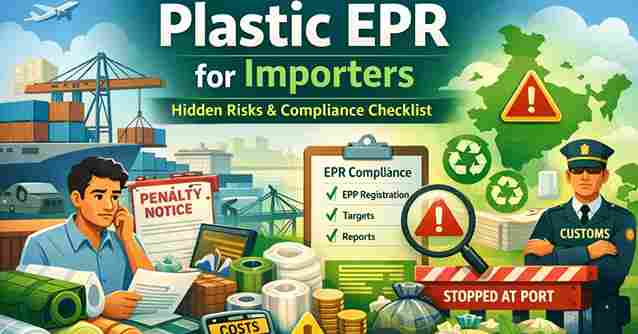
Plastic EPR shifts the responsibility of plastic waste management to the entity that introduces plastic into the Indian market. For importers, this responsibility applies the moment packaged goods cross the Indian border and enter commercial circulation.
From a regulatory perspective, importers are treated at par with producers and brand owners. This means compliance is not optional or indirect — it is a direct legal obligation.
For businesses, this translates into:
Plastic EPR is not a one-time formality. It is an ongoing compliance responsibility tied to your import volumes and packaging structure.
Many importers assume Plastic EPR applies only to manufacturers or large brands. In reality, the scope is much broader.
You are required to comply if you import:
Even if packaging decisions are made by an overseas supplier, Indian regulators hold the importer accountable, not the foreign manufacturer.
If plastic packaging is part of your import transaction, EPR compliance applies.
Importers often face higher scrutiny because their compliance data sits across multiple systems. Unlike manufacturers with centralized operations, importers must align information across customs, GST, and environmental portals.
This increases the risk of:
Regulators frequently cross-check import records against EPR filings, making importers more vulnerable to retrospective compliance action.
A common assumption is that EPR registration can be completed later, once imports stabilize. In practice, compliance obligations are linked to actual imports, not registration dates.
If imports begin before registration:
Early registration provides clarity and cost control.
Plastic packaging is not treated as a single category. Importers often:
Incorrect categorization leads to:
Accurate packaging mapping is one of the most critical steps in EPR compliance.
Small inconsistencies create large delays. Common issues include:
These mismatches can result in:
Clean data alignment saves time and prevents repeated corrections.
Some importers treat EPR certificates as a last-minute purchase without a compliance strategy. This approach often backfires.
Without proper planning:
Certificate procurement must be aligned with declared targets and verified recyclers.
| Area | What Importers Must Confirm |
|---|---|
| Entity Details | GST, IEC, PAN consistency |
| EPR Category | Correct importer classification |
| Packaging Mapping | All plastic layers identified |
| Quantity Assessment | Based on import data |
| Authorized Person | Same across all portals |
Proper setup reduces downstream corrections and audit risk.
| Compliance Area | Importer Responsibility |
|---|---|
| EPR Target Calculation | Annual obligation clarity |
| Recycler Engagement | Only registered recyclers |
| Certificate Procurement | Category-wise accuracy |
| Annual Returns | Filed within timelines |
| Record Maintenance | Invoices and certificates archived |
Ongoing compliance is about consistency, not just registration.
Businesses scaling imports quickly often find their EPR obligations increasing faster than expected. Without early planning, certificate costs rise and compliance becomes reactive.
Early assessment allows better budgeting and smoother growth.
Long-running importers may face challenges aligning historical data with current EPR requirements. Audits often highlight gaps in older records.
Structured documentation and corrective filings help stabilize compliance.
Non-compliance does not remain limited to regulatory notices. It can affect:
Environmental compliance is increasingly viewed as a business credibility factor, not just a legal checkbox.
Importers who approach EPR proactively benefit from:
Early compliance is almost always cheaper and easier than corrective compliance.
Plastic EPR for importers is here to stay. The real risk lies not in registration, but in delay, assumptions, and incomplete understanding.
📞 +91 78350 06182
📧 wecare@greenpermits.in
👉 Book a Consultation with Green Permits
We support importers with Plastic EPR registration, packaging assessment, certificate planning, and annual compliance management across India.