
Extended Producer Responsibility (EPR) compliance has become a core operational requirement for manufacturers, importers, brand owners, and recyclers in India. With increasing regulatory scrutiny from CPCB and SPCBs, businesses can no longer treat EPR as a one-time formality. Choosing the right EPR consultant plays a critical role in ensuring compliance, avoiding penalties, and maintaining uninterrupted operations.
This guide explains how Indian businesses should practically evaluate and select an EPR consultant, keeping regulatory accuracy, long-term compliance, and business continuity in mind.
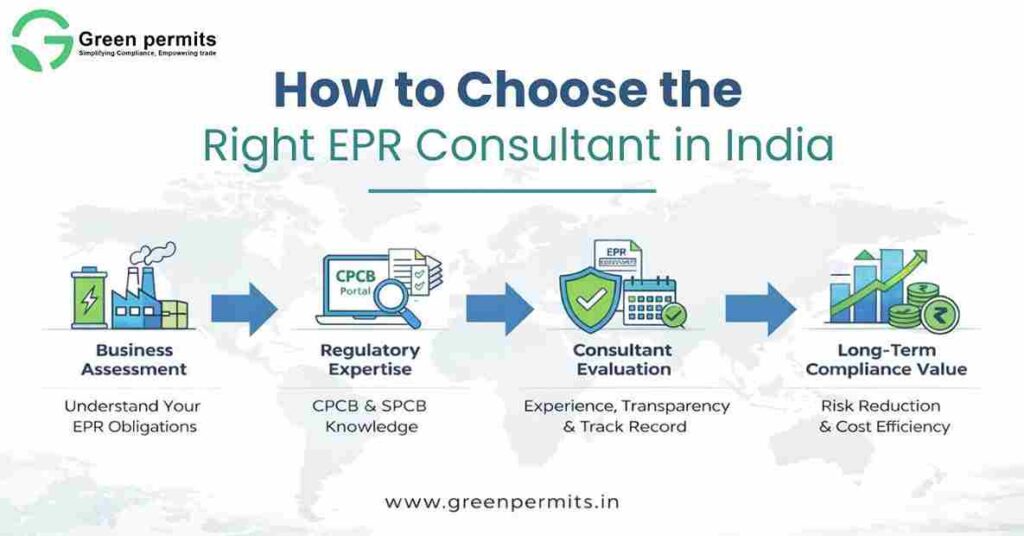
An EPR consultant acts as a compliance advisor who helps businesses interpret environmental regulations and translate them into actionable steps. Their responsibility goes far beyond filing applications on government portals.
A reliable EPR consultant supports businesses with:
From a business perspective, the consultant’s role directly impacts licensing approvals, market access, and long-term regulatory stability.
EPR non-compliance rarely happens intentionally. In most cases, it is the result of poor guidance or incorrect interpretation of rules. An inexperienced consultant can expose businesses to regulatory and financial risks.
Common issues caused by the wrong consultant include:
These issues often surface months after registration, when correcting mistakes becomes time-consuming and expensive.
EPR rules in India differ significantly across waste streams such as e-waste, plastic waste, battery waste, and tyres. A competent consultant must clearly understand how regulations apply to different industries.
Before onboarding a consultant, businesses should ensure they can explain:
Generic compliance advice often leads to incorrect registrations and long-term complications.
EPR compliance in India is driven almost entirely through online portals. Even small mistakes in portal submissions can delay approvals by weeks or months.
An experienced EPR consultant should:
From an operational standpoint, portal expertise reduces delays and ensures smoother approvals.
A professional EPR consultant does not operate in isolation. They should provide businesses with a clear compliance roadmap that outlines both immediate and future responsibilities.
This roadmap should include:
When businesses understand their compliance journey upfront, they can plan resources, budgets, and timelines more effectively.
Transparency is a strong indicator of consultant quality. Businesses should avoid consultants who provide vague assurances or avoid explaining processes in detail.
A reliable consultant will:
Clear communication reduces dependency and builds confidence in compliance decisions.
EPR compliance does not end with registration. Ongoing obligations such as annual returns, amendments, and audits require continuous support.
Before selecting a consultant, businesses should confirm:
Consultants who only focus on registration often leave businesses exposed during later compliance stages.
EPR consulting fees vary widely, but cost alone should not be the deciding factor. Low-cost services often limit scope, increasing future compliance risk.
A value-focused EPR consultant helps businesses:
When evaluated over time, reliable compliance support is far more cost-effective than repeated corrections.
Green Permits works as a compliance partner rather than a transactional service provider. The focus is on long-term regulatory alignment, not just certificate issuance.
Businesses choose Green Permits for:
This approach allows businesses to focus on growth while compliance is handled professionally.
Selecting the right EPR consultant in India directly impacts regulatory stability, operational continuity, and long-term cost control. A knowledgeable consultant helps businesses stay compliant, anticipate regulatory changes, and avoid unnecessary disruptions.
Treat EPR compliance as a strategic function, not an administrative burden.
📞 +91 78350 06182
📧 wecare@greenpermits.in
👉 Book a Consultation with Green Permits