
A lithium battery recycler operating near Pune recently shared this during a discussion:
They had invested in shredders, black mass separation, and pollution control systems. SPCB consents were in place. Operations had begun. But when producers approached them, one question kept coming up repeatedly — “Are your EPR certificates valid on the CPCB portal?”
That single question made them pause.
This is the reality for many recyclers today.
Technology and capacity are no longer enough. EPR compliance has become the real deciding factor for credibility, revenue, and long-term survival.
This guide explains lithium battery EPR obligations for recyclers in simple, practical terms — from registration to certificates, risks, and compliance benefits.
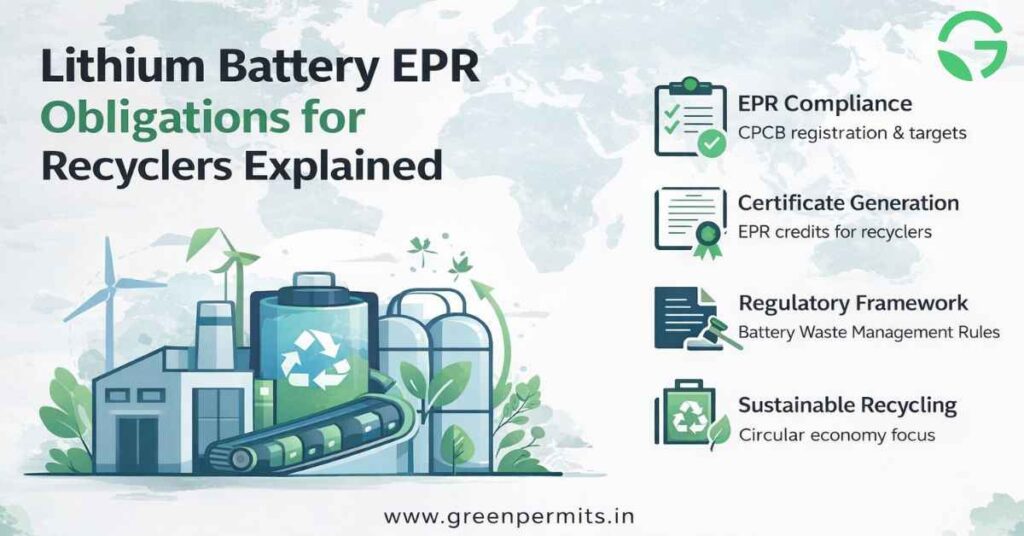
Extended Producer Responsibility under the Battery Waste Management Rules applies directly to recyclers, even though the name sounds producer-focused.
For recyclers, EPR is about authorization and accountability.
Once registered:
Without EPR registration, even a fully operational plant is considered outside the compliance ecosystem. That means producers cannot use your recycling data to meet their obligations, no matter how advanced your facility is.
In practical terms, EPR defines whether your recycling activity has regulatory value.
CPCB clearly distinguishes between different types of battery handlers.
To qualify as a recycler under lithium battery EPR, your unit must:
From a business perspective, this distinction matters because only recognised recyclers can issue EPR certificates.
Registration is not a state-level approval. It is a centralised CPCB process completed online.
Before applying, recyclers should ensure their documentation and plant readiness are aligned.
Many delays occur not due to missing documents, but because declared capacity and actual plant capability do not match.
Once registered, recyclers take on continuous obligations. These are not one-time tasks.
Recyclers must ensure:
Recyclers are required to:
Recyclers must:
EPR compliance is continuous. Missing even one reporting cycle can raise red flags.
EPR certificates for lithium batteries are not issued based on battery weight alone.
They are calculated on the basis of actual metal recovery.
| Aspect | How It Works |
|---|---|
| Unit of certificate | Kilograms of recovered metal |
| Reporting frequency | Quarterly |
| Data verification | Portal records and inspections |
| Certificate usability | Producers use them for EPR targets |
For recyclers, this means the accuracy of recovery data is more important than total battery inflow.
While EPR compliance involves fees, they are relatively modest compared to operational investments.
| Component | Amount |
|---|---|
| Registration fee | ₹15,000 |
| Annual maintenance | ₹5,000 |
| Renewal after validity | ₹7,500 plus transaction-based charges |
From a business angle, compliance costs are predictable, while non-compliance costs are uncertain and often higher.
Many recyclers assume compliance ends after registration. This is where problems begin.
Such gaps often lead to:
In today’s market, compliance lapses directly affect revenue continuity.
Recyclers who approach EPR proactively gain a competitive edge.
Early compliance also reduces friction during plant expansion or capacity enhancement.
Green Permits supports recyclers across India with:
Our role is to ensure recyclers remain operationally compliant and commercially credible, not just approved on paper.
Lithium battery recycling is a high-growth sector in India, but only compliant recyclers will scale sustainably.
Ignoring EPR obligations can result in:
Structured compliance leads to:
📞 +91 78350 06182
📧 wecare@greenpermits.in
Book a Consultation with Green Permits