
Extended Producer Responsibility for tyres has moved from being a regulatory concept to a direct operational requirement for businesses operating in India. Manufacturers and importers dealing in tyres are now expected to take responsibility for the end-of-life management of the products they introduce into the market. With increased scrutiny by regulatory authorities and growing integration of EPR compliance with digital portals, non-compliance no longer remains unnoticed.
For businesses, Tyre EPR is not only about environmental responsibility. It directly impacts import clearance, annual compliance audits, financial planning, and long-term business continuity. Understanding the compliance framework early helps organizations avoid penalties, operational delays, and reputational risks.
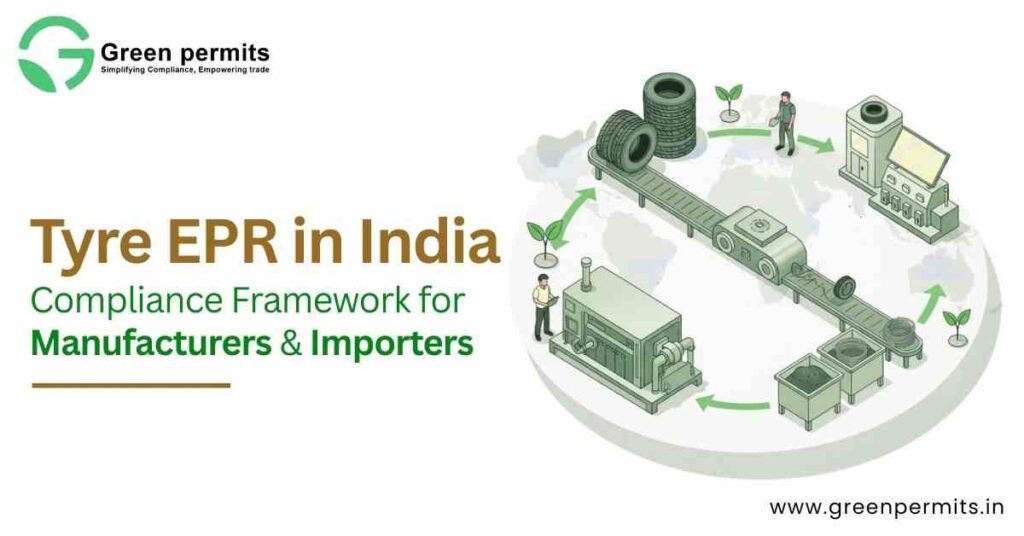
Tyre EPR is a compliance mechanism under India’s waste management regulations that places the responsibility of waste tyre management on the producer. In regulatory terms, a producer includes any entity that manufactures tyres domestically or imports tyres into India for sale, distribution, or captive use.
Under this framework, businesses are required to ensure that an equivalent quantity of waste tyres is collected and recycled in an environmentally sound manner. This responsibility does not end at sales or customs clearance. Instead, it continues through annual reporting, procurement of recycling certificates, and regular compliance updates on the CPCB EPR portal.
The intent behind Tyre EPR is to formalize the recycling ecosystem, reduce informal disposal practices, and promote circular use of materials within the tyre industry.
Tyre EPR compliance is enforced through a combination of environmental rules and government notifications. These regulations empower authorities to track tyre quantities introduced into the market and ensure that recycling obligations are met year after year.
The Central Pollution Control Board plays a central role in implementing this framework. It manages registration, assigns annual targets, reviews compliance submissions, and initiates action against defaulting entities. Since the framework is legally binding, failure to comply can result in environmental compensation, registration suspension, or further regulatory action.
For businesses, this means Tyre EPR is no longer advisory in nature. It is a mandatory compliance requirement linked directly to operational permissions.
Tyre EPR applies uniformly across the tyre value chain wherever tyres are placed in the Indian market. Domestic manufacturers producing tyres for sale are covered under this framework. Importers bringing tyres into India, whether for resale or captive consumption, are also classified as producers under EPR rules.
Vehicle manufacturers selling tyres under their own brand name or importing tyres as part of vehicle assemblies are equally responsible. Importantly, there are no exemptions based on turnover, business size, or volume of imports. Even small or occasional importers are required to register and comply.
This wide applicability has caught many businesses off guard, especially those who assumed EPR was relevant only to large manufacturers.
EPR targets are designed to progressively increase recycling responsibility over time. Initially introduced with partial targets, the framework now requires full recycling responsibility for tyres introduced into the market.
From a business perspective, these targets represent a future liability linked directly to today’s sales or imports. Every tyre introduced into the market adds to the company’s EPR obligation in subsequent years. This makes accurate data tracking and early planning essential for financial forecasting.
Companies that fail to account for these obligations often face sudden compliance costs when targets become due, whereas those that plan ahead are able to manage EPR costs more efficiently.
Tyre EPR compliance does not require companies to set up their own recycling infrastructure. Instead, obligations can be fulfilled by working with authorized recyclers registered on the CPCB portal. These recyclers process waste tyres using approved technologies and generate EPR certificates corresponding to the quantity recycled.
Producers purchase these certificates to offset their annual EPR targets. The certificates are then uploaded during annual return filing as proof of compliance. However, the responsibility for due diligence remains with the producer. Certificates obtained from unregistered or non-compliant recyclers can be rejected, exposing the business to penalties.
This makes structured recycler verification and certificate planning a critical part of Tyre EPR strategy.
The Tyre EPR registration process is conducted through an online portal managed by CPCB. Businesses are required to create an account, provide entity details, submit authorized person information, and upload statutory documents such as GST and import credentials.
Once registration is approved, an EPR registration number is issued. This number becomes mandatory for future filings, declarations, and compliance interactions. While the process is straightforward on paper, delays often occur due to documentation errors, incorrect category selection, or incomplete disclosures.
A well-prepared application significantly reduces processing time and prevents repeated queries from authorities.
A mid-sized tyre importing company operating across multiple Indian ports was engaged in importing passenger and commercial vehicle tyres. While the company maintained strong sales growth, EPR compliance was not integrated into its regulatory planning during the initial years of operation.
The company had not registered under Tyre EPR since the introduction of the framework. Historical import data was scattered across multiple logistics partners, and no recycler tie-ups were in place. As a result, the business faced potential exposure for multiple years of unreported EPR obligations.
A compliance review revealed that the company was at risk of regulatory notices, environmental compensation, and possible disruption of future imports. The absence of an EPR registration number further increased the likelihood of portal restrictions.
A structured approach was adopted, starting with reconciliation of import data and mapping historical tyre quantities against applicable EPR targets. Registration was completed with corrected documentation, followed by phased procurement of EPR certificates from verified recyclers. Backlog annual returns were filed sequentially to normalize the portal status.
The company successfully eliminated regulatory exposure without facing penalties or operational disruption. Import operations continued smoothly, and a long-term compliance calendar was established. The overall cost of compliance remained significantly lower than the potential penalties and business losses that could have arisen from continued non-compliance.
Non-compliance with Tyre EPR obligations can trigger a range of regulatory actions. These may include environmental compensation linked to the quantity of unmet targets, suspension of EPR registration, or restrictions on future business activities.
Penalties are often retrospective and escalate with time, making delayed compliance significantly more expensive than early corrective action. Businesses that ignore notices or miss filing deadlines face higher scrutiny during subsequent audits.
Early and structured Tyre EPR compliance allows businesses to control costs, avoid regulatory stress, and maintain uninterrupted operations. It also strengthens sustainability credentials, which are increasingly important for investor confidence and supply chain partnerships.
From a financial perspective, planned EPR certificate procurement and accurate forecasting reduce year-end compliance shocks. Operationally, proactive compliance minimizes regulatory interaction and improves approval timelines.
Green Permits provides comprehensive Tyre EPR support for manufacturers and importers across India. Our approach focuses on compliance clarity, risk reduction, and long-term regulatory stability.
We assist businesses with registration, compliance audits, target calculation, recycler verification, certificate procurement, and annual return filing. Our objective is not just to complete formalities but to ensure that your business remains protected from future regulatory exposure.
📞 +91 78350 06182
📧 wecare@greenpermits.in