
In B2B electronics and technology businesses, compliance issues rarely show up at the planning stage. They appear when money is already spent, timelines are fixed, and customers are waiting.
We often speak with founders and compliance managers who tell us the same story. The product was finalized, vendors were aligned, and shipments were scheduled. Everything looked ready on paper. Then, at the port or during a customer audit, one question surfaced: Is this product covered under BIS CRS?
By the time this question is asked, the cost of being wrong is already high. Storage charges start adding up, customers push back delivery timelines, and internal teams scramble to “fix compliance.” For B2B businesses operating at scale, this is not just a regulatory issue — it’s a commercial risk.
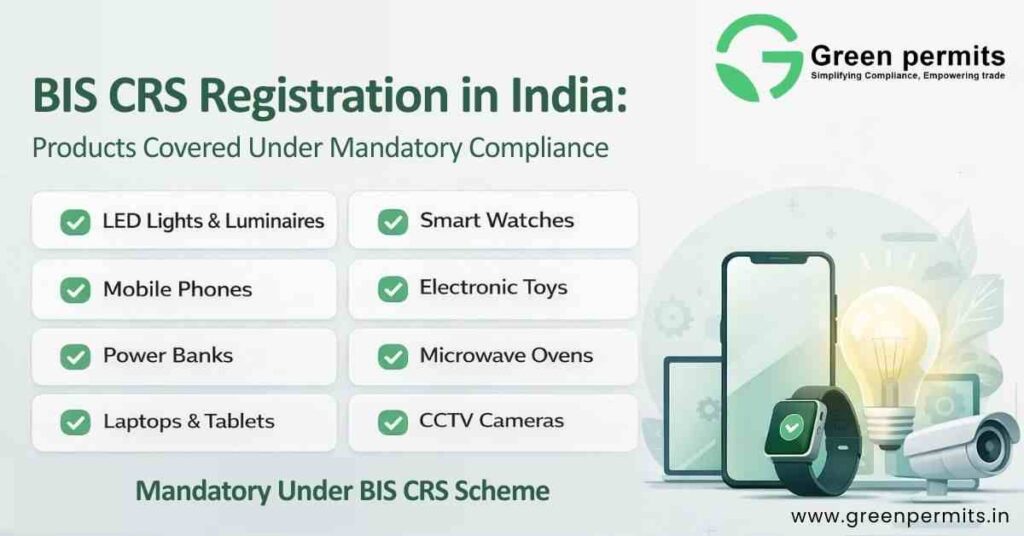
This is why understanding BIS CRS Registration in India and the products covered under mandatory compliance needs to happen much earlier in the business cycle.
BIS CRS Registration comes under the Compulsory Registration Scheme implemented by the Bureau of Indian Standards. While it is often explained as a “certification requirement,” in practice it works more like a market access gate.
If your electronic or IT product is notified under CRS, it cannot legally be manufactured, imported, or sold in India unless it is registered. There is no provisional clearance, no post-sale regularization, and no exemption based on company size. From a business standpoint, CRS determines whether your product is allowed to participate in the Indian market at all.
What many B2B companies overlook is that CRS registration is issued at the product model level. This means that even small design changes, technical upgrades, or model variations may require fresh approval. For businesses managing multiple SKUs or serving different clients with slightly customized products, this detail becomes critical.
In B2B environments, compliance failures rarely affect just one shipment. They disrupt contracts, long-term supply agreements, and enterprise relationships.
A distributor waiting for stock, a government tender with fixed delivery milestones, or a corporate buyer conducting vendor audits will not accommodate regulatory delays. Once CRS non-compliance surfaces, trust erosion happens quickly. This is why CRS should be treated as part of commercial readiness, not just regulatory hygiene.
B2B buyers today increasingly ask for compliance documentation upfront. In many cases, CRS certificates are reviewed even before pricing negotiations begin. Not having clarity here can quietly disqualify your business from opportunities before you realize it.
Responsibility under CRS follows the entity that introduces the product into the Indian market. This creates confusion in B2B supply chains where roles are often split between manufacturers, importers, and brand owners.
For Indian manufacturers, CRS compliance is directly linked to production. Selling or supplying a covered product without CRS registration exposes the business to enforcement actions and customer disputes. For importers, the responsibility is even heavier. Even if the manufacturing happens outside India, the importer remains accountable for ensuring that the product is CRS-registered and correctly labeled.
Brand owners face a different challenge. Many B2B brands outsource manufacturing but sell products under their own name. In such cases, CRS certificates must reflect the correct brand and model details. Any mismatch between certificate, product labeling, and documentation can trigger rejection during customs clearance or customer audits.
In practical terms, if your company name appears on the invoice or product label, CRS responsibility eventually comes back to you.
CRS primarily covers electronic and IT products that operate on electricity, handle power conversion, transmit data, or pose safety risks. Over time, the scope has expanded well beyond traditional consumer electronics.
B2B companies often assume their products are “industrial” or “specialized” and therefore outside CRS. In reality, enforcement focuses on functionality, not marketing classification. Products used in offices, commercial facilities, infrastructure projects, or enterprise deployments can still fall under CRS if their technical characteristics match notified categories.
What makes this tricky is that enforcement does not rely solely on product names. Authorities evaluate voltage ratings, intended use, electrical design, and similarity to existing notified products. As a result, even products that are not explicitly named in common lists may still be considered covered.
This is where many businesses misjudge risk. They rely on informal opinions instead of structured applicability assessment, only to discover non-compliance when shipments are already in transit.
CRS is not a static scheme. The list of covered products has expanded steadily as technology adoption increases and new risk patterns emerge.
From a business planning perspective, this means that products currently outside CRS may be included in the future. Companies that treat compliance reactively often find themselves rushing registration to meet contract commitments, paying higher costs and losing flexibility.
B2B businesses that monitor CRS expansion trends and prepare early are able to adapt without disrupting operations. They build compliance timelines into product roadmaps instead of firefighting at the last minute.
The direct cost of CRS non-compliance is visible in the form of delayed shipments, storage charges, and re-testing expenses. The indirect cost is often much higher.
Missed delivery commitments strain client relationships. Sales teams lose credibility. Procurement departments hesitate to place repeat orders. In regulated sectors, non-compliance can disqualify vendors from future tenders altogether.
In many cases, businesses end up applying for CRS under pressure, when they have little room to correct documentation errors or respond to queries. This turns a manageable process into an operational crisis.
B2B companies that treat CRS as part of early product planning operate with far more confidence. Customs clearance becomes predictable. Customer audits are easier to handle. Expansion into new regions or platforms does not trigger compliance panic.
Early compliance also enables better commercial discussions. When compliance is settled, sales teams can focus on value, pricing, and delivery instead of explaining delays or regulatory uncertainty.
From a leadership perspective, this reduces risk exposure and protects brand reputation in a market where compliance awareness is steadily increasing.
At Green Permits, we work primarily with B2B manufacturers, importers, and brand owners. Our role is not just to process applications, but to help businesses understand whether CRS applies, how it impacts their operations, and how to comply without disrupting growth.
We begin by assessing product applicability before major investments are made. From there, we manage testing coordination, documentation, filing, and follow-ups. For businesses dealing with overseas factories or multiple product models, we help structure compliance in a way that scales with growth.
Our focus is always on preventing last-minute surprises and ensuring that compliance supports, rather than blocks, your business plans.
BIS CRS Registration is no longer a checkbox activity. For B2B businesses, it directly affects timelines, contracts, and credibility.
Understanding whether your product is covered — and acting before compliance becomes urgent — is one of the most effective ways to protect your operations and maintain trust with customers.
📞 +91 78350 06182
📧 wecare@greenpermits.in