
Tyre EPR certificates are issued to CPCB-registered recyclers based on verified quantities of waste tyres processed within approved operational capacity. For recyclers, these certificates are not just proof of compliance but tradable compliance assets.
From a business lens, EPR certificates matter because they:
Recyclers who view EPR certificates as inventory—not paperwork—tend to make better pricing and sales decisions.
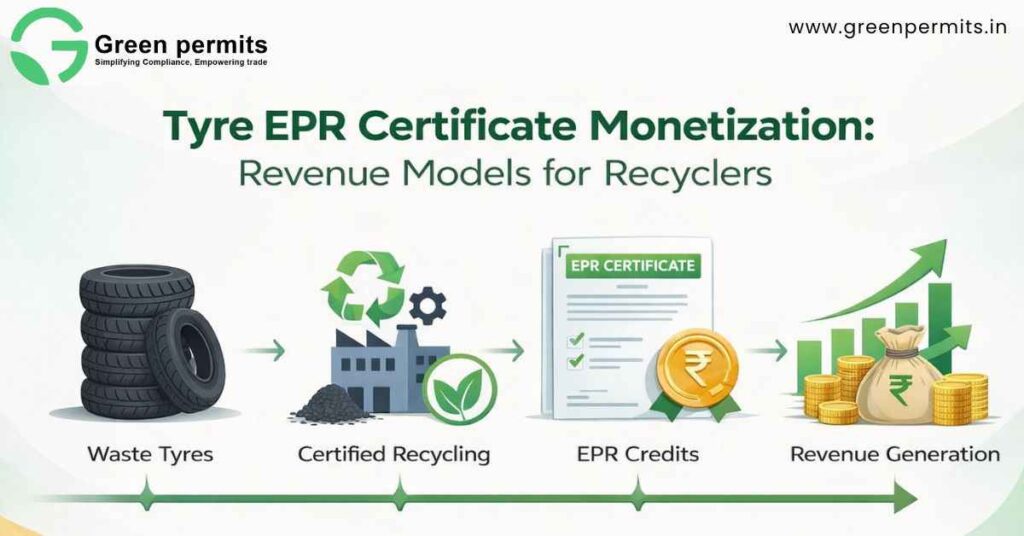
Recycling operations face fluctuating input costs, transport challenges, and scrap price uncertainty. Tyre EPR monetisation provides balance by adding a compliance-led income stream.
For most recyclers, EPR revenue helps:
When planned well, EPR monetisation acts as financial cushioning during low-demand recycling periods.
In this model, recyclers sell EPR certificates directly to tyre producers who need them to close compliance gaps.
This approach works best when recyclers:
However, direct sales demand discipline. Any mismatch in capacity, returns, or waste category can delay approvals and payment timelines.
Some recyclers prefer working with aggregators or compliance partners who manage certificate pooling and sales.
This model suits recyclers who:
The trade-off is reduced pricing control and lower per-certificate realisation.
Advanced recyclers combine recycling output with compliance assistance for producers, offering certificates as part of an end-to-end solution.
This model allows recyclers to:
It requires stronger regulatory understanding and internal compliance discipline but delivers higher lifetime value per client.
Tyre EPR certificate demand rises sharply during specific regulatory periods.
Typically, price pressure increases around:
Recyclers who time certificate releases around these cycles often achieve higher revenue without increasing processing volume.
Different tyre categories experience different compliance pressures based on producer portfolios.
Recyclers benefit when they:
Category clarity directly improves negotiation strength and reduces unsold inventory risk.
Most monetisation failures arise from data and documentation issues rather than recycling gaps.
Common risk areas include:
Strong compliance systems protect both revenue timelines and CPCB registration status.
Every monetisation strategy sits on a risk–reward spectrum.
Generally:
Successful recyclers choose their strategy intentionally rather than reacting to market pressure.
Before chasing better pricing, recyclers must ensure their fundamentals are solid.
Key readiness checks include:
Without these, even high market demand cannot be monetised safely.
📞 +91 78350 06182
📧 wecare@greenpermits.in
Book a consultation with Green Permits to structure tyre EPR monetisation, avoid CPCB risks, and maximise certificate value.