
BIS FMCS Certification: Complete Guide for Foreign Brands Entering India

  • Home
  • BIS
  • BIS FMCS Certification: Complete Guide for Foreign Brands Entering India

A European manufacturer finalized its Indian distributor. Marketing campaigns were live. Inventory was dispatched.

Then customs asked for one document:
BIS FMCS License.

The shipment was held at port. Storage charges started. Distributor confidence dropped.

The brand assumed certification could be completed “after launch.”

In India, compliance does not work that way.

If you are a foreign manufacturer planning to enter India, BIS FMCS Certification is not optional — it is your legal gateway.

This guide explains everything you need to know before you ship.
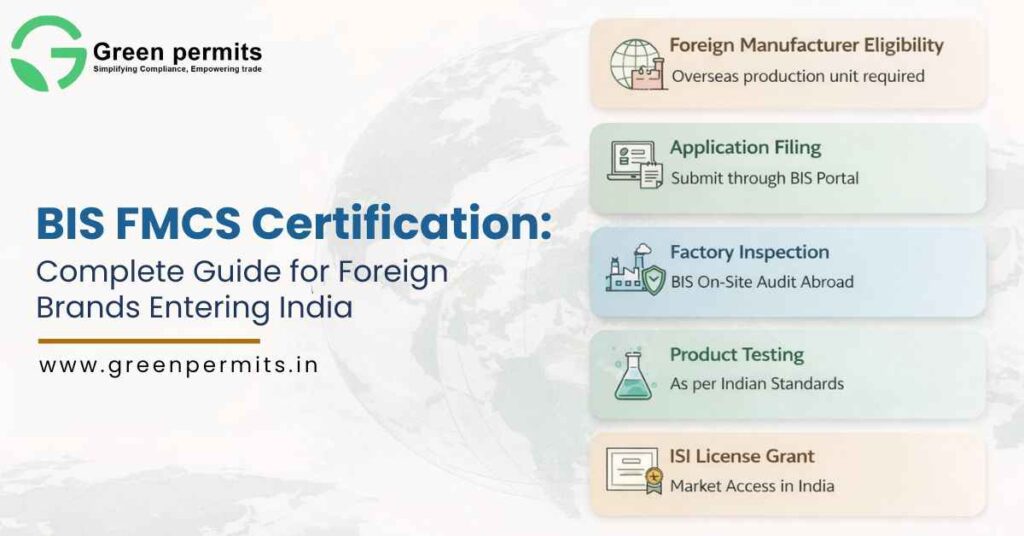
BIS Certification

What is BIS FMCS Certification?

BIS FMCS Certification (Foreign Manufacturer Certification Scheme) allows overseas manufacturers to obtain a BIS License to use the ISI Mark for products notified under mandatory Indian Standards.

It is governed under the BIS Act, 2016, and applies when:

  • Products fall under mandatory certification list
  • ISI marking is compulsory
  • Foreign manufacturing units export to India

Unlike simpler registration routes, FMCS involves:

  • Factory inspection by BIS officials
  • Product testing in BIS-recognized labs
  • Ongoing surveillance audits

This is not a document filing exercise — it is a compliance evaluation of your manufacturing system.

When is FMCS Required Instead of CRS?

Foreign brands often confuse FMCS with CRS (Compulsory Registration Scheme).

Here is the clear distinction:

Parameter FMCS CRS
Mark Required ISI Mark No ISI Mark
Factory Inspection Mandatory Not required
Applicable Products Safety & regulated industrial goods Electronics & IT equipment
Governing Standard Indian Standard (IS) Self-declaration + testing
Complexity High Moderate

Interpretation for foreign brands:
If your product must carry the ISI mark — FMCS is the only route.

Step-by-Step BIS FMCS Certification Process

Understanding the structured process helps avoid delays.

Appointment of Authorized Indian Representative (AIR)

Foreign manufacturers must appoint an Indian entity or representative.

The AIR:

  • Coordinates with BIS
  • Submits application
  • Handles inspection communication
  • Acts as compliance contact

Choosing an inexperienced AIR often causes delays.

Application Submission to BIS

The application includes:

  • Manufacturing details
  • Product specifications
  • Quality control systems
  • Testing capability documentation

Incomplete documentation is the most common reason for initial query notices.

Product Testing

  • Samples must be tested in BIS-recognized laboratories.
  • Testing must match applicable Indian Standard.
  • Non-conformity requires re-testing.

Many foreign factories fail here due to slight technical mismatches with Indian standards.

Factory Inspection by BIS Officials

BIS officials visit the foreign manufacturing facility.

Inspection includes:

  • Production process review
  • Quality control system audit
  • In-house testing facilities evaluation
  • Calibration verification
  • Raw material traceability check

This stage determines whether your factory is genuinely compliant — not just your product.

Grant of License

After satisfactory inspection and documentation clearance:

  • BIS issues license
  • ISI Mark usage is authorized
  • Manufacturer can legally export to India

Post-License Surveillance

Compliance does not end after approval.

BIS conducts:

  • Periodic factory inspections
  • Market sample testing
  • Renewal reviews

Non-compliance may result in suspension or cancellation.

Documents Required for BIS FMCS Certification

Foreign brands must prepare:

  • Business registration certificate
  • Factory layout plan
  • Manufacturing process flow
  • Quality control manual
  • Calibration certificates
  • In-house testing facility details
  • Trademark authorization (if applicable)
  • Appointment letter of AIR
  • Product test reports

Poor documentation alignment between factory practice and manual submission leads to inspection failure.

Estimated Timeline for FMCS Certification

Stage Approximate Duration
Documentation Preparation 3–6 weeks
Product Testing 3–5 weeks
BIS Inspection Scheduling 4–8 weeks
Final License Approval 2–4 weeks
Total Expected Time 4–6 months

Business Insight:
FMCS must be initiated at least 6 months before planned India entry.

Cost Components of FMCS Certification

While official BIS fees vary by product category, foreign brands should budget for:

  • Application fees
  • Testing charges
  • Inspection travel expenses of BIS officers
  • Annual marking fees
  • Renewal fees

The real cost, however, is often delay.

Compliance Risks & Penalties Under BIS Act, 2016

Ignoring FMCS requirements can lead to serious consequences:

  • Customs seizure of goods
  • Monetary penalties
  • Product recall orders
  • License suspension
  • Criminal liability in severe cases

India has strengthened enforcement at ports and through market surveillance.

Shipment detention alone can block working capital for months.

Real-World Scenario — Inspection Failure

A Southeast Asian manufacturer applied under FMCS without upgrading its internal QC lab to match Indian Standard requirements.

During inspection:

  • Calibration logs were incomplete
  • Batch traceability system was weak

Result:

  • License withheld
  • Re-inspection scheduled
  • 5-month delay
  • Distributor withdrew agreement

FMCS is a system compliance audit — not a paperwork formality.

Why Early FMCS Planning Protects Your Business

Foreign brands that prepare early benefit from:

  • Smooth customs clearance
  • Faster distributor onboarding
  • Strong brand credibility
  • Avoided port detention
  • Reduced compliance stress

Reactive compliance often results in:

  • Emergency filings
  • Expedited testing costs
  • Reputation damage
  • Lost market opportunity

Common Mistakes Foreign Manufacturers Make

  • Confusing CRS with FMCS
  • Appointing inexperienced AIR
  • Submitting incomplete factory manuals
  • Ignoring Indian Standard technical gaps
  • Underestimating inspection preparation

The FMCS route demands operational alignment — not just certification intent.

Strategic India Entry Advice for Foreign Brands

Before launching in India:

  • Conduct IS standard gap assessment
  • Upgrade QC documentation
  • Align production with Indian compliance requirements
  • Appoint experienced AIR
  • Plan certification before shipment

India is a high-opportunity market — but compliance-first.

Conclusion — FMCS is Your Legal Entry Gate

BIS FMCS Certification is not a regulatory hurdle.

It is your structured entry approval into India.

Foreign manufacturers who treat it strategically:

  • Reduce legal risk
  • Protect capital
  • Strengthen distributor trust
  • Build long-term presence in India

Waiting until customs stops your shipment is already too late. 

📞 +91 78350 06182

📧 wecare@greenpermits.in

Book a Consultation with Green Permits


Book a Technical Call with Expert

📞 +91 78350 06182

FAQs

It is the certification scheme allowing foreign manufacturers to use the ISI Mark for products under mandatory Indian Standards.

Yes, BIS officials inspect the foreign manufacturing facility before license grant.

Typically 4–6 months depending on product type and documentation readiness.

No. Appointment of an Authorized Indian Representative (AIR) is mandatory.