
A manufacturer once told us, “We’ve already produced 15,000 units. Now BIS says we need ISI.”
Production was complete. Packaging was ready. Dealers were waiting. But without ISI Mark Certification in India, dispatch had to stop.
This situation is more common than most business owners expect. Many manufacturers assume certification can be applied for later. In reality, for notified products, ISI is a legal requirement before commercial sale.
If you are planning to manufacture cement, steel, electrical products, packaged water, or any regulated product, understanding the mandatory list and approval timeline is critical for business continuity.
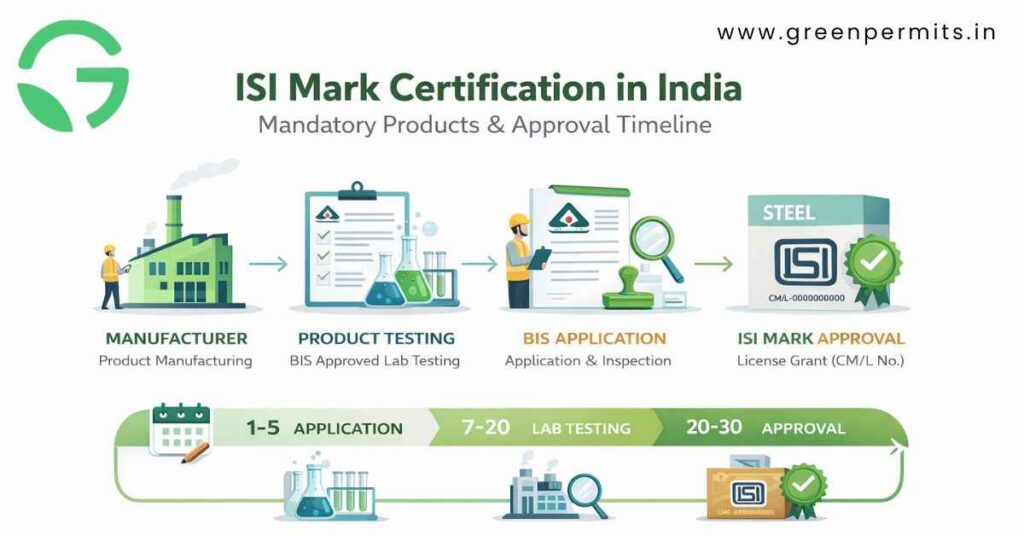
The ISI Mark is issued by the Bureau of Indian Standards (BIS) under the BIS Act, 2016. It confirms that a product conforms to the relevant Indian Standard (IS) and meets prescribed safety and quality benchmarks.
For a business owner, ISI certification is not just a regulatory formality. It directly impacts your ability to legally operate, scale production, and build long-term market credibility.
Without a BIS license, manufacturing or selling a mandatory product becomes a statutory violation. Enforcement actions can include seizure of stock, monetary penalties, and suspension of operations.
From a strategic perspective, ISI certification:
Manufacturers who align their internal processes with BIS standards often see operational improvements beyond compliance.
The Government notifies specific products under Quality Control Orders (QCOs). Once notified, certification under the ISI scheme becomes compulsory for manufacturing, storage, sale, and distribution in India.
This means even if you are supplying locally or through distributors, certification is mandatory if your product falls under the notified category.
| Category | Examples of Products | Relevant IS Standard |
|---|---|---|
| Cement | OPC, PPC, PSC | IS 269, IS 1489 |
| Steel | TMT Bars, Structural Steel | IS 1786 |
| Electrical Appliances | Switches, Cables, Geysers | IS 3854, IS 694 |
| LPG Equipment | Cylinders & Valves | IS 3196 |
| Packaged Drinking Water | Bottled Water | IS 14543 |
| Toys | Non-electronic & Electronic Toys | IS 9873 Series |
The list of mandatory products continues to expand. Over the past few years, sectors like electronics, chemicals, and construction materials have seen increased regulatory coverage.
For manufacturers, this means:
Many businesses discover mandatory requirements only after receiving regulatory notices. Early compliance review prevents such disruption.
India’s regulatory framework has evolved significantly in recent years. The expansion of mandatory ISI products is driven by:
As the Indian market becomes more regulated, compliance is shifting from optional to structured enforcement. Manufacturers entering new product lines must treat BIS applicability assessment as part of their feasibility study.
Ignoring this step can delay product launch by months.
One of the most important questions manufacturers ask is how long the approval process takes. While some agencies claim quick approvals, the actual timeline depends heavily on preparation and product complexity.
| Stage | Activity | Estimated Duration |
|---|---|---|
| Application Filing | Online submission + documentation | 3–5 days |
| Sample Testing | BIS-recognized laboratory testing | 15–30 days |
| Factory Inspection | BIS officer verification | 7–15 days |
| License Approval | Scrutiny and grant of CM/L | 10–20 days |
Average total duration: 45–90 days
However, real-world cases may extend beyond this window due to compliance gaps.
A common issue we see is manufacturers installing machinery but not aligning testing infrastructure as per BIS norms. This leads to inspection objections and rework.
Planning certification parallel to plant setup reduces delays significantly.
Understanding the process in detail helps manufacturers prepare internally before filing the application.
At this stage, BIS evaluates your factory’s legal and operational structure. Documentation must be complete and consistent.
Required information typically includes:
Incomplete or inconsistent documentation leads to avoidable delays.
Product samples are tested in BIS-recognized laboratories as per the applicable Indian Standard.
Testing covers:
If samples fail testing, corrective action and retesting are required. This can add several weeks to the approval timeline.
BIS officers visit the manufacturing facility to verify:
Inspection is not a paperwork exercise. It is a technical verification process.
Upon satisfactory inspection and documentation review, BIS issues a Certification Mark License (CM/L) number.
Post-approval, manufacturers must:
Certification is ongoing compliance, not a one-time approval.
Most rejections occur due to operational gaps rather than complex regulatory issues.
Frequent reasons include:
A steel manufacturer once faced rejection because their tensile testing machine’s calibration had expired. The oversight delayed their license by nearly two months and affected supply contracts.
Attention to detail matters.
Under the BIS Act, selling or manufacturing mandatory products without ISI certification is a punishable offence.
Possible consequences include:
For MSMEs, even a temporary shutdown can severely impact working capital and market trust.
Compliance should be viewed as risk management, not regulatory burden.
Manufacturers who proactively align with BIS standards gain long-term advantages.
Early certification helps:
Certification planning during project phase ensures smoother product launch.
ISI Mark Certification in India is not optional for notified products. It is a legal foundation for regulated manufacturing.
If your product falls under mandatory category, you must secure BIS approval before commercial sales.
Delays in compliance can lead to:
Planning certification alongside production setup reduces timeline uncertainty and compliance risk.
Green Permits supports manufacturers with structured BIS planning, documentation alignment, inspection readiness, and end-to-end certification management.
📞 +91 78350 06182
📧 wecare@greenpermits.in
Book a Consultation with Green Permits