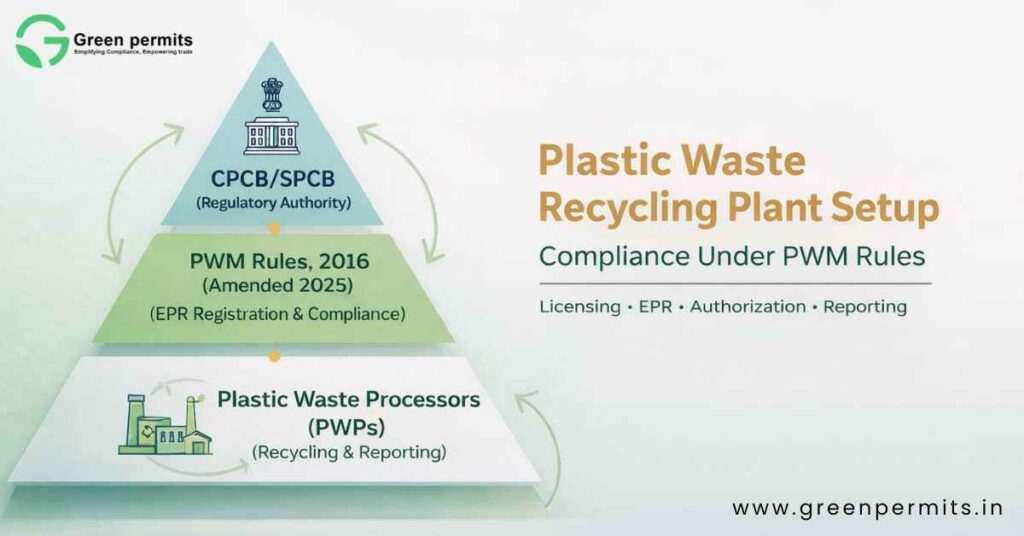
Plastic Waste Recycling Plant Setup: Compliance Under PWM Rules
A client recently approached us after investing nearly ₹2.2 crore in a plastic recycling plant. The shed was ready. Machinery installed. Workforce hired.
But the unit remained shut for 4 months.
The reason was simple: incomplete compliance under the Plastic Waste Management (PWM) Rules and missing CPCB Plastic Waste Processor registration.
In recycling, machinery is easy. Compliance is where businesses succeed or fail.
If you are planning a Plastic Waste Recycling Plant Setup, this guide will help you understand not just the cost, but the regulatory backbone required to run legally and profitably in India.
Understanding PWM Rules Before You Invest
Before committing capital, it is important to understand that plastic recycling is governed by central environmental legislation. It is not treated as a regular manufacturing unit. It is classified as a waste processing activity under the Environment (Protection) Act, 1986.
The Plastic Waste Management Rules, 2016 (amended in 2022 and 2025) introduced a structured compliance ecosystem where recyclers play a central role in the Extended Producer Responsibility (EPR) framework.
Under current rules:
100% plastic waste introduced into the market must be processed.
Producers must meet annual EPR targets.
Only registered recyclers can generate valid EPR certificates.
Unregistered recycling operations are treated as environmental violations.
This means your plant must be designed from Day 1 with regulatory compliance in mind.
PWM Amendment 2025 (Barcode / QR code traceability mandate)
Air (Prevention and Control of Pollution) Act, 1981
Water (Prevention and Control of Pollution) Act, 1974
Ignoring even one layer can delay approvals by 60–120 days.
Mandatory Registrations for Plastic Waste Recycling Plant Setup
When setting up a recycling plant, approvals are layered and sequential. Many entrepreneurs mistakenly apply randomly instead of following the regulatory order.
A properly structured compliance roadmap reduces delays by 30–40%.
Core Regulatory Approvals Required
Consent to Establish (CTE) from State Pollution Control Board
Consent to Operate (CTO) after installation
Plastic Waste Processor (PWP) Registration on CPCB Portal
Factory License under Factories Act
GST Registration
Trade License from local authority
Authorization under Hazardous Waste Rules (if applicable)
Additional Clearances Often Required
Fire NOC
Building Plan Approval
Groundwater NOC (if borewell used)
Weighbridge certification
Annual Return Filing registration
In practical terms, 70% of plant delays occur because applicants apply for CTO before completing CPCB registration.
CPCB Plastic Waste Processor Registration — The Revenue Gateway
In today’s EPR ecosystem, CPCB registration is not just compliance — it is your revenue license.
Only registered Plastic Waste Processors can:
Legally process plastic waste
Generate EPR certificates
Sell recycled output to major brand owners
Enter formal supply chains
The registration is done on the centralized EPR portal.
Information Required During Registration
Installed recycling capacity (TPD or TPA)
Type of plastic processed (PET, HDPE, LDPE, MLP etc.)
Process flow diagram
Consent documents (CTE/CTO)
GST, PAN, CIN details
Annual processing plan
Approval timelines typically range between 15 to 30 working days if documentation is complete.
Incomplete documentation can push the timeline to 60–90 days.
Plastic Waste in India — Why Compliance Demand Is Increasing
India generates approximately 3.5 to 4 million tonnes of plastic waste annually. Of this:
Around 60% is formally recycled.
20–25% remains uncollected.
The rest enters informal waste streams.
Under EPR guidelines:
Producers must meet 100% recycling obligation over phased targets.
Recyclers must report actual processing capacity.
Annual returns are mandatory.
This creates increasing demand for compliant recycling units.
In simple business terms, compliance-backed recyclers are becoming long-term supply partners for large brands.
Land, Layout & Infrastructure Requirements
A plastic recycling plant is not just about installing a shredder and extruder. SPCBs conduct physical inspections before granting Consent to Operate.
Typical land requirements:
Small plant (500 kg/hour): 8,000–12,000 sq ft
Medium plant (1–2 TPH): 15,000–40,000 sq ft
Large plant (5 TPH+): 1–2 acres
Infrastructure Must Include:
Raw material storage area
Segregation platform
Washing section
Shredding & granulation section
Finished goods storage
Effluent Treatment Plant
Storm water drainage
Fire safety systems
SPCB inspectors check:
Air emissions from extruders
Noise levels
Sludge handling
Water discharge points
Units failing inspection often face 45–90 day compliance correction periods.
Environmental Compliance: Effluent & Pollution Control
Plastic washing generates wastewater containing:
Oil & grease
Suspended solids
Microplastics
Chemical detergents
Under pollution norms, untreated discharge is prohibited.
Required Systems
Primary settling tank
Oil & grease trap
ETP (Effluent Treatment Plant)
Sludge drying bed
Reuse or recycling of treated water
Many states now push towards partial Zero Liquid Discharge (ZLD) models.
Failure to install ETP can lead to:
Closure notice
Electricity disconnection
Environmental compensation ranging from ₹5 lakh to ₹25 lakh
2025 Amendment — Traceability & Digital Monitoring
The 2025 PWM amendment introduces mandatory traceability through:
Barcode printing
QR codes on packaging
Quarterly updates on CPCB portal
While producers are directly affected, recyclers are indirectly impacted because:
Material traceability will be verified
Digital audit frequency will increase
Certificate authenticity will be monitored
Recyclers must maintain:
Input plastic quantity records
Processing logs
Output granule data
EPR transaction documentation
Digital documentation reduces compliance disputes by nearly 50%.
Estimated Cost of Plastic Waste Recycling Plant Setup
Investment depends on capacity and automation.
Capital Investment Range
Small unit (500 kg/hr) – ₹50 to ₹80 lakhs
Medium unit (1–2 TPH) – ₹1 crore to ₹3 crores
Large unit (5 TPH+) – ₹5 crores and above
Approximate Cost Distribution
Machinery: 40–50%
Civil construction: 20–30%
Pollution control system: 10–15%
Electrical installation: 5–10%
Working capital: 10–20%
Entrepreneurs who budget at least 12–15% for compliance systems face fewer operational disruptions.
Revenue Model Under EPR Regime
Earlier, recyclers earned only from selling granules. Today, revenue is diversified.
Major Revenue Streams
Sale of recycled granules
Processing charges from producers
EPR certificate transactions
Sale of rejected plastic fractions
Contract recycling agreements
Recyclers aligned with EPR framework report 15–25% higher long-term revenue stability compared to informal units.
Timeline for Complete Plastic Waste Recycling Plant Setup
Yes, all Plastic Waste Processors must register on the CPCB EPR portal before starting operations under PWM Rules.
You need Consent to Establish (CTE), Consent to Operate (CTO), CPCB PWP registration, Factory License, GST registration, and local trade approvals.
A small plant may require ₹50–80 lakhs, while a medium-scale unit can require ₹1–3 crores depending on capacity and automation level.
The complete process typically takes 4–8 months, depending on documentation readiness and SPCB processing timelines.
Assertively conceptualize cooperative potentialities with process centric internal or "organic" sources. Authoritatively pontificate B2C metrics via one-to-one synergy.
Operating without CPCB registration can result in plant closure, environmental compensation penalties, and cancellation of SPCB consent.