
Common SPCB Objections in Plastic Recycling Plant Approvals

  • Home
  • Recycling
  • Common SPCB Objections in Plastic Recycling Plant Approvals

A plastic recycling entrepreneur recently told us, “I thought buying machinery was the difficult part. I didn’t know documentation would stop my project.”

The land was finalized. The granulator and washing line were ordered. Workers were hired. But the SPCB raised multiple objections — layout mismatch, missing pollution control drawings, and unclear waste disposal tie-up. The project was delayed by 92 days. Interest meter kept running.

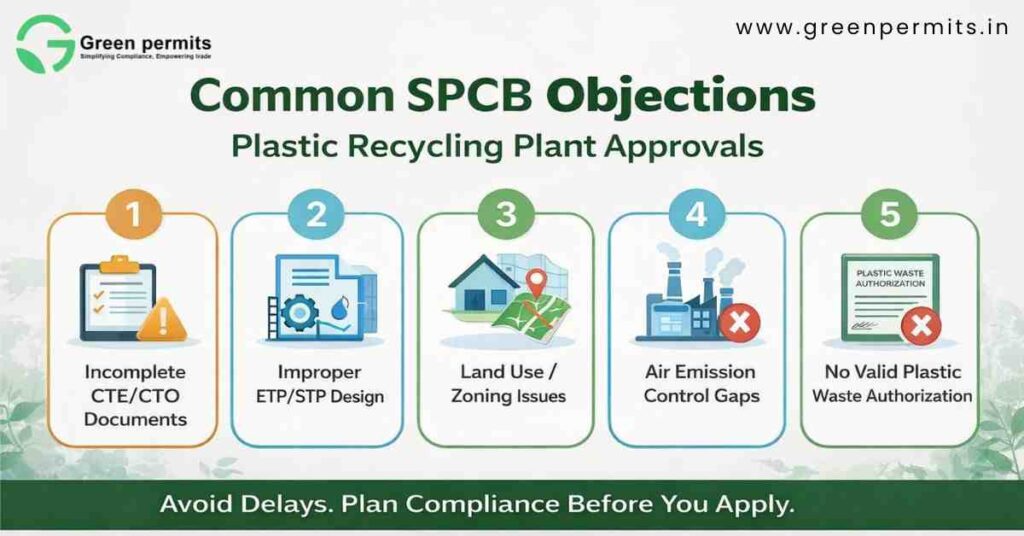
This is why understanding Common SPCB Objections in Plastic Recycling Plant Approvals before filing your application can save lakhs in avoidable delays.

Let’s break this down practically and structurally.
SPCB Plastic

Why SPCBs Raise Objections in Plastic Recycling Projects

State Pollution Control Boards are not rejecting projects randomly. Their role is to ensure compliance under the Environment Protection Act, Air Act, Water Act, and Plastic Waste Management Rules. Plastic recycling units, depending on capacity and process (washing, shredding, extrusion), usually fall under Orange or Red Category, which means deeper technical scrutiny.

In the last 3–5 years, scrutiny has increased significantly because:

  • India generates approximately 3.5–4 million MT of plastic waste annually
  • Formal recycling is increasing, bringing units under regulatory radar
  • Digital EPR tracking systems have improved compliance monitoring
  • Environmental compensation penalties are being imposed more actively

SPCB objections typically arise when there is a gap between:

  1. What is written in DPR
  2. What is shown in layout
  3. What is declared on the portal
  4. What is feasible on the ground

Most delays are preventable.

Land Use and Location-Based Objections

Before technical review even begins, SPCB verifies land compliance. Many projects get stuck here.

Industrial activity cannot legally operate on agricultural land unless proper conversion (CLU) is completed. Even if the land is purchased, revenue records must reflect industrial usage.

Common Location Objections

  1. Land shown as agricultural in revenue documents
  2. No industrial zoning certificate attached
  3. Unit within restricted buffer from residential cluster
  4. No distance mapping from water bodies
  5. Site located in flood-prone zone

Why SPCB Is Strict Here

Plastic recycling involves:

  • Storage of combustible material
  • Operation of electrical machinery
  • Potential emission and wastewater generation

If zoning is incorrect, SPCB may reject Consent to Establish outright.

Business Impact

  • 60–120 days delay
  • Additional legal conversion cost
  • Revised site planning expense

Many entrepreneurs underestimate this stage, but nearly 30–40% of early objections are land-related.

Incomplete or Improper Plant Layout

The layout drawing is one of the most critical documents. SPCB officers carefully evaluate whether your plant design reflects environmental compliance.

A recycling plant layout is not just a building plan. It is an environmental compliance blueprint.

Typical Layout Objections

  1. No segregation between raw material and finished goods
  2. No dedicated hazardous waste storage room
  3. No dust suppression system marked in shredding area
  4. No green belt demarcation
  5. No stormwater drainage channel
  6. No ETP/STP area marked
  7. No fire hydrant system in layout

What SPCB Expects in Layout

Component Minimum Compliance Expectation Common Gap
Raw Material Yard Covered and segregated Open dumping shown
Shredding Section Dust collection system No extraction system
Washing Section Effluent treatment mapping No ETP shown
DG Set Stack height marking No emission detail
Hazardous Waste Secured storage room Mixed storage

More than 50% of technical objections originate from poorly prepared layouts.

A well-prepared layout reduces review cycles significantly.

Pollution Control System Deficiencies

Plastic recycling, especially washing and shredding operations, generates dust, microplastic residue, and contaminated wash water.

SPCB checks pollution control measures in detail.

Frequent Technical Objections

  1. No bag filter or cyclone separator in shredding section
  2. No dust extraction calculation
  3. Stack height calculation missing for DG set
  4. No oil and grease trap for wash water
  5. ETP capacity not matching water usage
  6. No sludge disposal plan

For example, a washing unit processing 20 MT/day plastic may generate 15–25 KL/day wastewater, depending on process. If your ETP is undersized or not designed scientifically, SPCB will raise objections.

SPCB also verifies:

  • Air emission control efficiency
  • Noise levels
  • Wastewater reuse or discharge method

Without engineering-backed documentation, approval is delayed.

Waste Flow Mapping and Material Balance Issues

Under Plastic Waste Management Rules (amended 2025), accountability of waste is mandatory.

SPCB expects clarity in material balance.

For example, if you process 30 MT/day plastic, you must clearly show:

  • Input: 30 MT
  • Recovery: 24–26 MT granules
  • Reject: 4–6 MT sludge/impurity
  • Disposal channel: Registered recycler or authorized facility

Common Objections

  1. No reject waste disposal agreement
  2. No clarity on sludge handling
  3. DPR capacity mismatch with portal registration
  4. No downstream buyer details
  5. No recovery percentage calculation

Material balance inconsistencies immediately raise red flags.

SPCB officers often cross-check capacity declared in:

  • DPR
  • Application form
  • Electricity load
  • EPR portal

If numbers don’t align, file is kept pending.

Documentation Gaps and Data Mismatch

Documentation consistency is one of the biggest risk areas.

Even small mismatches can delay approval by 30–90 days.

Frequent Documentation Objections

  1. DPR shows 25 MT/day but machinery supports 35 MT/day
  2. Electricity load insufficient for installed equipment
  3. CA-certified project cost not attached
  4. Lease deed not notarized
  5. GST details mismatch
  6. Incorrect category selection

SPCB compares data across multiple documents. Any variation creates compliance doubt.

Approximately 25–35% of objections are documentation-related.

Fire and Safety Non-Compliance

Plastic is combustible. Fire safety is not optional.

Many recycling units underestimate this requirement.

Common Fire Objections

  1. No Fire NOC attached
  2. No fire hydrant network
  3. No fire water tank capacity calculation
  4. No separation between storage and processing area
  5. No emergency exit marking

In several states, SPCB processes application only after Fire Department clearance.

Delays due to fire compliance alone can extend up to 45–60 days.

Increasing Regulatory Scrutiny After 2025 Amendments

With amendments in Plastic Waste Management Rules and digital EPR tracking:

  • Portal-based tracking of recyclers has improved
  • Capacity verification is more strict
  • Random inspections have increased
  • Environmental compensation penalties are being imposed

India’s plastic waste generation is rising annually. Formalization of recycling sector is increasing, which means scrutiny is tighter.

SPCBs now expect:

  1. Accurate capacity declaration
  2. Scientific pollution control systems
  3. Clear waste traceability
  4. Portal registration alignment

Non-compliant units face operational risk.

Real Example — 90-Day Delay Case

A 30 MT/day recycling unit faced objections due to:

  1. No dust extraction calculation
  2. Layout missing hazardous waste room
  3. No end-user tie-up agreement

After correcting documents and upgrading pollution control drawings, approval was granted in 28 days.

The delay cost:

  • 3 months bank interest
  • Worker idle wages
  • Vendor penalty

Most of this was avoidable with structured compliance planning.

Compliance Risks of Ignoring SPCB Observations

Ignoring SPCB objections can result in:

  1. Application rejection
  2. Environmental Compensation penalty
  3. Unit sealing
  4. Electricity disconnection
  5. Legal prosecution

Financial impact can escalate quickly. A 60-day delay in a mid-sized plant can increase project cost by 3–5%, depending on financing structure.

Compliance planning is cheaper than post-objection correction.

How to Avoid Common SPCB Objections in Plastic Recycling Plant Approvals

A structured pre-application strategy reduces risk significantly.

Location Readiness

  1. Industrial zoning confirmation
  2. CLU approval completed
  3. Distance mapping done

Technical Preparation

  1. Engineering-approved layout
  2. Dust extraction system design
  3. Proper ETP sizing calculation
  4. Stack height compliance

Documentation Alignment

  1. DPR capacity matched with machinery
  2. CA-certified project cost
  3. Electricity load sanction
  4. Portal registration consistency

Waste Accountability

  1. Material balance chart
  2. Reject waste tie-up agreement
  3. Downstream buyer documentation

Well-prepared applications reduce objection probability by 60–80%.

Conclusion

Most Common SPCB Objections in Plastic Recycling Plant Approvals fall into six structured categories:

  1. Land and zoning issues
  2. Layout deficiencies
  3. Pollution control gaps
  4. Waste flow inconsistencies
  5. Documentation mismatch
  6. Fire safety non-compliance

Entrepreneurs who integrate compliance at design stage — not after machinery purchase — experience faster approvals and lower financial stress.

Regulation is becoming stricter. But with the right preparation, approvals can be predictable and smooth.

📞 +91 78350 06182 | 📧 wecare@greenpermits.in
Book a Consultation with Green Permits

Book a Technical Call with Expert

📞 +91 78350 06182

FAQs — Common SPCB Objections in Plastic Recycling Plant Approvals

Improper plant layout and missing pollution control system details are the most frequent reasons for delay.

With complete documentation, 30–60 days. With objections, it can extend to 3–6 months.

Yes, registration under Plastic Waste Management Rules on CPCB portal is mandatory.

Yes, especially in case of zoning violation or major environmental non-compliance.