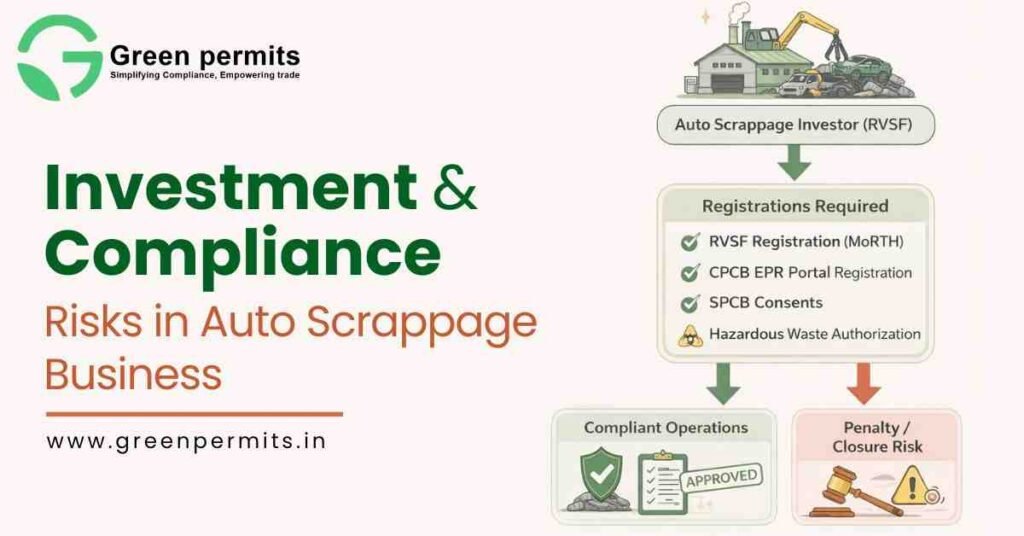
A Real Conversation Before Investing
A client recently told us, “The policy looks clear. Steel demand is strong. Government is pushing vehicle scrappage. What could go wrong?”
On paper, the auto scrappage business in India looks like a high-growth opportunity. But once we sat down and mapped the actual compliance layers — ELV Rules, EPR obligations, RVSF registration, hazardous waste handling, portal filings — the picture became more realistic.
Auto scrappage is not just a trading business. It is an infrastructure + regulatory + environmental compliance business.
If you are planning to invest ₹10–30 crore in this sector, this guide will help you understand the real risks and numbers involved.
Growth Potential of Auto Scrappage Business in India
India is entering a structured vehicle end-of-life management phase. The formal implementation of ELV Rules from 2025 has changed the industry landscape completely.
India has:
1+ crore vehicles estimated to be nearing end-of-life stage
70% average metal composition in passenger vehicles
8% to 18% steel-based EPR targets phased over coming years
Rapid expansion of organized scrapping facilities
For business owners, this means:
Structured demand from automobile manufacturers
Growing scrap steel consumption in India
Policy-backed circular economy push
Long-term regulatory support
However, growth only benefits those who align operations with compliance.
Regulatory Framework Governing Auto Scrappage Business in India
The auto scrappage business in India is governed by multiple legal frameworks. Understanding these before investing is critical.
1. Environment Protection (End-of-Life Vehicles) Rules, 2025
These rules introduce:
Extended Producer Responsibility (EPR)
Mandatory registration of Producers and RVSFs
Steel recovery-based targets
Online portal-based reporting system
2. Motor Vehicles (Registration & Functions of RVSF) Rules, 2021
These rules define:
Eligibility criteria for scrapping facilities
Infrastructure requirements
Equipment standards
Registration process
3. Hazardous & Other Waste Rules, 2016
Applicable for:
Waste oil
Coolants
Batteries
Brake fluids
Mercury components
4. Plastic, E-Waste and Solid Waste Rules
Vehicles contain:
20–25% non-metal materials
3–8% plastic components
Electronic assemblies requiring proper disposal
Business Impact:
EPR Targets: The Revenue Driver in Auto Scrappage Business in India
The financial viability of a scrappage facility is directly linked to steel recovery and EPR certificate generation.
Steel-Based EPR Targets (Phased Implementation)
Transport Vehicles
2025–2029: Minimum 8% of steel used
2030–2034: Minimum 13%
2035 onward: Minimum 18%
Non-Transport Vehicles
2025–2029: Minimum 8%
2030–2034: Minimum 13%
2035 onward: Minimum 18%
Why This Matters Financially
RVSFs generate EPR certificates based on actual steel recovery.
Producers must purchase these certificates.
Certificate pricing depends on supply-demand.
Incorrect reporting can lead to rejection.
Portal non-compliance can freeze transactions.
A facility processing 10,000 vehicles annually can generate significant steel output, but only compliant reporting converts that into revenue.
Investment Structure in Auto Scrappage Business in India
Investors often underestimate the capital structure required.
Typical Mid-Sized Facility Investment
Land (2–5 acres industrial zone): ₹3–8 crore
Civil construction & storage: ₹2–5 crore
Depollution equipment: ₹3–7 crore
Dismantling & handling machinery: ₹2–6 crore
Pollution control systems: ₹1–3 crore
Compliance, licensing & approvals: ₹0.5–1 crore
Working capital buffer (6–9 months): ₹3–5 crore
Total Estimated Range: ₹12–30 crore depending on scale and automation.
Additional Financial Realities
Steel price fluctuation impacts margins.
EPR certificate prices are market-driven.
Producer payments may follow 60–90 day cycles.
Insurance and environmental audit costs are recurring.
This is a capital-intensive, compliance-driven model.
Operational Structure of a Compliant RVSF
A properly structured auto scrappage business in India must include:
Depollution zone (fluid removal area)
Hazardous waste storage area
Segregation platform
Covered storage for recovered parts
Scrap dispatch logistics
Digital inventory tracking
ELV portal reporting system
Vehicles Contain:
70% steel
7–8% aluminum
3–8% plastic
Hazardous oils and fluids
Electronic components
Each of these streams must be handled scientifically.
Compliance Risks That Can Disrupt Business
Registration Risk
If RVSF registration is incomplete:
No legal scrapping allowed
No EPR certificate generation
No producer contracts
Portal Reporting Risk
Producers and RVSFs must:
Declare annual obligations
File returns
Update steel recovery data
Maintain transaction records
Failure may result in:
Portal suspension
Rejection of certificates
Financial penalties
Environmental Inspection Risk
Improper handling of:
Waste oil
Battery acid
Brake fluids
Contaminated soil
Can lead to:
Immediate closure notice
Monetary penalty
Revocation of registration
Real-World Risk Scenario
One facility invested ₹18 crore in infrastructure but delayed hazardous waste authorization by 3 months.
Result:
Inspection notice issued
Temporary operational halt
OEM contract withheld
Bank funding delayed
Estimated revenue loss ₹80 lakh in 60 days
In this sector, compliance delay equals revenue loss.
Financial Risk Factors Investors Must Evaluate
Before entering the auto scrappage business in India, evaluate:
Steel scrap price volatility (5–15% monthly variation possible)
Demand-supply imbalance of EPR certificates
Seasonal variation in ELV inflow
Logistic cost fluctuations
Working capital blockage due to delayed payments
A 5% drop in scrap realization can significantly reduce EBITDA margins.
Long-Term Sustainability Outlook
India’s push toward circular economy means:
Increased reliance on recycled steel
Formalization of scrap supply chain
Elimination of informal scrap yards
Mandatory compliance ecosystem
Secondary steel production consumes significantly lower energy compared to primary steel production. This supports long-term policy continuity.
Auto scrappage is not a short-term speculative play. It is a regulated infrastructure opportunity
Strategic Checklist Before Investing
If you are serious about entering the auto scrappage business in India:
Conduct land due diligence (industrial zoning mandatory).
Obtain Consent to Establish from SPCB.
Apply for RVSF registration.
Prepare hazardous waste handling plan.
Install pollution control infrastructure.
Set up ELV portal compliance team.
Structure OEM partnerships early.
Maintain digital documentation system.
Compliance planning should begin before construction.
Conclusion
The auto scrappage business in India presents structured growth supported by policy and environmental regulation.
However:
It is capital-intensive.
It is compliance-sensitive.
It is inspection-driven.
It requires long-term planning.
Those who invest in documentation, registration, environmental systems, and structured operations will build scalable businesses.
Those who ignore regulatory discipline may face:
Operational shutdown
License suspension
EPR certificate rejection
Financial strain
In this sector, compliance is not an expense — it is your competitive advantage.
📞 +91 78350 06182
📧 wecare@greenpermits.in
Book a Consultation with Green Permits