
A Delhi-based electronics importer believed everything was ready. The shipment had already sailed. Payment was released. Retailers were waiting for stock before the festive season. Then an email arrived from DGFT — “Deficiency observed in application.”
The HS code did not match the technical write-up. The IEC address was outdated. The BIS registration number was missing. Within 17 working days, the application was rejected. The container remained at port for 29 days. Demurrage crossed ₹6.2 lakh.
For many Indian businesses, DGFT licence rejections are not paperwork issues — they are working capital crises.
In 2025–2026, DGFT processing is digitally integrated with PAN, GSTN, ICEGATE, and sectoral databases. Even a 1-digit HS error or mismatch in company details can trigger rejection within 10–20 working days.
This article explains the legal triggers, compliance timelines, penalty exposure, and preventive strategy.
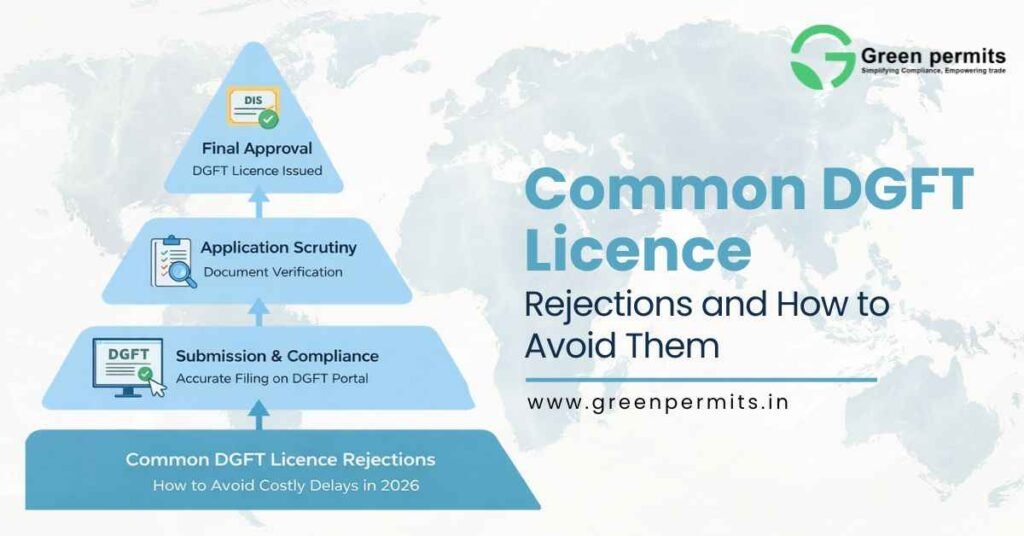
DGFT approvals operate under a structured statutory system. Understanding the framework reduces rejection risk significantly.
Key laws and policies include:
Business relevance:
In 2025, over 90% of applications are digitally validated before officer review. System mismatches are now the leading cause of rejection.
IEC (Import Export Code) is the foundation of trade compliance.
Rejection typically happens due to:
Regulatory facts:
Business impact example:
A Gujarat-based machinery importer lost 21 working days due to IEC address mismatch. Bank LC extension charges alone crossed ₹1.8 lakh.
HS classification errors account for a significant percentage of DGFT licence rejections.
Why it happens:
Key compliance points:
Numerical exposure:
A 1-digit HS mistake can convert a 15-day approval process into a 60-day compliance issue.
In 2025, DGFT cross-verifies applications with other regulatory databases.
Common linked compliance areas:
For example:
Vehicle importers fall under End-of-Life Vehicle compliance framework effective 01 April 2025. Producers include importers of vehicles. If EPR registration is not completed before licence application, scrutiny increases.
EPR targets for vehicles are progressive:
Failure to align environmental compliance may not immediately reject DGFT licence, but it significantly increases query probability.
Penalty risk under environmental non-compliance may arise under Section 15 of Environment Protection Act, 1986.
Capital goods imports under EPCG carry long-term compliance responsibility.
Important numbers:
Common rejection triggers:
Financial exposure example:
A capital goods importer miscalculated export obligation by 5%. The duty benefit of ₹2.4 crore became payable with interest.
DGFT usually issues deficiency memo within:
Applicant response window:
If no response is filed within timeline:
Responding within 48 hours significantly improves approval probability.
DGFT portal requires Class-III DSC linked to authorized signatory.
Rejections occur due to:
Correction timeline:
In high-value imports, even 5-day delay may cost ₹2–5 lakh in logistics and interest.
| Regulation | Key Requirement | Deadline | Applicable To | Risk if Ignored |
|---|---|---|---|---|
| FTDR Act Sec 7 | Valid IEC | Before import/export | All traders | Licence rejection |
| FTP 2023 (Amended) | Correct HS classification | At filing | Importers/exporters | Customs hold |
| EPCG Scheme | Export obligation fulfilment | 6 years | Capital goods importers | Duty + 15% interest |
| Environmental Rules | EPR registration | Ongoing | Regulated sectors | Compliance scrutiny |
| Customs Act Sec 111 | Valid licence | At import | Restricted goods | Confiscation risk |
Interpretation:
DGFT approval is no longer isolated. It is integrated with customs, environmental, and certification compliance systems.
| Step | Authority | Timeline | Documents Required | Risk Area |
|---|---|---|---|---|
| IEC Validation | DGFT | Instant | PAN, GST | Data mismatch |
| Licence Filing | DGFT | Day 0 | HS code, tech sheet | Wrong classification |
| Deficiency Memo | DGFT | 10–20 days | Clarifications | Delay in response |
| Approval/Rejection | DGFT | 20–30 days | Complete documents | Rejection |
| Customs Clearance | ICEGATE | At port | Approved licence | Shipment hold |
Ignoring DGFT rejection risks may lead to:
For MSMEs operating at 8–12% margins, a 45-day delay can erase quarterly profit.
Structured approach reduces rejection probability significantly.
Pre-submission checklist:
Professional pre-filing audit can reduce rejection risk by more than 70%.
DGFT licence rejections in 2025–2026 are data-driven compliance failures, not clerical errors.
With automated validation across:
Even minor mismatches can trigger rejection within 10–20 working days.
The financial cost of rejection includes:
Early compliance alignment, accurate HS classification, and structured documentation prevent rejection and protect business continuity.
📞 +91 78350 06182
📧 wecare@greenpermits.in