
Rohit, an electronics importer from Andheri, had just received confirmation that his ₹1.2 crore shipment of smart Wi-Fi devices had landed at Nhava Sheva Port. BIS certification was complete. IEC was active. Retail distributors across Maharashtra had already issued advance purchase orders worth ₹2.1 crore for the festive season launch.
Within 48 hours, customs flagged the consignment – no valid WPC Equipment Type Approval (ETA) for the 2.4 GHz RF module embedded inside the device.
For the next 18 days, Rohit watched demurrage charges rise beyond ₹6.8 lakh. One distributor invoked a 3% delay penalty clause. Marketing campaigns were paused. The issue was not product safety – it was wireless spectrum compliance.
If your product transmits radio frequency – even at 10 mW output – WPC Approval in India is mandatory before import, warehousing, distribution, or sale.
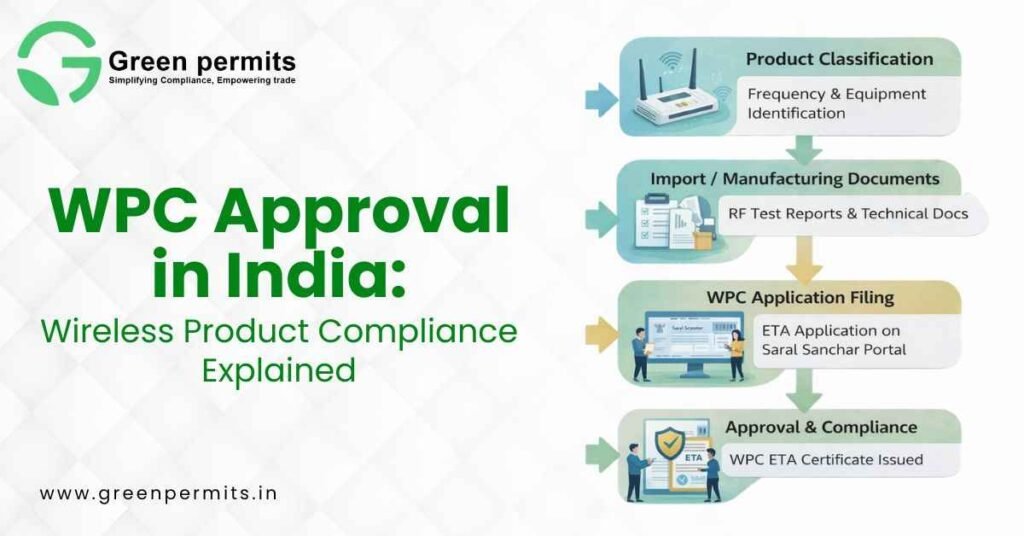
WPC Approval in India is regulatory authorization issued by the Wireless Planning & Coordination (WPC) Wing under the Department of Telecommunications (DoT), Government of India. It governs the use of radio frequency spectrum and ensures that wireless products operate strictly within India’s allocated frequency bands.
Wireless spectrum is a national resource. Under Indian law, its usage is controlled and licensed by the Central Government. Any device transmitting radio frequency signals – including Wi-Fi, Bluetooth, GSM, RFID, LoRa, Zigbee, or proprietary RF modules – must comply before entering the Indian market.
Wireless regulation in India is backed by statutory provisions:
Violation of these provisions may result in seizure, confiscation, monetary penalties, or re-export of goods. In high-value consignments exceeding ₹1 crore, enforcement action can significantly impact working capital and supply chain commitments.
Wireless enforcement has become more structured and technology-driven in 2025. Customs authorities now digitally verify ETA approvals against the DoT database before clearance.
Recent compliance trends show:
A 20-day customs hold can result in:
Wireless compliance must therefore be completed before dispatch from the country of origin.
Understanding the type of approval required is essential to avoid rejection.
ETA is required for products operating in license-exempt frequency bands. It is the most common form of WPC Approval in India.
Common bands include:
ETA characteristics:
In 2024–2025, nearly 70% of wireless import delays were linked to incorrect ETA filings or mismatched RF parameters.
If a product operates in licensed GSM or telecom bands:
Failure to obtain the correct category of approval is one of the top 3 reasons for regulatory rejection.
Distributors and warehousing entities handling wireless devices may require DPL. Possession of wireless equipment without required authorization can attract enforcement action.
The scope of wireless regulation is broader than many businesses assume. The following products commonly require approval:
Even if the RF module is certified in the USA or EU, Indian ETA approval remains mandatory.
A structured approach reduces approval delays.
Before filing, the product must undergo RF testing to verify:
Testing timeline: 5–10 working days.
Incorrect RF power declaration accounts for nearly 30% of ETA rejection cases.
Application is submitted through the DoT Saral Sanchar portal.
Required documentation includes:
Preparation timeline: 3–5 working days.
Incorrect model naming between invoice and application is a frequent compliance risk.
| Stage | Authority | Typical Timeline | Compliance Risk |
|---|---|---|---|
| Application Submission | Applicant | 3–5 days | Incorrect frequency band |
| Technical Scrutiny | WPC Wing | 10–15 working days | RF mismatch |
| Clarification Window | Applicant | 7 days | Delayed response |
| ETA Issuance | DoT | 15–25 working days | Incomplete documentation |
Well-prepared applications are typically approved within 20 working days. Incomplete filings may extend the cycle to 30–45 working days.
| Frequency Band | Typical Max Power | Usage | Risk if Non-Compliant |
|---|---|---|---|
| 2.4 GHz | ~100 mW | Wi-Fi, Bluetooth | Customs detention |
| 5 GHz | Band-specific | Routers | Seizure |
| 865–867 MHz | Low power | RFID | Rejection |
| GSM Bands | Licensed | Telecom | Legal action |
Incorrect declaration of antenna gain or ERP values may lead to rejection even if frequency band is correct.
More than 40% of ETA delays occur due to documentation inconsistency.
Failure to secure WPC Approval in India may result in:
For mid-sized electronics importers, one compliance failure may affect 5–8% of annual turnover.
| Parameter | WPC Approval | BIS Certification |
|---|---|---|
| Authority | DoT | BIS |
| Focus | RF Spectrum | Safety & Quality |
| Mandatory for Wireless | Yes | Sometimes |
| Customs Impact | Direct | Indirect |
| Validity | Model-based | Usually 2 years |
Many wireless consumer electronics require both approvals before sale.
A proactive compliance plan includes:
Early compliance reduces customs risk exposure by over 70% and protects supply chain continuity.
WPC Approval in India is a statutory wireless spectrum compliance requirement under Indian law. It is not an optional procedural step.
The cost of non-compliance:
The cost of structured compliance:
For importers, manufacturers, and IoT brands, early WPC compliance safeguards capital, timelines, and market credibility.
📞 +91 78350 06182
📧 wecare@greenpermits.in