
A European manufacturer finalized its Indian distributor. Marketing campaigns were live. Inventory was dispatched.
Then customs asked for one document:
BIS FMCS License.
The shipment was held at port. Storage charges started. Distributor confidence dropped.
The brand assumed certification could be completed “after launch.”
In India, compliance does not work that way.
If you are a foreign manufacturer planning to enter India, BIS FMCS Certification is not optional — it is your legal gateway.
This guide explains everything you need to know before you ship.
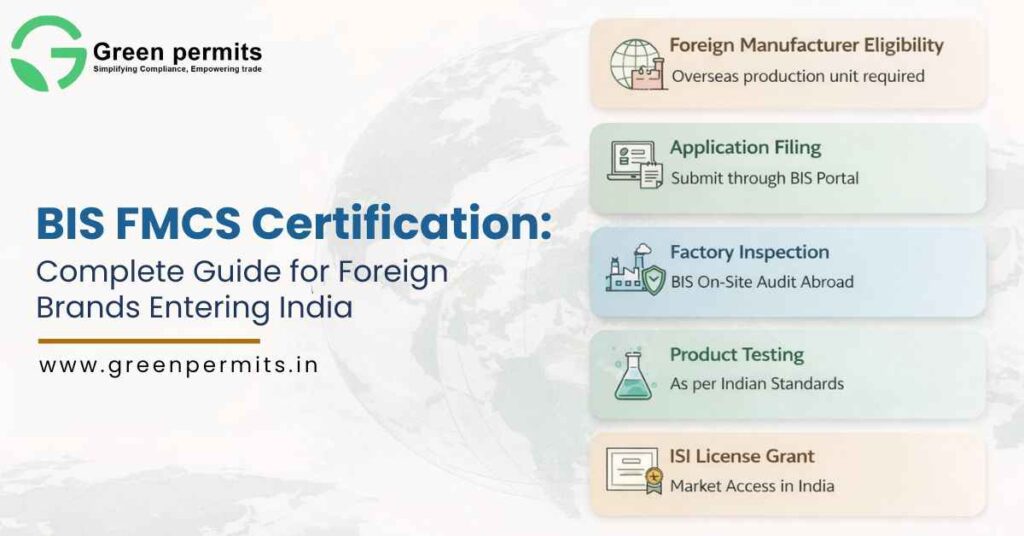
BIS FMCS Certification (Foreign Manufacturer Certification Scheme) allows overseas manufacturers to obtain a BIS License to use the ISI Mark for products notified under mandatory Indian Standards.
It is governed under the BIS Act, 2016, and applies when:
Unlike simpler registration routes, FMCS involves:
This is not a document filing exercise — it is a compliance evaluation of your manufacturing system.
Foreign brands often confuse FMCS with CRS (Compulsory Registration Scheme).
Here is the clear distinction:
| Parameter | FMCS | CRS |
|---|---|---|
| Mark Required | ISI Mark | No ISI Mark |
| Factory Inspection | Mandatory | Not required |
| Applicable Products | Safety & regulated industrial goods | Electronics & IT equipment |
| Governing Standard | Indian Standard (IS) | Self-declaration + testing |
| Complexity | High | Moderate |
Interpretation for foreign brands:
If your product must carry the ISI mark — FMCS is the only route.
Understanding the structured process helps avoid delays.
Foreign manufacturers must appoint an Indian entity or representative.
The AIR:
Choosing an inexperienced AIR often causes delays.
The application includes:
Incomplete documentation is the most common reason for initial query notices.
Many foreign factories fail here due to slight technical mismatches with Indian standards.
BIS officials visit the foreign manufacturing facility.
Inspection includes:
This stage determines whether your factory is genuinely compliant — not just your product.
After satisfactory inspection and documentation clearance:
Compliance does not end after approval.
BIS conducts:
Non-compliance may result in suspension or cancellation.
Foreign brands must prepare:
Poor documentation alignment between factory practice and manual submission leads to inspection failure.
| Stage | Approximate Duration |
|---|---|
| Documentation Preparation | 3–6 weeks |
| Product Testing | 3–5 weeks |
| BIS Inspection Scheduling | 4–8 weeks |
| Final License Approval | 2–4 weeks |
| Total Expected Time | 4–6 months |
Business Insight:
FMCS must be initiated at least 6 months before planned India entry.
While official BIS fees vary by product category, foreign brands should budget for:
The real cost, however, is often delay.
Ignoring FMCS requirements can lead to serious consequences:
India has strengthened enforcement at ports and through market surveillance.
Shipment detention alone can block working capital for months.
A Southeast Asian manufacturer applied under FMCS without upgrading its internal QC lab to match Indian Standard requirements.
During inspection:
Result:
FMCS is a system compliance audit — not a paperwork formality.
Foreign brands that prepare early benefit from:
Reactive compliance often results in:
The FMCS route demands operational alignment — not just certification intent.
Before launching in India:
India is a high-opportunity market — but compliance-first.
BIS FMCS Certification is not a regulatory hurdle.
It is your structured entry approval into India.
Foreign manufacturers who treat it strategically:
Waiting until customs stops your shipment is already too late.
Book a Consultation with Green Permits