
A Delhi-based importer recently had a 40-foot container of LED drivers worth ₹1.2 crore stuck at port. The products were tested. Payment cycles were aligned. Distributors across 5 states were ready to receive inventory.
But customs requested a valid BIS registration number under the applicable IS standard. The registration was still under process.
The delay lasted 21 days. Storage charges crossed ₹45,000 per day. Total demurrage crossed ₹9–10 lakh. Two major distributors cancelled purchase orders worth ₹32 lakh.
The product was compliant — but the timing wasn’t.
This is where BIS OTR certification directly affects working capital, launch timelines, and revenue cycles.
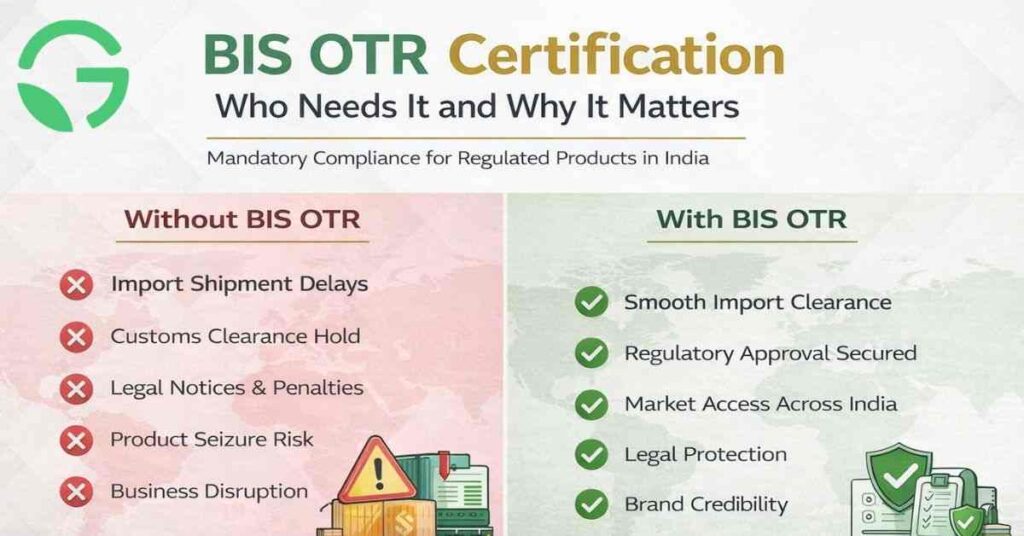
BIS OTR (Online Registration) Certification is the digital registration process under the Bureau of Indian Standards (BIS), primarily governed through the Compulsory Registration Scheme (CRS).
As of 2024–25, more than 100+ product categories fall under mandatory BIS registration across electronics, IT goods, batteries, and consumer equipment.
Under BIS OTR, a manufacturer must:
Registration validity is typically 2 years, after which renewal is mandatory.
Selling without registration can trigger enforcement under the BIS Act, 2016.
BIS OTR operates under a legally enforceable regulatory structure.
| Regulation | Year | Authority | Impact |
|---|---|---|---|
| BIS Act | 2016 | BIS | Enforcement & penalties |
| CRS Scheme Launch | 2012 | MeitY | Mandatory electronics registration |
| QCO Expansion | 2018–2025 | Various Ministries | Product coverage increase |
Since 2015, the number of mandatory regulated product categories has increased by nearly 3x to 4x.
India’s Quality Control Orders (QCOs) now cover:
For businesses, this means regulatory coverage is expanding at a rate of approximately 10–20 new product notifications per year.
Any manufacturer producing goods covered under CRS must register before selling in India.
This includes:
Foreign manufacturers must appoint 1 Authorized Indian Representative (AIR) to handle compliance matters.
Manufacturers are responsible for:
If your brand name appears on the product, compliance responsibility lies with you.
This applies to:
Even if the factory has tested the product, you must ensure:
In some cases, companies importing 5–10 model variants forget that each model may require separate registration.
India’s regulatory tightening is visible through product expansion.
| Year | Approx. Mandatory Categories |
|---|---|
| 2015 | ~30 |
| 2020 | ~75 |
| 2024–25 | 100+ |
That represents a 250–300% increase in regulated products within 10 years.
Businesses must actively monitor notifications because products previously considered “optional” may become mandatory overnight.
Proper documentation reduces rejection probability significantly.
Typical documentation checklist includes:
A large percentage of application delays occur due to:
Even small inconsistencies can trigger 1–2 weeks of additional scrutiny.
Testing typically takes 2–4 weeks, depending on laboratory workload.
Testing costs can vary between ₹25,000 to ₹1,50,000 per model, depending on product complexity.
Products are evaluated for:
If a product fails, re-testing can add 2–3 additional weeks and additional costs.
Once testing is completed, application is submitted via BIS portal.
Approval generally takes 2–4 weeks, subject to query resolution.
The full process may take 4–8 weeks in total, depending on:
Dispatching goods before registration approval significantly increases risk.
| Stage | Estimated Duration |
|---|---|
| Product Testing | 2–4 weeks |
| Documentation Filing | 5–7 days |
| BIS Scrutiny | 2–4 weeks |
| Total Cycle | 30–60 days |
For seasonal products, a 30-day delay can impact:
Compliance should be initiated at least 60 days before planned shipment.
Under the BIS Act, non-compliance can result in:
Financial exposure may include:
A single compliance delay can erode 5–15% of total shipment value in indirect costs.
| Feature | BIS OTR (CRS) | ISI Mark | FMCS |
|---|---|---|---|
| Launch Year | 2012 | Earlier regime | 2000+ |
| Inspection | Lab-based | Factory inspection | Overseas factory audit |
| Validity | ~2 years | 1–2 years | 1–2 years |
| Coverage | Electronics & IT | Broader product list | Foreign manufacturers |
Selecting the wrong certification route can delay approvals by 4–8 additional weeks.
Delays affect financial metrics directly.
Common impacts include:
Early compliance planning ensures:
For growing brands, compliance stability supports long-term scalability.
Businesses handling 10+ product SKUs should implement structured compliance systems.
Recommended steps:
A proactive approach reduces rejection probability and avoids revenue leakage.
BIS OTR Certification is more than documentation. It is a legally enforceable requirement with direct operational and financial implications.
In an environment where mandatory product categories have increased by nearly 300% in a decade, compliance planning must move from reactive to proactive.
Businesses that integrate compliance into production and supply chain planning avoid delays, reduce financial exposure, and maintain market credibility.
Book a Consultation with Green Permits
We assist manufacturers and importers with complete BIS OTR certification — from lab coordination to registration approval — ensuring your shipments move without compliance disruptions.