
A mid-sized manufacturer in Pune once told us, “We don’t generate waste — waste just happens.”
Rejected materials, expired packaging, damaged goods, obsolete electronics — they pile up quietly until one day a notice arrives from the Pollution Control Board or a large customer asks uncomfortable ESG questions.
What most businesses don’t realise is that this “waste problem” is not an operational failure. It’s a linear business mindset colliding with a circular regulatory world.
The circular economy is not a buzzword anymore. For Indian businesses, it is becoming the default operating model, whether they choose it or not.
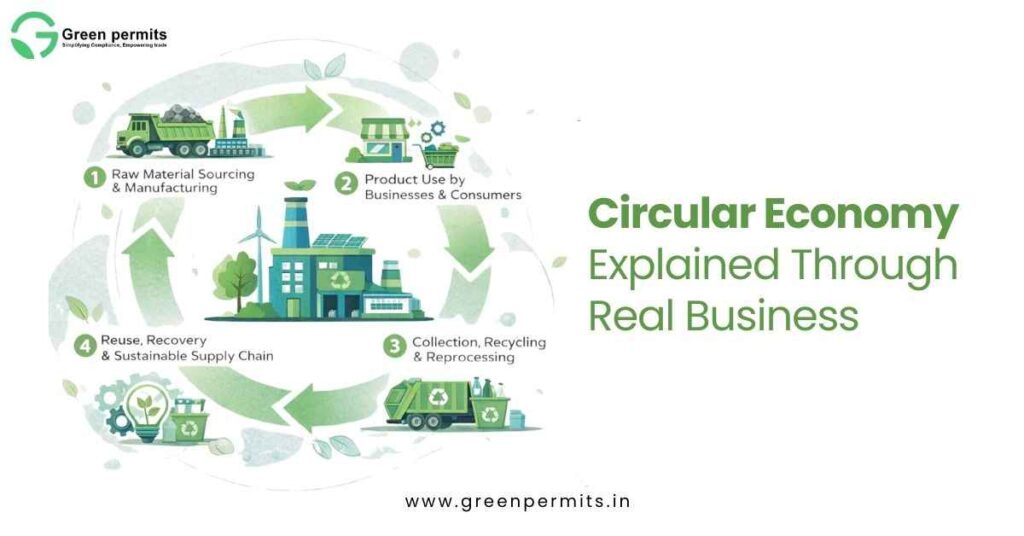
For most business owners, the circular economy sounds abstract — something discussed at conferences, not factory floors. In reality, it’s far more practical.
At its core, the circular economy focuses on:
In business terms, it shifts waste from being a cost line item to a managed resource. Instead of paying repeatedly for disposal, transport, and penalties, businesses design systems where materials flow back into production or authorised recycling channels.
This approach directly affects margins, compliance stability, and long-term scalability.
Most Indian industries still operate on a linear model: procure, produce, sell, discard. This worked when regulations were lighter and raw materials cheaper. That reality no longer exists.
| Business Aspect | Linear Economy | Circular Economy |
|---|---|---|
| Raw material dependency | High and volatile | Reduced and controlled |
| Waste handling | Reactive | Planned and systematic |
| Regulatory exposure | Frequent notices | Lower enforcement risk |
| Cost predictability | Poor | Much higher |
What businesses experience on the ground:
Linear operations invite sudden inspections, surprise penalties, and rushed compliance spending. Circular operations allow planning — and planning is where costs come down.
A medium-scale plastic moulding unit faced repeated margin pressure due to fluctuations in virgin polymer prices. Initially, the focus was on negotiating better supplier rates.
The real shift happened when they:
This didn’t require major capex or plant changes. What changed was the procurement mindset.
Over time:
Circular economy here wasn’t a sustainability project. It was cost risk management.
E-waste is one of the most misunderstood compliance areas. Many importers and manufacturers assume it’s only about end-of-life recycling.
In reality, circular economy in e-waste is about:
A consumer electronics importer once struggled with unpredictable EPR costs every financial year. By aligning product data, sales volumes, and recycler tie-ups, EPR moved from a yearly panic to a controlled compliance activity.
The waste didn’t change — the planning did.
India is not moving towards circular economy slowly — it’s being embedded directly into policy, approvals, and industrial planning.
| Indicator | Impact on Businesses |
|---|---|
| Rising material imports | Higher input costs |
| Waste regulations tightening | Higher compliance exposure |
| ESG-linked procurement | Supplier scrutiny |
| Resource efficiency focus | Competitive advantage |
What this means for businesses:
Circular economy is no longer voluntary. It is being enforced indirectly through procurement rules, environmental clearances, and corporate governance requirements.
A common mistake businesses make is treating sustainability initiatives and regulatory compliance as two different activities.
In India, they are deeply connected.
Circular economy practices are enabled through:
Without compliance, circular models collapse. Without circular planning, compliance becomes expensive and reactive.
The strongest businesses are those that design circularity into compliance itself.
Battery waste is rapidly becoming one of the most scrutinised waste streams due to EV growth and safety risks.
A supplier handling lithium battery packs struggled with:
By aligning with authorised recyclers and registering correctly, the business achieved:
Circular economy here was not about profits — it was about operational survival and risk reduction.
Ignoring circular practices doesn’t cause immediate shutdowns — it causes slow damage.
Common consequences include:
Most penalties don’t come from intentional violations, but from poor systems and late action.
One of the biggest myths is that circular economy needs new plants, new machinery, or large capital outlay.
In practice, most businesses start by:
The biggest investment is not money — it’s clarity.
Businesses that act early gain:
Late compliance always costs more — in money, management bandwidth, and reputation.
Circular economy rewards preparation, not panic.
Circular economy is no longer about environmental responsibility alone. For Indian businesses, it has become:
Those who integrate it early gain control. Those who delay are forced to react.
If circular economy feels confusing or overwhelming, you don’t need theory — you need a clear, step-by-step compliance and execution plan.
📞 +91 78350 06182
📧 wecare@greenpermits.in