
When NovaLink Imports, a growing electronics distributor in Pune, submitted their E-Waste EPR application, they believed everything was accurate. Within a week, the CPCB portal returned their application with multiple observations: wrong EEE codes, mismatched import data, incomplete RoHS documentation, and an incorrect CA certificate. Their registration was pushed back by more than a month, and a full shipment worth lakhs got stuck at the port.
This is a familiar story for many Indian importers. E-Waste EPR registration is not complex, but it is extremely detail-driven. A single mismatch—whether in brand, sales data, or document format—can result in significant delays.
Below is an expanded breakdown of the most common compliance errors importers make and how you can avoid them.
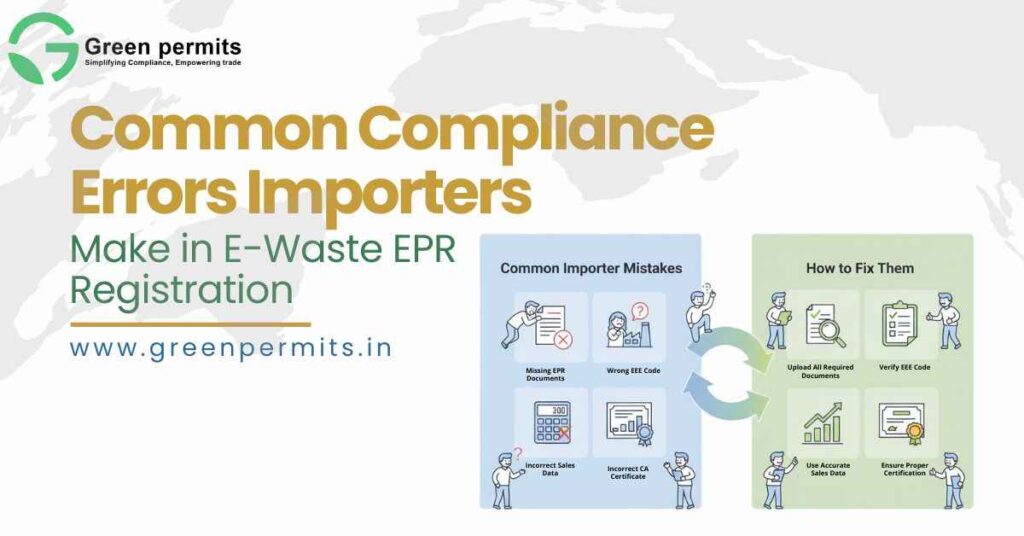
Selecting the correct EEE code is one of the most underestimated compliance steps. The CPCB’s EEE schedule spans multiple categories, each having detailed subcategories. Most importers choose based on their interpretation of the product rather than CPCB’s technical classification.
Here’s what typically goes wrong:
Why this matters:
Incorrect codes generate inaccurate EPR targets for metals like gold, copper, and aluminium. This directly impacts the EPR cost you eventually pay. CPCB usually puts such applications under review, delaying approvals by several weeks and sometimes triggering a manual audit.
RoHS compliance is mandatory for every importer, but it is one of the most misunderstood requirements. Many businesses upload half-complete RoHS declarations or old lab test reports hoping they will pass.
Common errors include:
Why this matters:
RoHS compliance is a legal requirement under E-Waste Rules. If documentation does not support the imported product’s chemical composition, CPCB will not issue registration. Applications remain pending until correct documentation is provided, delaying shipments, customs clearance, and sales timelines.
Sales data is one of the most frequently rejected sections of EPR applications. CPCB requires importers to report the total weight (MT) of EEE placed on the Indian market for historic years equal to the product’s average lifespan.
Here’s where importers slip:
Why this matters:
Sales data drives your EPR target. If it is incorrect, your EPR liability will be miscalculated, often pushing your cost higher than necessary. CPCB often returns applications for correction, requiring fresh CA-certified data.
Brand linkage is a common blind spot for importers. Many believe that importing and reselling under their own store name is automatically compliant—but this can completely change your registration category.
Typical brand-related errors include:
Why this matters:
E-Waste rules classify “Producer” differently from “Importer”. If you sell an imported item under your own brand, you are treated as a Producer and must meet Producer-level obligations, including an awareness plan, higher documentation, and stricter compliance.
Applications are often held back until branding consistency is established.
The CA certificate is the backbone of the EPR application because it validates the importer’s sales data. Unfortunately, many CA certificates do not follow the required format.
Importers commonly make these mistakes:
Why this matters:
CPCB treats any inconsistency between sales data and the CA certificate as a major red flag. The application is returned for revision, delaying registration and affecting timelines for customs clearance.
| Compliance Error | Why It Happens | Impact | Average Delay |
|---|---|---|---|
| Wrong EEE Code | Misreading CPCB’s categories | Wrong EPR targets, manual verification | 15–25 days |
| Missing RoHS Docs | Partial or incorrect EN 50581 files | Application kept under review | 20–40 days |
| Incorrect Sales Data | No MT calculation or CA mismatch | Incorrect target allocation | 10–20 days |
| Brand Mismatch | Selling under wrong/unlisted brand | Application returned | 15–30 days |
| Incomplete CA Certificate | No breakdown, no UDIN | Re-submission required | 10–20 days |
| Document | Format | Key Requirement |
|---|---|---|
| GST Certificate | Address must match registration details | |
| IEC Certificate | Mandatory for importers | |
| CA Certificate | Must show FY-wise MT data | |
| RoHS Documents | Must meet EN 50581 standards | |
| Awareness Plan | Required for Producer-level importers | |
| Brand Proof | Needed if selling under a private or Indian brand |
Most compliance errors seem minor at first glance, but they carry serious consequences:
One Delhi-based importer unknowingly selected the wrong EEE category for LED TVs. This resulted in incorrect target calculations, inflating their EPR contribution by nearly 40 percent. The mistake was discovered only after the annual return filing—which made correction impossible for that financial year.
E-Waste EPR registration is designed to be straightforward, but it requires accuracy and attention to detail. Most delays come from simple oversights—wrong EEE codes, incomplete RoHS files, mismatched sales data, or incorrect brand declarations. Importers who invest time in getting this right save weeks of back-and-forth, avoid unnecessary EPR costs, and ensure smooth clearance of imports.
If you want your registration to be accurate the first time, expert guidance can save you significant time and compliance risk.
📞 +91 78350 06182
📧 wecare@greenpermits.in
Book a Consultation with Green Permits