
This is usually how the conversation begins.
Not with anger.
Not with negligence.
But with genuine confusion.
The business is operational. Products are selling. Compliance was assigned to a capable team or consultant. The Plastic EPR registration was approved. Annual returns were filed. Certificates were uploaded. No deadlines were missed.
And yet, one day, the CPCB portal shows a single word that changes everything:
Suspended.
No detailed explanation.
No immediate clarity on what went wrong.
Just uncertainty — and operational risk.
To understand why this happens, it’s important to understand how CPCB actually looks at EPR compliance, which is very different from how most businesses think about it.
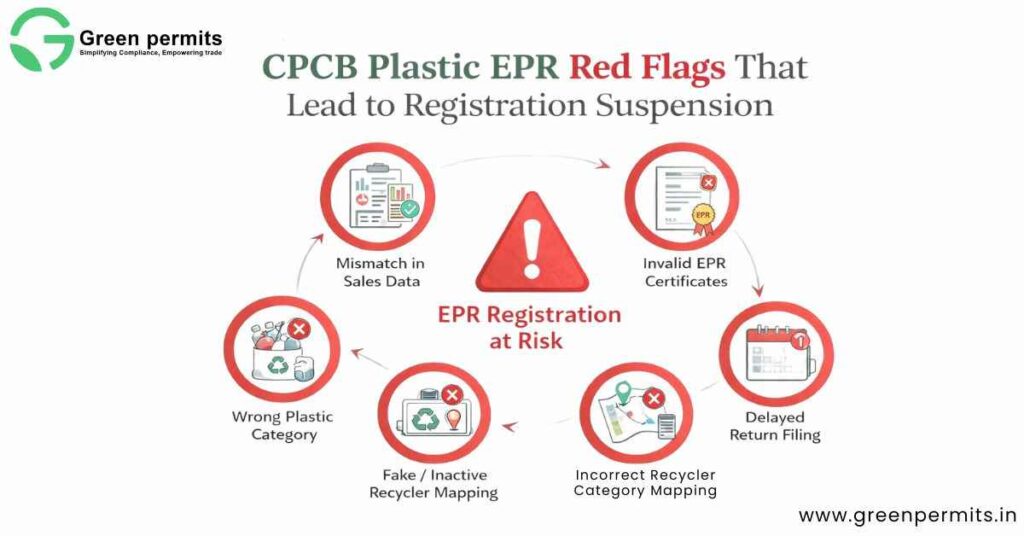
For most companies, EPR is treated like a task:
For CPCB, EPR is not a task.
It is a live compliance system.
CPCB does not evaluate your EPR filing in isolation. It looks at:
Suspension usually doesn’t mean CPCB thinks you are deliberately violating the law.
More often, it means your data raised questions that were not answered clearly enough.
This is the most common and most misunderstood issue.
Every Plastic EPR obligation begins with one fundamental declaration — how much plastic packaging you introduced into the market. CPCB treats this number as a reflection of your actual business activity.
Problems arise when that number does not evolve logically.
For example, CPCB becomes uncomfortable when:
From the business side, these changes often feel reasonable:
From CPCB’s side, unexplained changes look like risk signals.
What CPCB quietly asks is:
“If the business is growing, why is the plastic footprint shrinking so sharply?”
If that question doesn’t have a documented, traceable answer, suspension becomes a control tool.
Many businesses are shocked to learn this, but CPCB does not consider all plastic credits interchangeable.
Buying EPR certificates is not about volume alone. It’s about fit.
CPCB checks whether:
A common real-world scenario looks like this:
A company uses mostly flexible packaging but buys a large portion of rigid plastic credits because they were easily available. On paper, the numbers add up. In CPCB’s system, the logic doesn’t.
CPCB doesn’t reject these cases immediately.
They flag them.
They watch them.
And during return scrutiny, they act.
One of the biggest mistakes businesses make is treating registration data as “initial paperwork.”
For CPCB, registration data is the baseline truth.
If your annual returns later show:
without a formal registration amendment, CPCB reads that as inconsistency.
This usually happens when businesses:
All of these are normal business events.
But CPCB expects them to be formally acknowledged, not silently corrected.
Silent corrections are one of the fastest ways to lose CPCB’s confidence.
Not all suspensions are data-related.
Some are procedural.
CPCB monitors how entities interact with the EPR portal. When clarification requests are raised, CPCB expects:
Suspension risk increases when:
From CPCB’s point of view, non-response is not neutral.
It signals avoidance — even when that is not the intention.
This is the risk most companies don’t see coming.
Your EPR compliance is only as strong as the recyclers you rely on.
CPCB actively audits recyclers for:
If a recycler linked to your credits fails scrutiny later, CPCB does not isolate that failure. It looks at everyone connected to that recycler.
This is why some companies are suspended even when:
Compliance today is network-based, not individual.
CPCB rarely jumps straight to suspension.
What usually happens is a progression:
Suspension is often CPCB’s way of saying:
“We need clarity before this entity continues compliance activity.”
The danger lies in delayed or defensive responses, which escalate the issue further.
Businesses that avoid suspension don’t just “file EPR.”
They manage EPR.
They treat it as an ongoing compliance system, not a yearly ritual.
Such businesses typically:
This approach costs far less than fixing issues after suspension.
Most Plastic EPR suspensions are not about bad intent.
They are about:
CPCB’s real question is simple:
“Does this company’s compliance story make sense?”
If the answer is unclear, CPCB pauses the system until it does.
📞 +91 78350 06182
📧 wecare@greenpermits.in
Book a Consultation with Green Permits
A quick EPR review today can prevent months of operational stress tomorrow.