
An entrepreneur in Gujarat invested over ₹1.8 crore in shredding machinery, pollution control systems, and trained manpower. The facility was technically ready within 8 months. However, commercial operations were delayed by almost 90 days.
The reason was simple — CPCB registration had minor documentation mismatches. The installed recycling capacity declared on the portal did not match the Consent to Operate issued by the State Pollution Control Board.
In India’s current regulatory environment, CPCB Registration for E-Waste Recyclers is not just a compliance formality. It is the legal foundation of your business model. Without it, you cannot legally recycle, generate EPR certificates, or sign agreements with producers.
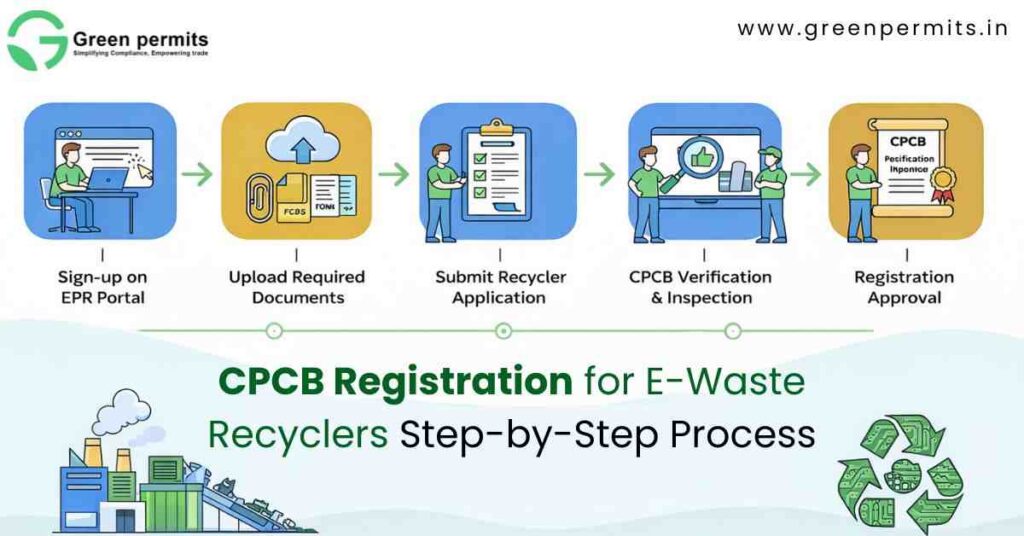
This guide explains the complete process clearly, with practical insights and regulatory facts.
CPCB registration is mandatory under the E-Waste (Management) Rules, 2022. These Rules came into force on 1 April 2023 and introduced a centralized digital compliance system.
The registration ensures traceability of e-waste movement, transparency in recycling capacity, and accountability in material recovery.
From a business standpoint, registration is critical because:
There are three major compliance pillars under the current framework:
Without valid registration, any recycling activity can attract regulatory action under the Environment (Protection) Act, 1986.
The regulatory structure for e-waste recycling is built on multiple legal layers. Understanding them helps avoid compliance mistakes.
The core laws applicable are:
Key compliance facts every recycler should know:
The Rules also prohibit carrying out recycling activities without portal registration. This makes pre-commissioning compliance planning extremely important.
Under the E-Waste (Management) Rules, 2022, four categories of entities are required to register:
If your facility performs any of the following activities, you fall under the recycler category:
Even if you are operating on a small scale, registration is mandatory before starting commercial recycling.
Before initiating portal registration, ensure all regulatory documents are valid and aligned.
Mandatory documents typically include:
From a practical compliance perspective:
Many applications get delayed because of inconsistencies between consent documents and portal declarations.
The process begins by creating a login on the official CPCB EPR portal.
During this stage, you must:
Make sure the authorized person is a senior official of the company, not a consultant.
Once logged in, detailed plant information must be entered.
The portal requires:
Capacity accuracy is extremely important. If CTO mentions 2,000 MT/year and you declare 3,000 MT/year, the application will likely be flagged.
All supporting documents must be uploaded in PDF format.
The portal generally requires:
Ensure document clarity and legibility. Blurred or partially scanned documents can delay approval.
The declaration section requires technical inputs.
You must specify:
From an audit standpoint, CPCB may verify:
After submission:
Failure to respond on time may result in rejection or prolonged delay.
CPCB registration enables recyclers to generate EPR certificates based on key metal recovery.
Currently, the framework considers:
Gold obligations started at 20% in FY 2023–24 and are planned to increase gradually to 100% by FY 2028–29.
From a business perspective:
Recycling is no longer just scrap processing — it is a regulated compliance-driven business ecosystem.
A realistic timeline for registration is:
Delays commonly occur due to:
Planning registration before plant commissioning avoids revenue loss.
Operating without valid CPCB registration can lead to serious consequences.
Potential risks include:
In one recent case, a recycler’s EPR certificate generation was blocked due to expired Hazardous Waste authorization. The financial impact was immediate because producers could not transact certificates.
Compliance protects business continuity and reputation.
Early CPCB registration offers strategic advantages:
In a competitive recycling market, regulatory readiness creates a significant advantage.
CPCB Registration for E-Waste Recyclers is the legal backbone of recycling operations in India.
It is not just an approval — it is:
If you are planning to establish a new recycling plant or regularize an existing facility, structured compliance planning can prevent delays and protect your investment.
📞 +91 78350 06182 | 📧 wecare@greenpermits.in
Book a Consultation with Green Permits