
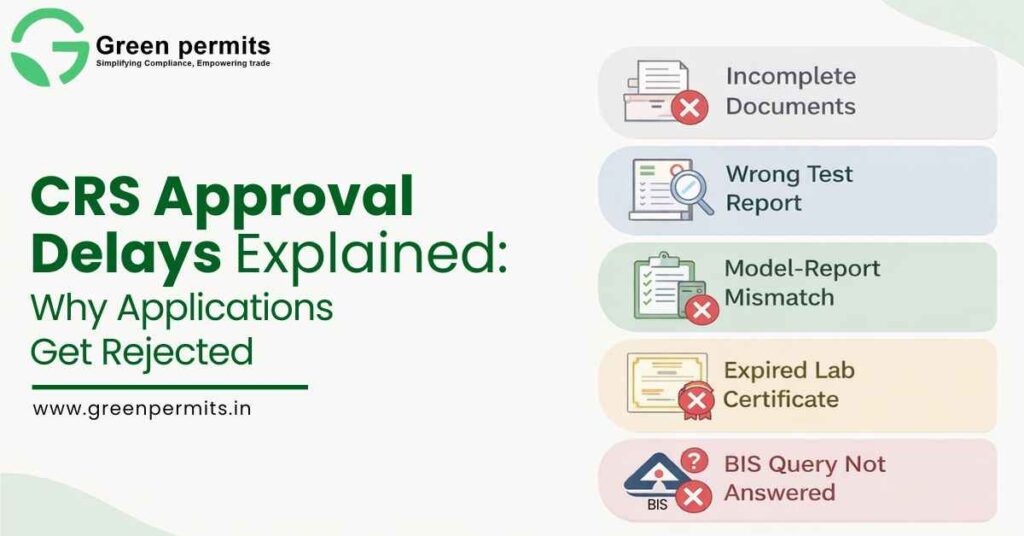
CRS approval delays are one of the most common compliance bottlenecks faced by electronics manufacturers and importers in India. Many businesses assume that once testing is done and documents are uploaded, approval is only a matter of time.
In reality, BIS evaluates CRS applications with a strict validation lens. Even small inconsistencies can pause the file indefinitely. Understanding where businesses go wrong is the first step toward faster approvals.
CRS approval is not just a regulatory formality. It directly determines whether a product can legally enter the Indian market. For importers and manufacturers, CRS sits at the intersection of compliance, supply chain planning, and revenue timelines.
When CRS approval is delayed, the impact is rarely limited to compliance alone. It spills into operations, finance, and business credibility.
From a business standpoint, CRS approval affects:
This is why CRS delays hurt growing businesses more than established ones.
Product testing is the foundation of CRS approval. BIS relies heavily on test reports to determine whether a product meets Indian safety standards. Even minor testing-related issues can halt the entire approval process.
Many businesses unknowingly submit reports that look acceptable on the surface but fail BIS scrutiny.
CRS testing delays commonly occur due to:
From BIS’s perspective, an unclear or incomplete test report creates compliance risk. As a result, applications are either sent back for clarification or held until fresh testing is completed.
CRS approval requires absolute clarity on who is responsible for the product placed in the Indian market. BIS closely checks whether the manufacturer, brand owner, and applicant details are aligned across all documents.
Delays often arise when businesses rely on generic authorization formats or reuse documents prepared for other certifications.
Common documentation issues include:
If responsibility cannot be clearly traced, BIS treats the application as high-risk and pauses approval.
One of the most overlooked reasons for CRS delays is incorrect product classification. BIS evaluates applications strictly based on the declared product category and IS standard.
Businesses often misclassify products due to marketing-driven assumptions rather than regulatory definitions.
This typically happens when:
Once the wrong standard is selected, the entire application moves in the wrong direction, leading to clarifications, rework, or rejection.
Labeling is one of the most common yet underestimated reasons for CRS approval delays. BIS expects labeling to match regulatory requirements exactly, not approximately.
Many businesses treat labeling as a post-approval task, which often backfires.
Typical CRS labeling issues include:
Even when testing and documents are perfect, labeling non-compliance alone can stall approval.
The BIS CRS portal does not guide applicants through mistakes. Any incorrect entry or skipped declaration remains the applicant’s responsibility.
Delays frequently occur because businesses rush through portal submission without cross-verifying details.
Common portal-related issues include:
These issues usually trigger clarification requests, which add days or weeks to the approval timeline.
Most businesses expect CRS approval to be completed within a few weeks. In practice, timelines often stretch due to multiple review and clarification cycles.
| Stage | Expected Timeline | Realistic Timeline |
|---|---|---|
| Product Testing | 2–3 weeks | 3–5 weeks |
| Application Review | 10–15 days | 20–30 days |
| Clarifications | 3–5 days | 2–3 weeks |
| Final Approval | 30–45 days | 60–90 days |
The biggest delays usually occur after submission, when issues surface during BIS review.
A mid-sized electronics importer applied for CRS approval for LED drivers. The testing was correct, and documents were complete.
However, the product label mentioned a trade name, while the application listed the legal entity name.
This single mismatch led to:
The approval was delayed by over a month, despite no technical non-compliance.
Not every CRS issue means rejection. Many applications are delayed simply because businesses misinterpret BIS status updates.
| BIS Status | What It Indicates |
|---|---|
| Clarification Raised | Minor, fixable issues |
| Application Returned | Major compliance gaps |
| Rejection Issued | Fresh application required |
| No Update | Pending response or review |
Knowing the difference helps businesses respond strategically instead of restarting unnecessarily.
CRS compliance does not operate in isolation. Many delays are caused by indirect compliance mismatches that businesses fail to anticipate.
Common hidden risks include:
These issues may not cause immediate rejection, but they significantly slow approvals.
Businesses that plan CRS approval early tend to experience fewer delays and lower costs. Preparation before testing and filing makes a significant difference.
Effective CRS planning includes:
Early planning can reduce CRS approval timelines by 30–40%.
CRS compliance is not just about submitting documents. It requires understanding how BIS interprets safety, responsibility, and traceability.
Expert-led filing helps businesses:
For growing businesses, this translates into predictable timelines and smoother market entry.
CRS approvals are rarely delayed without reason. Most delays arise from documentation gaps, classification errors, or labeling issues that could have been avoided with better planning.
With the right approach, businesses can:
CRS compliance works best when handled proactively, not reactively.
📞 +91 78350 06182
📧 wecare@greenpermits.in
Book a Consultation with Green Permits
We help manufacturers and importers achieve faster, error-free CRS approvals with structured compliance support.