
- Home
- About Us
- Services
- Resources
- Contact Us
- Home
- About Us
- Services
- Resources
- Contact Us
Three weeks ago, “TechNova Imports Pvt. Ltd.,” a mid-sized electronics importer in Mumbai, reached out in distress.
Their high-value shipment of tablets—valued at over ₹58 lakhs—was held at Chennai Port.
The reason wasn’t an invoice mismatch or a missing BIS label.
It was something far more unexpected:
They didn’t have EPR registration.
The team assumed only manufacturers needed EPR compliance.
But under India’s E-Waste Rules, every importer of electronics is legally treated as a Producer—even if they only buy, ship, and resell.
That single misunderstanding cost them:
This guide is designed to ensure your company never faces that situation again.
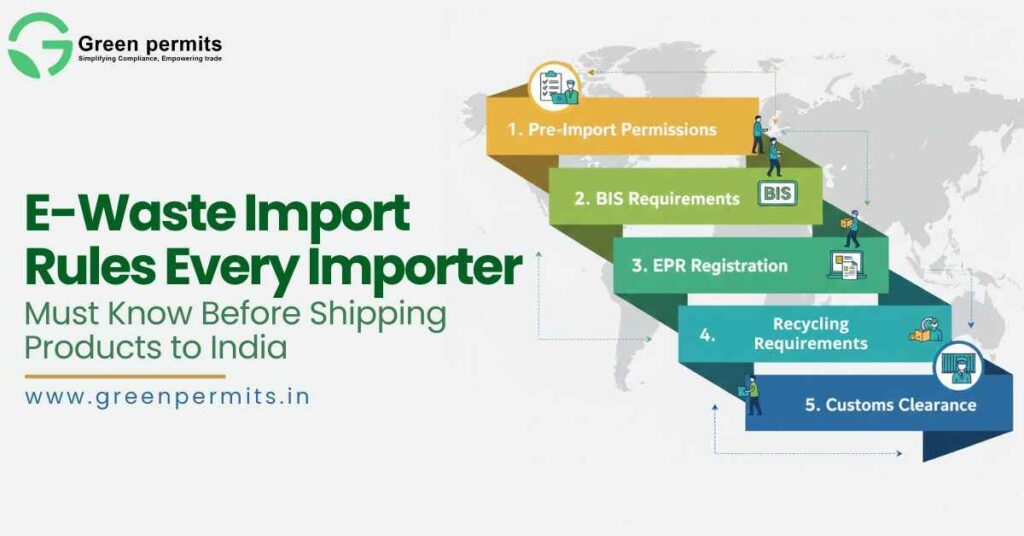
Many importers are unaware that simply bringing electronics into India triggers compliance obligations. The law doesn’t consider whether you manufacture, assemble, or just trade.
An importer becomes a “Producer” if they:
This classification places full responsibility on you for handling, recycling, and reporting the waste generated when the product reaches end-of-life.
In simple terms:
If it enters India under your IEC, you own the environmental responsibility.
Before any consignment leaves the foreign port, verify if your products fall under the regulated EEE list.
The list includes 95+ categories, broadly covering:
These have high turnover, meaning faster end-of-life cycles and higher EPR expectations.
These attract strict RoHS and labeling compliance.
Because of their weight, EPR targets are much higher.
Importers often overlook these but they fall squarely under EPR obligations.
Solar EPR compliance is now strongly enforced.
If your product category appears anywhere in the EEE list, EPR registration is non-negotiable.
Understanding e-waste import rules is critical for smooth customs clearance. These rules define what you can import, how you must declare it, and what obligations apply after the products enter India.
Below is the expanded breakdown.
This is the cornerstone rule.
Without EPR registration, customs officers can legally:
Customs systems today digitally cross-check:
Any mismatch triggers a red flag, often leading to prolonged detention.
EPR registration is not a document you arrange after import — it is required before the goods leave the export port.
Most importers don’t realize that importing used electronics is treated differently from importing new products.
Used equipment often falls under:
You must secure:
Even with all approvals, the clearance process is far slower and more uncertain compared to new electronics.
If any shipment resembles waste, disassembled parts, incomplete assemblies, or scrap-like material, customs may classify it as electronic waste, leading to immediate detention.
A crucial compliance step many importers miss is BIS CRS (Compulsory Registration Scheme).
Products under BIS must:
If your overseas supplier manufactures without certification, you cannot import legally.
This includes common items like:
EPR + BIS together form the foundation of import readiness.
When your shipment arrives, customs assesses compliance holistically—not category by category.
They verify:
Failure in any one area can hold the entire shipment, even if all other documents are perfect.
Customs inspectors are trained to detect:
These checks are now routine on all electronics imports.
EPR registration affects your customs experience more than most importers expect.
Importers without a history of compliance are routed for:
This often delays clearance by days.
Customs checks that labels match:
Incorrect labeling frequently leads to detention.
Servers, telecom gear, and solar equipment often undergo extended review due to higher EPR impact.
The penalties for non-compliance can be severe and financially damaging.
Ports fees, demurrage, and ground rent rise rapidly.
Based on unfulfilled EPR obligations, EC can multiply your financial exposure.
The most expensive outcome — you pay for:
Repeated violations can lead to IEC blocking and loss of import rights.
Ignoring EPR rules is never worth the “risk” because customs now enforce them strictly.
Here is the expanded, more practical workflow:
Understand the exact EEE category code your product belongs to. This ensures:
EPR approval can take time because:
Start 10–15 days before your planned shipment.
If your product falls under CRS:
These must be correct and consistent:
Your CHA must understand:
A well-informed CHA prevents unnecessary delays.
| Compliance Area | Requirement | Business Impact if Missing |
|---|---|---|
| EPR Registration | Mandatory | Shipment detention |
| BIS Certification | Required for many electronics | Clearance denial |
| Labeling Requirements | Must match product | Misdeclaration penalty |
| DGFT Compliance | Permission for used items | Re-export or seizure |
| RoHS Declaration | Must be included | Compliance queries |
| Parameter | New Electronics | Used / Refurbished Electronics |
|---|---|---|
| Import Status | Allowed | Restricted |
| Required Approvals | EPR + BIS | EPR + DGFT + Inspection |
| Customs Risk Level | Moderate | Very high |
| Clearance Time | Faster | Slower |
| Documentation | Straightforward | Extensive |
“TechNova Imports Pvt. Ltd.” learned this the hard way.
Their tablets arrived without EPR registration and customs flagged the shipment.
The team attempted to apply post-arrival, hoping it would resolve the issue.
Instead, the officer issued a show-cause notice, questioning:
By the time the dust settled:
Compliance was the difference between a smooth operation and a costly mistake.
For importers in India, EPR is not optional.
It determines your ability to move goods quickly, avoid penalties, and maintain customer trust.
By complying early, you protect your business from:
If you import electronics—even occasionally—get EPR-ready before the shipment leaves the foreign port.
📞 +91 78350 06182
📧 wecare@greenpermits.in
Book a Consultation with Green Permits — safeguard your imports with complete compliance.