
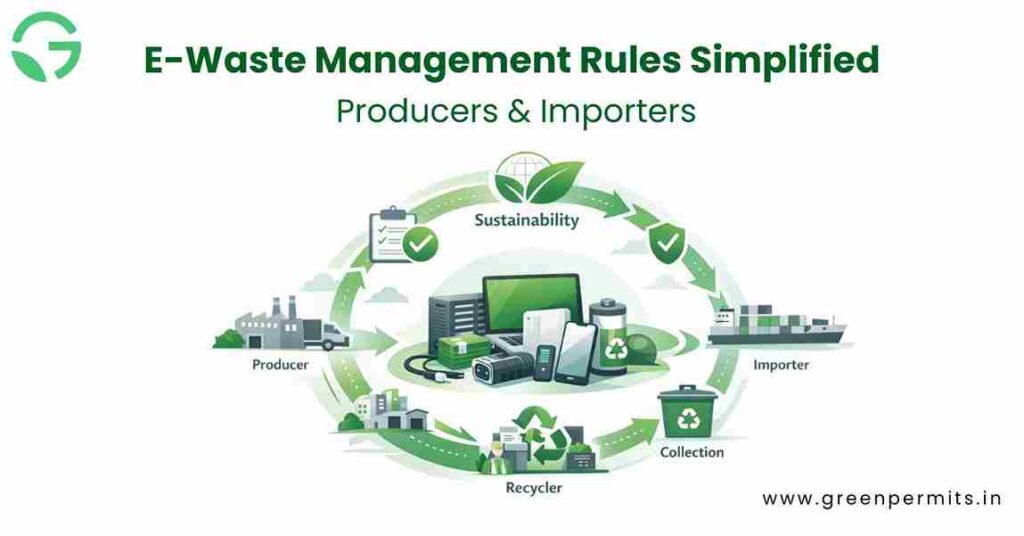
Primary Keyword: E-Waste Management Rules for Producers
Audience: Indian business owners, compliance heads, founders
India’s electronics market is expanding rapidly, and with it, regulatory oversight has become stricter. The E-Waste (Management) Rules are no longer limited to large manufacturers alone. Importers, brand owners, startups, and even businesses selling through online platforms are now directly accountable.
For producers and importers, e-waste compliance is not just an environmental requirement. It directly affects import clearance, operational continuity, brand reputation, and long-term scalability. Understanding these rules early helps businesses avoid regulatory friction and unexpected compliance costs.
The E-Waste (Management) Rules, 2022 came into force on 1 April 2023, replacing the earlier 2016 framework. These rules aim to ensure environmentally sound management of electrical and electronic waste while promoting a structured recycling ecosystem.
From a business perspective, the rules introduce a fully digital compliance system. Registrations, target calculations, recycling certificates, and returns are now monitored through centralized portals. This shift means higher transparency but also tighter enforcement.
Key changes businesses should note include mandatory EPR registration, weight-based target calculations, and stricter accountability for non-compliance.
Many businesses assume that only manufacturers fall under e-waste obligations. In reality, the definition of a producer is much broader.
You are considered a producer if you manufacture electronics, import finished electronic goods or components, sell products under your own brand, or import used electronics for resale. Even if manufacturing is outsourced, brand ownership alone is sufficient to trigger compliance.
This wide definition ensures that responsibility is assigned to the entity that places products in the Indian market, not just the entity that physically manufactures them.
Extended Producer Responsibility (EPR) is the core concept behind e-waste regulation. It makes producers financially and operationally responsible for managing electronic waste generated from their products at end-of-life.
For businesses, EPR translates into ongoing obligations rather than a one-time registration. Companies must track sales data, plan recycling obligations, engage authorized recyclers, and demonstrate compliance through annual and quarterly filings.
EPR also links business growth with compliance responsibility. As sales increase, recycling obligations increase proportionally, making forward planning essential.
E-waste registration with the Central Pollution Control Board is mandatory before commencing sales or imports. Without valid registration, businesses risk delays in customs clearance, regulatory notices, and potential suspension of operations.
Registration is granted through the CPCB E-Waste Portal and remains valid for five years. However, amendments and renewals must be managed proactively. Businesses expanding product categories or modifying operations often overlook the need for timely profile updates, which can lead to compliance gaps.
Early registration ensures smoother operations and avoids last-minute regulatory complications.
Accurate documentation plays a critical role in successful registration. Authorities verify consistency across all submitted records, and even minor discrepancies can delay approval.
Businesses must submit statutory registrations such as GST, PAN, and IEC (for importers), along with incorporation documents. Sales data, certified by a Chartered Accountant, is required to establish EPR targets. In addition, declarations related to RoHS compliance and consumer awareness initiatives must be provided.
Preparing documents carefully and aligning information across portals significantly reduces approval timelines.
EPR targets are calculated based on the quantity of electronics placed in the market during previous years. The calculation considers product category, average life cycle, and weight of equipment sold.
This approach ensures that recycling responsibility is proportionate to market contribution. For businesses, this means that compliance costs are not static. Rapidly growing brands or importers often see higher EPR obligations in subsequent years.
Understanding target calculations early allows businesses to plan budgets, negotiate recycler contracts, and avoid last-minute certificate procurement at higher costs.
Producers are not required to set up recycling facilities themselves. Instead, they must engage with CPCB-authorized recyclers who process e-waste and generate EPR certificates.
These certificates serve as proof of compliance and must be submitted through the portal while filing returns. Choosing the right recyclers is essential, as working with unregistered entities can invalidate compliance efforts.
A structured recycler engagement strategy helps businesses meet targets efficiently while maintaining regulatory credibility.
Compliance does not end with registration or certificate purchase. Producers must file returns periodically, reporting sales data, recycling performance, and awareness activities.
Quarterly returns focus on ongoing obligations, while annual returns require comprehensive disclosures, including awareness initiatives. Missed deadlines or incorrect filings often result in notices and penalties.
Maintaining an internal compliance calendar or outsourcing return management helps ensure consistency and accuracy throughout the year.
Most compliance failures occur due to lack of awareness rather than intent. Common risks include delayed registration, incorrect product classification, underreporting sales, and engaging unauthorized recyclers.
Another frequent issue is failing to update registration details after business expansion or product diversification. These gaps may not surface immediately but can trigger enforcement actions during audits or inspections.
Proactive compliance management reduces operational risk and protects long-term business continuity.
Non-compliance with e-waste rules can lead to financial penalties in the form of environmental compensation. Authorities may also suspend or cancel registrations, effectively halting business operations.
For importers, the risk extends to customs clearance issues and supply chain disruptions. Beyond regulatory penalties, non-compliance can negatively impact investor confidence, ESG ratings, and brand trust.
From a business standpoint, preventive compliance is significantly more cost-effective than corrective action.
Businesses that address e-waste compliance early gain operational stability. Early planning allows smoother imports, predictable compliance costs, and faster approvals for future expansions.
Compliance also strengthens sustainability credentials, which is increasingly important for partnerships, tenders, and investor evaluations. Treating e-waste compliance as a strategic function rather than an administrative task creates long-term advantages.
Green Permits provides end-to-end support for e-waste compliance, covering registration, documentation, EPR target planning, recycler coordination, and return filing.
By acting as a single compliance partner, Green Permits helps businesses avoid regulatory confusion and focus on core operations while staying fully compliant with evolving regulations.
The E-Waste Management Rules are designed to make producers accountable, transparent, and environmentally responsible. For businesses, compliance is no longer optional or deferrable.
Understanding obligations early, maintaining accurate records, and working with the right compliance partner ensures smooth operations and sustainable growth in India’s regulated electronics market.
📞 +91 78350 06182
📧 wecare@greenpermits.in
👉 Book a Consultation with Green Permits