
Last year, a Gujarat-based electronics trader walked into our office with confidence. He had already spoken to two machinery suppliers. One promised a shredding line in 60 days. Another assured him that “CPCB registration is just paperwork.”
Three months later, the plant structure was ready. Machinery was installed. Workers were hired. But operations couldn’t begin because Hazardous Waste authorization and CPCB registration were incomplete.
An E-Waste Recycling Plant Setup in India is not just about buying machines. It is about building a compliant, inspection-ready, regulation-aligned facility from day one. This guide explains licences, machinery, costs, timelines, and real business risks in practical terms.
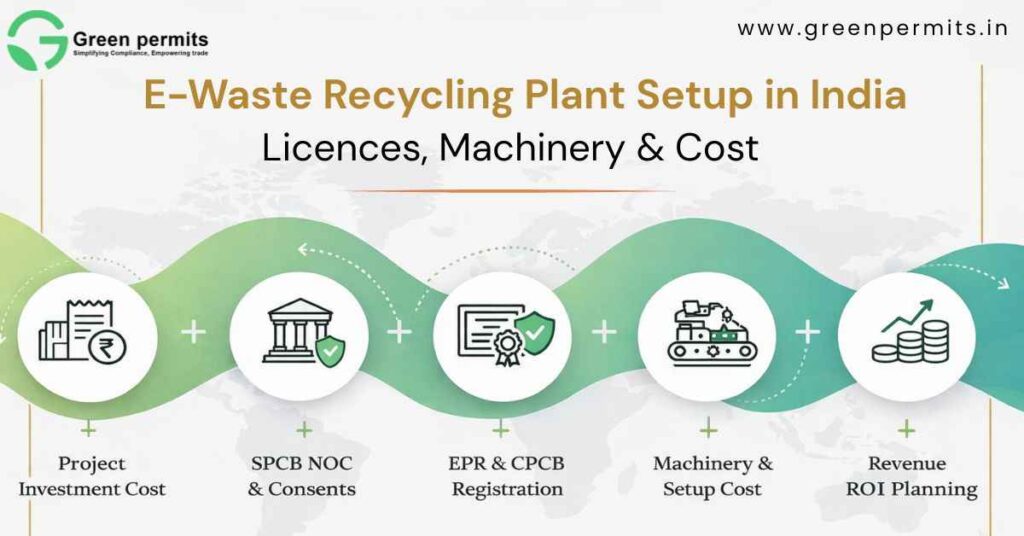
Before investing even one rupee in machinery, you must understand the regulatory ecosystem that governs e-waste in India. The E-Waste (Management) Rules make registration mandatory for all stakeholders in the value chain.
E-waste recycling is not treated like a normal trading business. It is classified under environmental regulation because it involves hazardous components, heavy metals, and chemical handling. Authorities evaluate not only your infrastructure but also your technical capability and documentation readiness.
If you start construction without mapping approvals, you may face inspection objections, cost overruns, or forced shutdowns.
The regulatory structure is strict but predictable — if planned properly.
When clients ask, “What is the first licence required?” the honest answer is — it depends on sequencing. Approvals are layered and interconnected.
You cannot apply for CPCB registration without Pollution Control Board approvals. You cannot obtain Consent to Operate without infrastructure readiness.
Understanding this order reduces delays significantly.
CPCB registration is the backbone of your plant’s legal standing. Without this registration, you cannot legally operate or generate EPR certificates.
The application requires detailed disclosures regarding infrastructure, capacity, and environmental safeguards.
The registration authority may request clarifications or conduct inspections before granting approval.
Operational insight: Many applications are delayed due to incomplete geo-tagging, improper layout segregation, or missing hazardous storage details.
Before approaching CPCB, you must secure approvals from your State Pollution Control Board.
These approvals ensure that your plant does not cause environmental harm.
Inspection officers evaluate:
Failure in any one area can lead to objections or conditions imposed in CTO.
Choosing the right land is more strategic than most investors realize. Several plants face rejection because they purchase non-industrial or poorly zoned land.
An E-Waste Recycling Plant Setup in India must be located in approved industrial areas with proper access and utilities.
Infrastructure planning must focus on compliance as much as efficiency.
Minimum recommended land size:
Practical observation: Plants with poor layout design face 2–4 months additional delay during inspection stage.
Machinery defines your production capacity and revenue potential. However, selecting equipment without aligning with EPR eligibility and compliance norms is a common mistake.
There are three practical models.
This is suitable for MSMEs starting with limited capital.
It focuses on manual separation and resale of components.
Investment range: ₹50 Lakhs – ₹1.5 Crore
Revenue depends heavily on copper recovery and resale margins.
This model increases throughput and metal recovery efficiency.
It involves semi-automation and higher output.
Investment range: ₹2–5 Crore
This model improves consistency and scalability.
This is the advanced, capital-intensive route. It requires strong technical expertise and higher regulatory scrutiny.
Investment range: ₹5–10 Crore or more
Regulatory risk increases due to chemical handling and hazardous effluent generation.
EPR certificates are generated based on recovery of key metals from e-waste. Your plant’s ability to extract these metals determines certificate eligibility and revenue.
If your machinery does not efficiently recover these metals, your EPR revenue potential reduces.
Business planning insight: Many investors overestimate certificate revenue without understanding actual metal yield rates.
Cost estimation must include both capital expenditure and working capital.
| Component | Estimated Cost (INR) |
|---|---|
| Land (Lease) | 10–40 Lakhs |
| Civil Construction | 40–80 Lakhs |
| Basic Machinery | 50 Lakhs – 1.5 Crore |
| Advanced Line | 2–5 Crore |
| Pollution Control Systems | 25–75 Lakhs |
| Utilities & Electrical | 20–50 Lakhs |
| Working Capital | 50 Lakhs – 2 Crore |
Hidden cost factor: Delays increase interest burden and idle asset cost.
Investors often assume a 3–4 month timeline. Realistically, a structured plan takes longer.
Total realistic duration: 6–10 months
Improper sequencing can extend timeline beyond 12 months.
One recycler invested ₹3 Crore in shredding machinery before applying for Hazardous Waste authorization.
Inspection findings included:
Result:
Lesson: Compliance must lead the project, not follow it.
An E-Waste Recycling Plant Setup in India can be profitable and scalable, but only when approached strategically.
Success depends on:
Ignoring compliance can convert a ₹5 Crore opportunity into a financial liability.
+91 78350 06182
wecare@greenpermits.in
Book a Consultation with Green Permits