
- Home
- About Us
- Services
- Resources
- Contact Us
- Home
- About Us
- Services
- Resources
- Contact Us
When Sahana, an operations manager from Bengaluru, first explored the e-waste recycling business, she wasn’t sure where to begin. Every article she found online seemed either too technical or too generic.
But during a visit to an industrial estate in Peenya, she noticed something unmistakable — piles of discarded electronics moving informally through scrap dealers while corporates struggled to find legal recyclers for compliance.
That moment changed her trajectory.
She realised that Karnataka’s booming electronics consumption and strict EPR norms had created a gap: the state needs more authorised, compliant, professional e-waste recyclers.
If you’re standing at the same crossroads today, this guide simplifies the entire journey — approvals, locations, costs, incentives, and the market landscape — in a way that feels more like a conversation than a compliance manual.
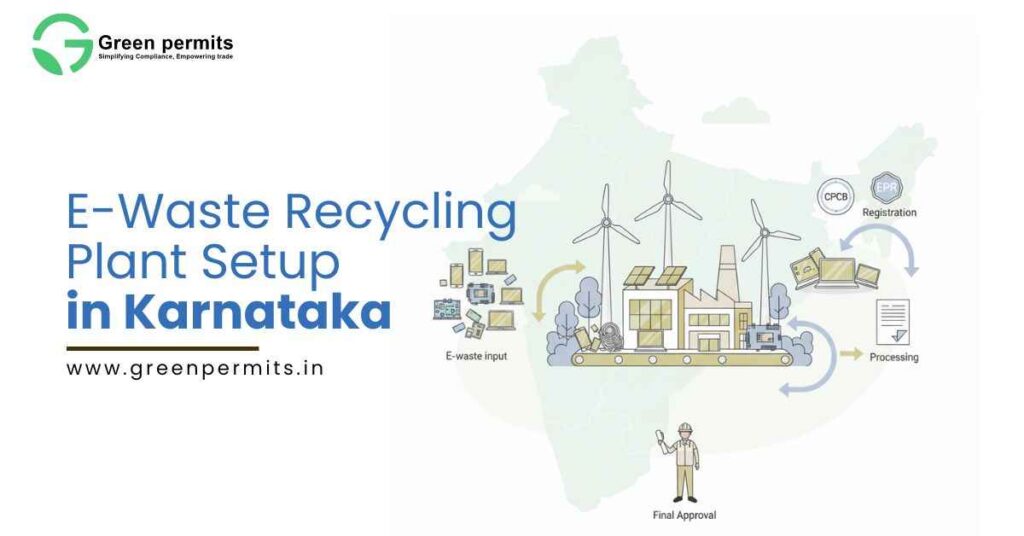
Karnataka is one of India’s strongest hubs for electronics manufacturing and IT services. This naturally translates into high e-waste generation.
Bengaluru alone contributes nearly a tenth of India’s total e-waste. With massive corporate clusters, tech parks, service centres, and R&D facilities, the flow of e-waste remains consistent year-round.
This makes Karnataka uniquely positioned for entrepreneurs who want to build a compliant, long-term e-waste recycling business.
Choosing the right location determines how efficiently you can collect, process, and dispatch materials.
Ideal for mid- to large-scale plants due to proximity to IT parks, OEMs, refurbishers, and logistics hubs.
Lower operational costs, growing manufacturing base, and suitable for small-to-medium facilities.
Serves northern Karnataka, offers affordable land and good connectivity to Pune–Bengaluru corridors.
Favourable for units exploring KIADB industrial estates and state incentives.
Most recyclers prefer industrial estates because approvals move faster, and basic infrastructure is already in place.
Before setting up your plant, it’s important to understand the supply ecosystem.
These sources offer predictable supply volumes, especially once you sign long-term disposal contracts.
While these clusters can supply mixed e-waste, registered recyclers gain a larger advantage by working directly with Producers under EPR, not just scrap traders.
Every e-waste recycling facility in India must secure registrations at both state and central levels.
This is the central permission required to operate legally as a recycler. The application includes:
The registration is valid for five years, and CPCB typically processes complete applications in about a month. A physical or virtual inspection follows to verify operations.
You will need:
KSPCB reviews your environmental management plan, fire safety, land documents, and overall facility layout.
Once registered, recyclers must regularly update:
These entries generate EPR certificates, which become a key revenue source.
| Machinery | Cost Range | Purpose |
|---|---|---|
| Shredder | ₹8–15 lakh | Breaks down large components |
| Conveyor and sorting line | ₹5–10 lakh | Manual segregation |
| Crusher / granulator | ₹7–12 lakh | Reduces PCB size |
| Gravity separator | ₹10–18 lakh | Metal–non-metal separation |
| Magnetic separator | ₹1–3 lakh | Extracts ferrous metals |
| Dust collection units | ₹3–7 lakh | Air pollution control |
Interpretation:
Mechanical lines are cost-effective for most startups. Plants exploring metal recovery through chemical processes require higher investment due to reactors, scrubbers, and safe acid-handling systems.
| Plant Capacity | Investment Range |
|---|---|
| 500 MT/year | ₹25–35 lakh |
| 1,000 MT/year | ₹45–65 lakh |
| 3,000 MT/year | ₹1.2–1.8 crore |
| 10,000 MT/year | ₹3–5 crore |
| Expense Head | Estimated Cost |
|---|---|
| Manpower | ₹2–5 lakh |
| Electricity | ₹1–3 lakh |
| Compliance & audits | ₹10,000–₹25,000 |
| Transportation & procurement | ₹3–10 lakh |
Operating expenses vary based on your incoming waste quality, automation, and whether you manage your own logistics fleet.
Recycling units categorised as environmental management services may benefit from:
These benefits are particularly favourable in non-Bengaluru zones.
Recyclers earn through two channels:
Corporates pay for legal, documented disposal of e-waste. The rate depends on material complexity and distance.
Producers must meet annual recycling targets under the E-Waste Rules. They can only purchase certificates from registered recyclers. Certificates are generated for recovered metals such as:
For many recyclers, this becomes the most profitable part of the business model.
Your key responsibilities include:
Compliance is not optional. Facilities may face:
A real-world example:
A recycler from Mysuru once uploaded an inactive video link during registration. The application was treated as incomplete, causing a significant delay in approval. This postponement forced the unit to halt corporate onboarding and resulted in lost contracts worth several lakhs. A simple oversight cost months of progress.
| Stage | Duration |
|---|---|
| Land selection / KIADB allotment | 15–45 days |
| KSPCB CTE | 30–45 days |
| Civil works + machinery installation | 45–90 days |
| CPCB registration | Around 30 working days |
| CTO + commissioning | 30–45 days |
A well-planned project usually achieves full commissioning within 4–6 months.
Setting up an e-waste recycling plant in Karnataka is more than a business opportunity — it’s a chance to be part of the state’s circular economy transformation. The demand from Producers, corporates, and institutions ensures a stable market. But success depends on one thing above all: getting the compliance and planning right from day one.
Facilities that delay registrations, skip documentation, or choose the wrong machinery often face long setbacks. Those who plan early, work with experienced consultants, and follow the regulatory process usually launch faster, spend less, and build lasting relationships with major clients.
Green Permits Consulting helps you with:
📞 +91 78350 06182
📧 wecare@greenpermits.in
Book a Consultation with Green Permits