
Ramesh manages a mid-sized transport operation near Pune. Every year, hundreds of worn-out tyres stack up behind his warehouse. Scrap dealers quote inconsistent prices, disposal options are unclear, and inspections have become more frequent.
One day, a recycler approaches him—not asking for money, but offering to buy those waste tyres legally.
That moment sparks a realization many Indian business owners are having today:
If waste tyres have value, there must be a structured business opportunity behind them.
Tyre recycling in India is no longer about informal scrap handling. It is slowly becoming a regulated, opportunity-driven recycling business—but only for those who understand the market and compliance together.
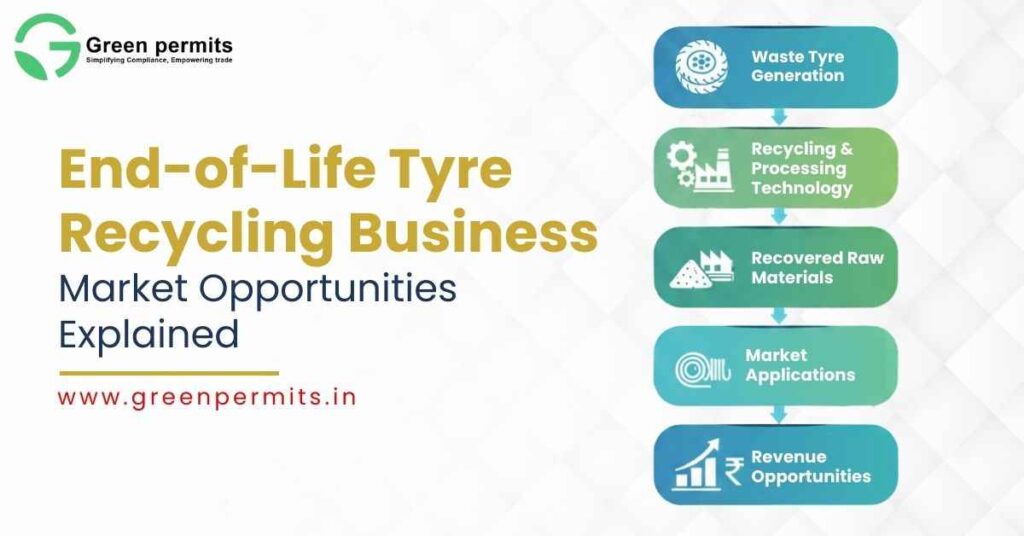
End-of-life tyres are tyres that can no longer be used safely on vehicles due to wear, damage, or age. For decades, they were treated as low-value scrap or disposed of through informal channels.
Today, the situation has changed.
With rising vehicle ownership, commercial transport growth, and stricter environmental oversight, end-of-life tyres are now viewed as regulated waste with recoverable economic value.
From a business perspective, this shift matters because:
Tyres contain rubber, carbon black, steel, and energy-rich compounds. When processed correctly, these materials feed directly into construction, manufacturing, and industrial fuel markets.
Tyre recycling is not gaining attention because it is fashionable. It is growing because policy pressure and market demand are meeting at the same point.
On one side, authorities are tightening controls on illegal dumping and burning of tyres. On the other, industries are actively seeking recycled rubber and alternative fuels to reduce costs and meet sustainability goals.
This creates a situation where:
For entrepreneurs, this means tyre recycling is shifting from a risky informal activity to a structured industrial opportunity—provided compliance is built into the plan.
India’s tyre waste generation is increasing steadily due to growth in passenger vehicles, freight movement, construction equipment, and logistics fleets.
As infrastructure and transportation expand, tyre replacement cycles shorten, creating a growing stream of end-of-life tyres.
| Year | Approximate ELT Generation (Million Tonnes) |
|---|---|
| 2020 | ~1.1 |
| 2023 | ~1.4 |
| 2026 | ~1.8 |
| 2030 | ~2.2 |
This growth highlights a critical business reality:
Organized recycling capacity is still lower than waste generation.
For compliant recyclers, this imbalance translates into reliable raw material availability and long-term demand.
Tyre recycling is not a single-path business. Entrepreneurs can choose different models depending on capital, technology, and regulatory comfort.
Each model serves a different market and comes with its own compliance intensity.
Lower-emission models such as shredding often have smoother approval pathways, while pyrolysis requires stronger pollution control planning.
The right model depends on how well compliance, capital, and market access are aligned.
Many online articles focus on machinery costs and profit margins. What they rarely explain is that tyre recycling is a regulated activity, not a free-entry business.
Before operations begin, recycling units typically require:
Skipping or delaying approvals may seem faster initially, but it often leads to forced shutdowns, penalties, or loss of investor confidence.
In tyre recycling, regulatory approval is not paperwork—it is your license to operate.
A recycler in North India invested heavily in a tyre pyrolysis setup after watching several high-ROI videos online. Production began before final approvals were secured.
Within months, an inspection resulted in:
The demand was real. The technology worked.
The business failed because compliance was treated as secondary.
Many entrepreneurs believe approvals slow business growth. In reality, most delays happen due to incorrect documentation or poor planning, not because of the approval process itself.
Early compliance planning helps:
In regulated recycling businesses, compliance is a long-term cost saver, not an obstacle.
One entrepreneur in Gujarat chose to begin with tyre shredding instead of pyrolysis. The lower emission profile allowed:
Once operations stabilized and compliance systems were tested, scaling became far easier.
The lesson is simple:
Starting compliant is more important than starting big.
Green Permits works with businesses that want to enter tyre recycling with clarity and confidence.
We help clients:
Our role is to remove regulatory uncertainty, so businesses can focus on execution and growth.
End-of-life tyre recycling in India is a genuine business opportunity—but only for those who respect compliance as much as profitability.
Ignoring regulations leads to shutdowns, penalties, and lost investments.
Planning compliance early leads to stability, scalability, and long-term returns.
📞 Call or WhatsApp: +91 78350 06182
📧 Email: wecare@greenpermits.in
Book a Consultation with Green Permits