
When Mahesh Patel, a second-generation fleet operator managing over 100 commercial vehicles across Ahmedabad, Vadodara, and the Kandla corridor, reviewed his annual costs, tyre replacement stood out. Nearly 1,500 tyres were replaced every year. Earlier, worn-out tyres were sold informally to local dealers — no paperwork, no tracking, just routine practice.
In 2024, while onboarding a multinational logistics client, Mahesh was asked to submit waste disposal records, including end-of-life tyre handling. He had no clear documentation. That single compliance gap delayed the contract approval by months.
This situation is becoming common across Gujarat. Waste tyres are no longer treated as informal scrap — they are now a regulated resource and a fast-emerging business opportunity, driving interest in the end-of-life tyre recycling business.
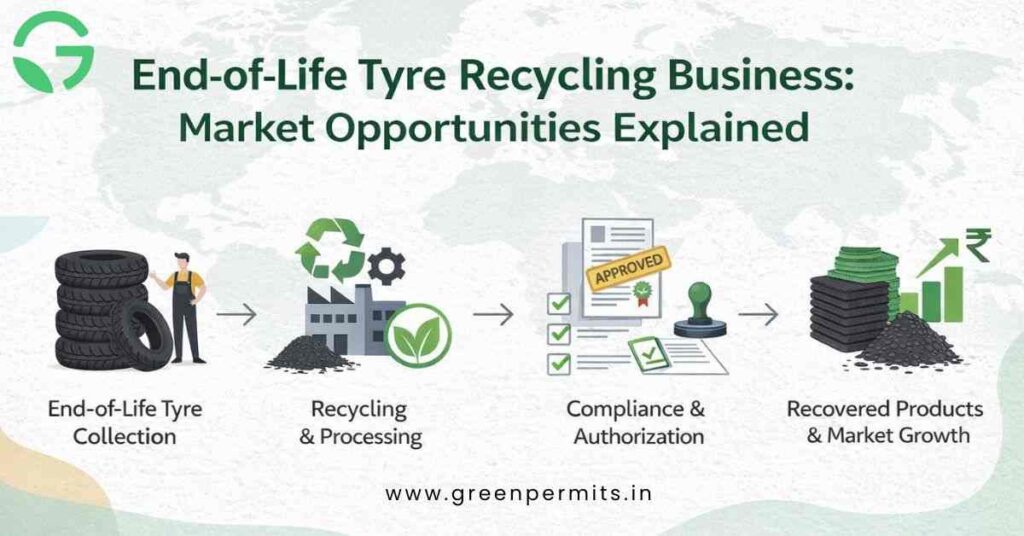
India’s transport ecosystem is expanding at an unprecedented pace. More vehicles mean more tyres — and every tyre has a defined end-of-life.
What’s changing now is how the government and industry view waste tyres.
This combination has created a strong regulatory push + market demand, making tyre recycling one of the most promising waste management businesses today.
An end-of-life tyre recycling business involves the collection, processing, and recovery of materials from discarded tyres using approved recycling technologies.
The goal is to:
Each method has distinct compliance and pollution control requirements, making regulatory planning critical from day one.
| Year | Waste Tyres Generated (Million Tonnes) |
|---|---|
| 2022 | 1.8 |
| 2024 | 2.1 |
| 2027 (Projected) | 2.7 |
What this means for investors and founders:
India produces more waste tyres every year than its authorised recycling capacity can handle. This supply-demand gap ensures long-term feedstock availability for compliant recycling plants.
Unlike traditional waste businesses, tyre recycling offers multiple monetisation channels, reducing dependency on a single product.
| Recycled Output | End-Use Industries |
|---|---|
| Crumb Rubber | Road construction, sports flooring, mats |
| Pyrolysis Oil | Industrial boilers, furnaces |
| Recovered Steel | Steel plants, scrap markets |
| Carbon Black | Rubber & plastic manufacturing |
Business insight:
Diversified outputs protect recyclers from price volatility and improve cash-flow stability.
Tyre recycling is a regulated industrial activity. Operating without approvals is one of the biggest reasons plants get sealed.
Why compliance directly impacts revenue:
Large corporates, infrastructure companies, and exporters only work with authorised recyclers. Non-compliance blocks access to high-value contracts.
A tyre recycler in central India installed a pyrolysis unit without securing CTO approval, assuming regularisation could be done later. During a routine SPCB inspection:
The financial loss exceeded the original compliance cost.
Lesson for new entrants:
In the end-of-life tyre recycling business, compliance delays directly translate into revenue loss.
| Parameter | Typical Range |
|---|---|
| Initial Investment | ₹1.5–5 Crore |
| Break-even Period | 2.5–4 Years |
| Gross Margin | 20–35% |
| ROI Stability | High (with compliance) |
Interpretation:
Plants designed with compliance, layout approvals, and pollution controls from the beginning achieve faster stabilisation and fewer shutdown risks.
With ESG reporting becoming mandatory, corporates must show:
This has shifted demand sharply towards SPCB-authorised tyre recyclers.
For recyclers, this results in:
Before setting up a plant, successful founders evaluate:
Often, a medium-scale compliant plant in the right location outperforms a larger but poorly planned facility.
Businesses that secure approvals before installation benefit from:
In regulated industries, compliance is not an expense — it is risk insurance.
The end-of-life tyre recycling business in India offers strong market demand, diversified revenue streams, and long-term sustainability.
However, success is not driven by machinery alone. It depends on:
Those who plan early scale faster. Those who ignore regulations struggle to survive.
📞 +91 78350 06182
📧 wecare@greenpermits.in
Book a Consultation with Green Permits
Get end-to-end support for SPCB approvals, compliance planning, and tyre recycling plant setup.