
For many Indian business owners, compliance becomes visible only when something goes wrong. A notice arrives. A portal shows a mismatch. An approval gets stuck without explanation.
What usually starts as “we’ll manage this internally” slowly turns into founders chasing consultants, teams scrambling for old data, and operations getting disrupted. Most of these situations don’t happen because businesses ignore compliance—they happen because compliance is handled in parts, not as a system.
That is exactly where end-to-end compliance support changes outcomes.
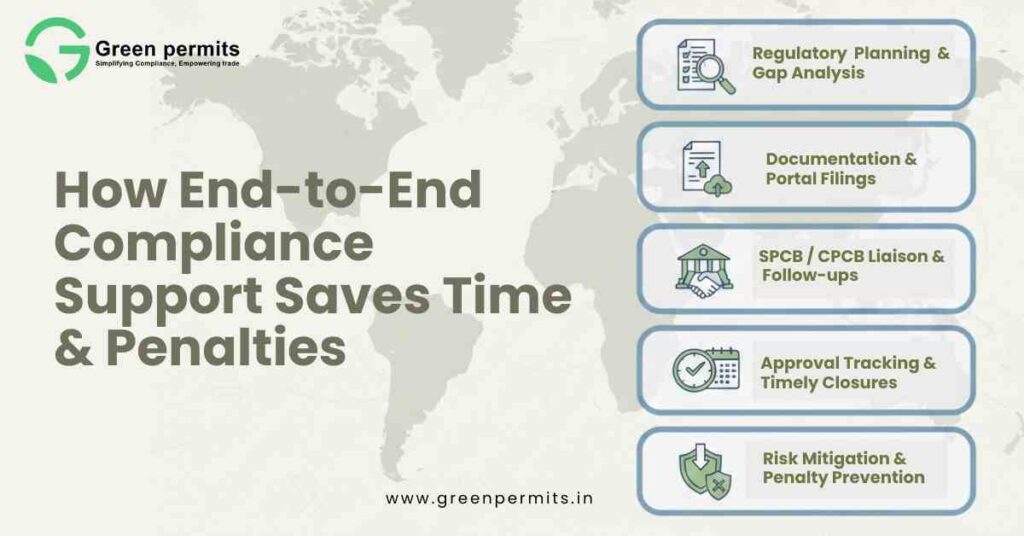
End-to-end compliance support is not just assistance with registrations or filings. It is complete lifecycle management of regulatory obligations, handled proactively instead of reactively.
It begins much before an application is filed and continues well after approvals are granted.
Why this matters:
When compliance is treated as a continuous process rather than isolated tasks, delays and penalties reduce dramatically.
Most businesses don’t realize how much time they lose until compliance becomes a bottleneck.
Fragmented compliance usually looks manageable in the beginning. One consultant handles EPR. Another looks after BIS. Someone internally tracks returns on a spreadsheet. Everything works—until it doesn’t.
Over time, this creates confusion, delays, and dependency on firefighting instead of planning.
End-to-end compliance replaces this chaos with clear ownership and structure.
Time savings in compliance do not come from working faster. They come from working once, correctly.
Instead of reacting to rules as they arise, businesses operate with:
With end-to-end compliance:
| Compliance Approach | Typical Approval Time | Business Involvement |
|---|---|---|
| Fragmented handling | 6–9 months | Frequent |
| End-to-end support | 2–4 months | Minimal |
Business takeaway:
Time saved in compliance directly translates into smoother operations, predictable planning, and less management distraction.
Most penalties are not the result of deliberate non-compliance. They occur because of small procedural gaps that compound over time.
A company importing batteries faced rising EPR costs year after year. The issue wasn’t sales growth—it was incorrect historical data carried forward without review. Once compliance was handled end-to-end, data was corrected, targets were aligned properly, and unnecessary financial exposure was avoided.
Many businesses believe they save money by handling compliance piece by piece. In reality, the opposite is true.
| Area | Reactive Compliance | End-to-End Compliance |
|---|---|---|
| Consultant costs | Multiple, unpredictable | Consolidated |
| Penalty exposure | High | Low |
| Approval delays | Common | Controlled |
| Internal workload | Heavy | Optimized |
| Long-term visibility | Poor | Clear |
What this means:
End-to-end compliance is not an added cost—it is cost control.
This approach delivers the most value to businesses that:
If compliance feels uncertain, reactive, or stressful, end-to-end support is usually the missing piece.
Businesses that switch to end-to-end compliance often say the same thing:
“It finally feels under control.”
That happens because:
Compliance stops being a recurring problem and becomes part of normal operations.
Compliance is unavoidable—but disruption is not.
When compliance is handled end-to-end:
If compliance currently feels like a constant risk, the issue is not regulation—it’s fragmentation.
📞 +91 78350 06182
📧 wecare@greenpermits.in
Book a Consultation with Green Permits