
Earlier this year, Marvex Polymers Pvt. Ltd., a mid-sized importer based in Mumbai, faced a sudden setback. Their shipment of plastic closures worth ₹30 lakh was halted at customs. Everything was in order — invoices, IEC, GST — except one thing: EPR Registration.
The owner told us he always assumed EPR applied only to manufacturers. But in 2025, the rules have changed. Importers introducing plastic packaging or plastic-containing products into India are now held equally responsible for managing the waste that follows.
To help avoid the uncertainty and losses firms like Marvex experienced, here’s a clear and practical checklist covering everything from registration to annual returns.
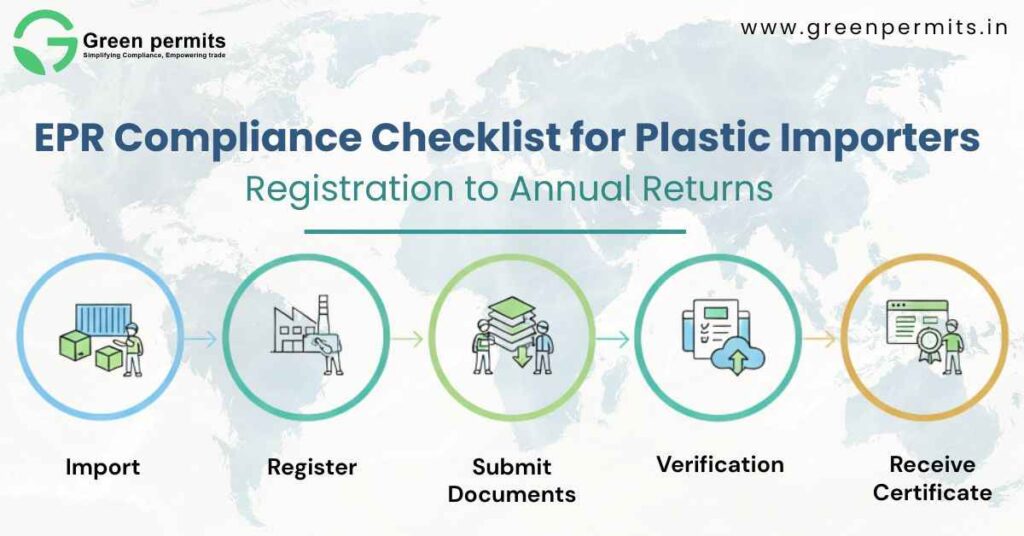
Any importer bringing plastic or plastic-packaged products into India falls under EPR regulations.
Once these products enter the Indian market, you must ensure an equivalent quantity of plastic waste is processed or recycled through authorized processors.
Before starting the online application, gather the following documents to avoid delays.
| Document | Requirement |
|---|---|
| PAN (Company) | Required |
| GST Certificate | Required |
| CIN (if applicable) | Required |
| IEC (Import Export Code) | Required |
| PAN or Aadhaar of Authorized Person | Required |
| Plastic packaging data for last 2 years | Required |
| Raw material procurement details | Required |
| Digital signature image | Required |
| DIC Registration | If applicable |
A complete and accurate application significantly reduces approval time.
Your responsibility begins with registration — and continues annually.
Poor documentation is the most common reason for penalties. Maintain these records for at least 3–5 years:
These records help prove compliance during audits and prevent unexpected penalties.
Every importer with EPR registration must file returns — regardless of the import volume.
30 June of the following financial year.
EPR is now a top priority for both CPCB and customs. Importers ignoring compliance are facing real consequences.
A Gujarat-based importer had purchased recycling certificates from a processor who later turned out to be operating beyond approved capacity. During audit, the importer was held responsible for due diligence and had to correct the deficit at his own cost. This shows why compliance isn’t just about ticking boxes — it’s also about choosing the right partners.
| Requirement | Status | Notes |
|---|---|---|
| EPR Registration completed | ☐ | Ensure GST/IEC accuracy |
| Plastic categories mapped | ☐ | Categories I–IV |
| Import invoices organized | ☐ | Keep both digital & physical |
| Procurement details updated | ☐ | Registered + unregistered |
| Certificates purchased | ☐ | Only from valid PWPs |
| Annual return filed | ☐ | Deadline: 30 June |
| Awareness initiatives documented | ☐ | Required for annual return |
EPR compliance for plastic importers is now a core regulatory requirement directly tied to customs clearance and business continuity. Getting registered early, maintaining proper records, and filing timely returns will keep your operations moving smoothly in 2025 and beyond.
If you need expert help with EPR registration, documentation, certificate procurement, or annual returns, our team at Green Permits is here to support you.
📞 +91 78350 06182
📧 wecare@greenpermits.in